Discuss Scratch

- Discussion Forums
- » Things I'm Making and Creating
- » ✮ ~ Toko's Writing Thread ~ ✮
![[RSS Feed]](//cdn.scratch.mit.edu/scratchr2/static/__4bc739c53cfd81b94c5e6780b6a19bb8__//djangobb_forum/img/feed-icon-small.png "[RSS Feed]")
![[RSS Feed]](http://cdn.scratch.mit.edu/scratchr2/static/__4bc739c53cfd81b94c5e6780b6a19bb8__//djangobb_forum/img/feed-icon-small.png "[RSS Feed]")
- TokoWrites
-
 Scratcher

500+ posts
✮ ~ Toko's Writing Thread ~ ✮
march 23 - 383 words
The night I was born, the storm arrived first—as if even the sky knew a Chosen One required proper dramatic lighting. Lightning split the heavens, thunder rolled like a prophecy clearing its throat, and somewhere in the distance, a hooded figure whispered, “It begins.”
I, of course, remember none of this. I was too busy being orphaned before the first sentence.
Raised by a wise mentor with a beard that seemed to contain entire winters, I grew up in a quiet village that was anything but ordinary, though I didn’t know it yet. “You are not like the others,” my mentor would say, staring meaningfully into the middle distance. “Also, you must never go into the Forbidden Forest.”
Naturally, I went immediately. That’s where I met them—both of them. The love triangle arrived right on schedule. One was brooding, shadow-eyed, and morally ambiguous. The other was radiant, kind, and suspiciously good at everything. They hated each other instantly, which made things convenient for me. “I can’t choose,” I whispered dramatically to the wind, which responded with a sudden, howling gale. Of course it did.
And then, because timing is everything, my evil twin appeared. Same face. Same voice. Sharper smile. “Hello,” they said, stepping out from behind a conveniently placed tree. “I’m everything you could have been.”
“I don’t even know what I am,” I replied, clutching a mysterious pendant I’d only just discovered I’d been wearing my whole life.
“Exactly.”
Cue the dramatic monologue. Mine, theirs, the mentor’s (who arrived just in time to be cryptic and then immediately die), and even the brooding love interest got one in before the rain intensified into a full cinematic downpour.
“You must fulfill the prophecy,” my mentor rasped with his final breath. “But also… defy it.”
“Which is it?” I shouted.
“Yes,” he said, and then he was gone.
Lightning struck again. The storm swelled. My twin laughed. The love triangle reached peak emotional tension. The pendant began to glow.
“I choose my own destiny,” I declared, as required.
“Predictable,” my twin sneered.
“Predictably chaotic,” I corrected.
And then everything happened at once—betrayal, redemption, a shocking reveal about my parents (royalty, obviously), and a cliffhanger so abrupt it practically demanded a sequel. Because of course there would be a sequel. There’s always a sequel.
The night I was born, the storm arrived first—as if even the sky knew a Chosen One required proper dramatic lighting. Lightning split the heavens, thunder rolled like a prophecy clearing its throat, and somewhere in the distance, a hooded figure whispered, “It begins.”
I, of course, remember none of this. I was too busy being orphaned before the first sentence.
Raised by a wise mentor with a beard that seemed to contain entire winters, I grew up in a quiet village that was anything but ordinary, though I didn’t know it yet. “You are not like the others,” my mentor would say, staring meaningfully into the middle distance. “Also, you must never go into the Forbidden Forest.”
Naturally, I went immediately. That’s where I met them—both of them. The love triangle arrived right on schedule. One was brooding, shadow-eyed, and morally ambiguous. The other was radiant, kind, and suspiciously good at everything. They hated each other instantly, which made things convenient for me. “I can’t choose,” I whispered dramatically to the wind, which responded with a sudden, howling gale. Of course it did.
And then, because timing is everything, my evil twin appeared. Same face. Same voice. Sharper smile. “Hello,” they said, stepping out from behind a conveniently placed tree. “I’m everything you could have been.”
“I don’t even know what I am,” I replied, clutching a mysterious pendant I’d only just discovered I’d been wearing my whole life.
“Exactly.”
Cue the dramatic monologue. Mine, theirs, the mentor’s (who arrived just in time to be cryptic and then immediately die), and even the brooding love interest got one in before the rain intensified into a full cinematic downpour.
“You must fulfill the prophecy,” my mentor rasped with his final breath. “But also… defy it.”
“Which is it?” I shouted.
“Yes,” he said, and then he was gone.
Lightning struck again. The storm swelled. My twin laughed. The love triangle reached peak emotional tension. The pendant began to glow.
“I choose my own destiny,” I declared, as required.
“Predictable,” my twin sneered.
“Predictably chaotic,” I corrected.
And then everything happened at once—betrayal, redemption, a shocking reveal about my parents (royalty, obviously), and a cliffhanger so abrupt it practically demanded a sequel. Because of course there would be a sequel. There’s always a sequel.
- TokoWrites
-
Scratcher
500+ posts
✮ ~ Toko's Writing Thread ~ ✮
march 24 - 491 words
The air presses close, thick with the damp breath of early morning. It clings to skin like a second layer, warm and faintly sticky, carrying with it the mingled scents of earth and something faintly sweet—perhaps crushed fruit left somewhere to soften. Each inhale feels heavier than the last, as though the world itself is leaning in, listening.
Underfoot, the ground shifts between textures. One step lands on something firm and packed, the next sinks slightly, yielding with a quiet give that suggests mud or moss. Small fragments crunch here and there, brittle and dry, snapping sharply before dissolving into softer terrain again. The rhythm of movement becomes a conversation with the unseen surface, a constant negotiation between balance and uncertainty.
Sound travels strangely in this place. It does not echo so much as linger, hovering just long enough to make its origin uncertain. A distant drip repeats at uneven intervals, patient and methodical, while somewhere closer, a faint rustling suggests movement—too deliberate to be wind, too subtle to identify. Occasionally, a low hum threads through everything, steady and almost comforting, like the quiet vibration of something alive but at rest.
The air carries layers of smell that shift with every step. There is the mineral sharpness of stone, cool and clean, followed by a deeper, richer scent—loam, perhaps, or decaying leaves turned soft with time. Beneath it all lies a trace of something metallic, faint but persistent, catching at the back of the throat. It leaves a taste behind, dry and slightly bitter, as if the air itself has weight and flavor.
A brush of contact interrupts the stillness. Something thin grazes along an arm—flexible, almost delicate—before slipping away. Another step forward brings a different sensation: a broader surface, rough and ridged, meeting fingertips when a hand reaches out. It is solid, unmoving, its texture uneven and cool, as though it has not known warmth in a very long time. Tracing along it reveals dips and rises, patterns formed without intention.
The temperature shifts subtly as movement continues. Pockets of cooler air gather in certain places, slipping over skin in quiet currents, while other areas feel close and almost suffocating. These invisible boundaries carve the space into sections, each with its own presence, its own quiet mood.
Breathing grows louder in the absence of anything else familiar, each inhale and exhale marking time. The body becomes acutely aware of itself—the stretch of muscles, the slight tremor of effort, the steady pulse beneath it all. Even the smallest movement feels amplified, as though the world has narrowed to nothing but sensation.
Then, without warning, the sounds change. The distant drip fades, replaced by something broader, more continuous—a soft rush, like liquid moving with purpose. The air cools again, fresher now, carrying with it a cleaner scent that cuts through the heaviness. The ground beneath shifts once more, firmer, steadier.
There is no need to see to understand: something ahead is different.
The air presses close, thick with the damp breath of early morning. It clings to skin like a second layer, warm and faintly sticky, carrying with it the mingled scents of earth and something faintly sweet—perhaps crushed fruit left somewhere to soften. Each inhale feels heavier than the last, as though the world itself is leaning in, listening.
Underfoot, the ground shifts between textures. One step lands on something firm and packed, the next sinks slightly, yielding with a quiet give that suggests mud or moss. Small fragments crunch here and there, brittle and dry, snapping sharply before dissolving into softer terrain again. The rhythm of movement becomes a conversation with the unseen surface, a constant negotiation between balance and uncertainty.
Sound travels strangely in this place. It does not echo so much as linger, hovering just long enough to make its origin uncertain. A distant drip repeats at uneven intervals, patient and methodical, while somewhere closer, a faint rustling suggests movement—too deliberate to be wind, too subtle to identify. Occasionally, a low hum threads through everything, steady and almost comforting, like the quiet vibration of something alive but at rest.
The air carries layers of smell that shift with every step. There is the mineral sharpness of stone, cool and clean, followed by a deeper, richer scent—loam, perhaps, or decaying leaves turned soft with time. Beneath it all lies a trace of something metallic, faint but persistent, catching at the back of the throat. It leaves a taste behind, dry and slightly bitter, as if the air itself has weight and flavor.
A brush of contact interrupts the stillness. Something thin grazes along an arm—flexible, almost delicate—before slipping away. Another step forward brings a different sensation: a broader surface, rough and ridged, meeting fingertips when a hand reaches out. It is solid, unmoving, its texture uneven and cool, as though it has not known warmth in a very long time. Tracing along it reveals dips and rises, patterns formed without intention.
The temperature shifts subtly as movement continues. Pockets of cooler air gather in certain places, slipping over skin in quiet currents, while other areas feel close and almost suffocating. These invisible boundaries carve the space into sections, each with its own presence, its own quiet mood.
Breathing grows louder in the absence of anything else familiar, each inhale and exhale marking time. The body becomes acutely aware of itself—the stretch of muscles, the slight tremor of effort, the steady pulse beneath it all. Even the smallest movement feels amplified, as though the world has narrowed to nothing but sensation.
Then, without warning, the sounds change. The distant drip fades, replaced by something broader, more continuous—a soft rush, like liquid moving with purpose. The air cools again, fresher now, carrying with it a cleaner scent that cuts through the heaviness. The ground beneath shifts once more, firmer, steadier.
There is no need to see to understand: something ahead is different.
- TokoWrites
-
Scratcher
500+ posts
✮ ~ Toko's Writing Thread ~ ✮
critique for rose!
what is working well in my opinion
character depth: eden’s inner thoughts and conflicts are really intriguing. you’ve done a great job showing her emotional detachment, her careful manipulation of relationships, and her wariness around isabella. eden feels complex, like someone who is used to playing a role and constantly thinking about the consequences of her actions. that tension between her job and the human connections she’s being forced to navigate makes her very compelling.
natural dialogue: the dialogue between eden and isabella feels authentic, especially the back-and-forth where eden teases her, and isabella tries to defend her future career. their interactions feel grounded and believable. the dynamic between the characters, particularly eden and isabella, is also a good balance of lightheartedness and tension, which adds layers to their relationship.
world-building: i love the hints of the supernatural, like emotional manipulation through spellcraft and the mention of emotional sorcery. these ideas don't feel fully fleshed out yet, but they’re intriguing enough that i’m curious to see how they’ll be explored further. there’s a nice balance between the mundane college setting and the magical elements, making the world feel rich.
pacing: the pacing feels pretty smooth overall. the transitions between scenes are mostly seamless, and the story has a nice flow, especially with eden’s inner turmoil being gradually revealed.
where you could improve?
clarify eden’s internal conflicts: there’s a lot going on inside eden’s head, which is great, but at times it can feel a bit scattered. her emotional conflict seems to shift from one thing to the next (feeling detached from isabella’s emotions, feeling guilty about her manipulations, etc.). it might help to focus a bit more on one or two central conflicts she’s grappling with in each scene. for example, you could dive deeper into her struggle between doing her job well and actually forming a real connection with isabella, rather than trying to balance a dozen conflicting emotions at once.
character relationships: while we get a sense of eden’s relationship with isabella, it might be helpful to add a bit more detail about why eden is so wary of getting too close to her. the hints of eden’s job and how it affects her relationships are interesting, but it could be even clearer why she doesn’t want to form deeper emotional bonds. is it just because she’s used to being detached, or is there a deeper, more personal reason she avoids closeness? providing a bit more context about eden’s past or her experiences could help readers understand her motivations better?
show, don’t tell: yes, this is a bit cliche, but specifically the line “Eden felt sick for a second” is a bit of an abrupt shift? i think it could help to show that reaction more subtly, through her actions or physical cues (maybe her stomach tightens, or she rubs her eyes as if trying to push the thought away).
flow of information: there are some points where information feels a bit rushed or confusing. for instance, the reveal that eden’s “mark” is emotionally manipulative isn’t fully explained, and i found myself wondering why it mattered that she didn’t want to study emotional sorcery. is it tied to her job, her personal preferences, or something deeper? you could tease out this connection a little more before dropping those pieces of info. also, when you mention lex, it’s not entirely clear what their role is in eden’s life–is lex a mentor, a friend, or someone else? a quick line or two of clarification might help!
more about the world: the world-building could be enriched a bit more in my opinion. you mention things like “chaunticleer,” “watcher,” and a repurposed warehouse, but we don’t know much about these elements yet. are these part of eden’s job, or are they connected to something larger? introducing these concepts a little more gradually or providing small, clear details about them could make the world feel more immersive and less like it’s being introduced all at once!
(666 words)
what is working well in my opinion
character depth: eden’s inner thoughts and conflicts are really intriguing. you’ve done a great job showing her emotional detachment, her careful manipulation of relationships, and her wariness around isabella. eden feels complex, like someone who is used to playing a role and constantly thinking about the consequences of her actions. that tension between her job and the human connections she’s being forced to navigate makes her very compelling.
natural dialogue: the dialogue between eden and isabella feels authentic, especially the back-and-forth where eden teases her, and isabella tries to defend her future career. their interactions feel grounded and believable. the dynamic between the characters, particularly eden and isabella, is also a good balance of lightheartedness and tension, which adds layers to their relationship.
world-building: i love the hints of the supernatural, like emotional manipulation through spellcraft and the mention of emotional sorcery. these ideas don't feel fully fleshed out yet, but they’re intriguing enough that i’m curious to see how they’ll be explored further. there’s a nice balance between the mundane college setting and the magical elements, making the world feel rich.
pacing: the pacing feels pretty smooth overall. the transitions between scenes are mostly seamless, and the story has a nice flow, especially with eden’s inner turmoil being gradually revealed.
where you could improve?
clarify eden’s internal conflicts: there’s a lot going on inside eden’s head, which is great, but at times it can feel a bit scattered. her emotional conflict seems to shift from one thing to the next (feeling detached from isabella’s emotions, feeling guilty about her manipulations, etc.). it might help to focus a bit more on one or two central conflicts she’s grappling with in each scene. for example, you could dive deeper into her struggle between doing her job well and actually forming a real connection with isabella, rather than trying to balance a dozen conflicting emotions at once.
character relationships: while we get a sense of eden’s relationship with isabella, it might be helpful to add a bit more detail about why eden is so wary of getting too close to her. the hints of eden’s job and how it affects her relationships are interesting, but it could be even clearer why she doesn’t want to form deeper emotional bonds. is it just because she’s used to being detached, or is there a deeper, more personal reason she avoids closeness? providing a bit more context about eden’s past or her experiences could help readers understand her motivations better?
show, don’t tell: yes, this is a bit cliche, but specifically the line “Eden felt sick for a second” is a bit of an abrupt shift? i think it could help to show that reaction more subtly, through her actions or physical cues (maybe her stomach tightens, or she rubs her eyes as if trying to push the thought away).
flow of information: there are some points where information feels a bit rushed or confusing. for instance, the reveal that eden’s “mark” is emotionally manipulative isn’t fully explained, and i found myself wondering why it mattered that she didn’t want to study emotional sorcery. is it tied to her job, her personal preferences, or something deeper? you could tease out this connection a little more before dropping those pieces of info. also, when you mention lex, it’s not entirely clear what their role is in eden’s life–is lex a mentor, a friend, or someone else? a quick line or two of clarification might help!
more about the world: the world-building could be enriched a bit more in my opinion. you mention things like “chaunticleer,” “watcher,” and a repurposed warehouse, but we don’t know much about these elements yet. are these part of eden’s job, or are they connected to something larger? introducing these concepts a little more gradually or providing small, clear details about them could make the world feel more immersive and less like it’s being introduced all at once!
(666 words)
- TokoWrites
-
Scratcher
500+ posts
✮ ~ Toko's Writing Thread ~ ✮
weekly 4: 2531 words
part 1: 200 words to start the story (382 words)
The wind off Galway Bay tugged at Koah’s jacket as he stood on the edge of the dock, eyes fixed on the horizon where the sky met the churning water. There was something about the sea—the way it always felt both familiar and foreign—that gnawed at him, like a song whose lyrics he couldn’t quite remember. It was the same feeling that tugged at him when his father asked, for the hundredth time, if he was ready to join the family business. The same feeling when his mother looked at him over breakfast with that quiet worry in her eyes, as though she could see the restlessness that ran through his veins like a current.
Koah glanced down at the boat half-completed in the workshop, the hull still bare, the wooden frame a skeleton waiting to be fleshed out. It was meant to be his masterpiece, a boat to prove to himself that he was more than just a son who inherited the same tools his father used. But even in the silence of the workshop, where the scent of cedar wood and varnish filled the air, the weight of expectations pressed down on him. He’d always felt it. His father’s voice, echoing through his memories—“A man’s word is his bond, Koah. You finish what you start. You don’t leave your work unfinished.”
The pluck of a fiddle string echoed faintly from the house, a sound Koah couldn’t ignore. Music was the only thing that let him breathe in ways his father’s stern voice never could. It was in his blood, a gift from his grandmother who’d always whispered tales of the fae and of hidden magic in the music itself. The old woman said the music was a part of him—a way of connecting with something bigger than himself.
But that wasn’t what his father wanted to hear. The boat was real. The music? A whim. A distraction.
Koah closed his eyes for a moment, letting the wind whip through his hair. Somewhere deep inside, he knew that something was about to change. Whether it would be a choice between his family’s legacy and his own dreams, or something more—he wasn’t sure. But he could feel it in his bones, like the first whisper of a storm on the horizon.
part 2: 400 words where the character receives a new opportunity (439 words)
Koah had barely put the tools down when it happened.
The bell above the workshop door chimed, a sound that usually meant another customer or a neighbor looking to chat about the weather. Koah didn’t immediately look up—his hands were still working the chisel, shaping the delicate curve of the boat’s bow. The faint scent of sawdust and varnish hung in the air, mixing with the brine of the sea. It was a smell he’d come to love, the tangible proof that something was being built, something real.
“Koah, is your father around?” A voice called from the doorway. It was familiar, but not one he heard often.
He glanced over his shoulder, the motion slow, almost reluctant. It was Seán, a man from the docks. Seán’s rough hands and weathered face spoke of a life lived on the water, but it was his reputation that made him stand out. He was known for talking big, offering promises of work that might lead to something more—usually involving ships or trade, something beyond the small harbor town. Something beyond Galway.
“He's not here,” Koah answered, wiping his hands on a rag, his gaze narrowing as Seán stepped into the workshop.
Seán smiled, a gleam in his eye that Koah didn’t quite trust. “Good. I was hoping I’d catch you instead. Got a proposition for you.”
Koah set the chisel down, his pulse quickening slightly. Something about Seán's grin told him this wasn't just a casual offer.
“Go on,” Koah said, leaning against the table, his arms crossed.
“You’ve got talent, kid. Your work with wood—it’s not just craftsmanship. It’s something else. You can feel the grain, the way the boards fit together. It’s in your blood.” Seán paused, gauging Koah's reaction. “I know a man who’s looking for someone to help build a boat—no, not a boat, a ship. Something that could cross the oceans. He needs someone who understands the sea, who has the patience for something this big.”
Koah felt the pulse of his heart beneath his ribcage. This wasn’t the sort of offer he could easily turn down. He swallowed, suddenly aware of how still the workshop had become. “A ship? For who?”
Seán leaned closer, lowering his voice. “It’s not about who, Koah. It’s about where. There’s more than just this little harbor waiting for you. It’s time to leave the shore behind.”
The words hung in the air, like the promise of a storm. The choice was in Koah’s hands now. The offer of a lifetime. But could he really leave? Could he leave the sea, his family, and everything that had always been his?
part 3: 300 words where the character learns something new (334 words)
Koah sat cross-legged on the floor of the workshop, the afternoon sun casting long shadows across the timber. The boat—his boat—was still unfinished, the planks waiting for a touch of something that he couldn’t quite name. But today, his mind wasn’t on the boat. Instead, his fingers traced the edges of an old leather-bound book that had belonged to his grandmother.
Grandmother Brigid had always told him that the sea was full of secrets—monsters, she’d called them, though he had never taken her stories seriously. To him, they were just tales, the kind to be whispered over a fire, not to be believed. But ever since that strange day when the sea had seemed to call him—when he’d felt the wind shift and the waters stir in a way that felt unnatural—he couldn’t shake the sense that there was more to the world than he had ever known.
Flipping the pages, Koah found the passage that caught his attention: The Selkie—guardians of the deep. His grandmother’s notes scribbled in the margins, the words barely legible.
They appear in the form of seals, but beneath the skin, they wear the flesh of men and women. They are the keepers of the ocean’s heart, the ones who protect the souls lost to the waves.
Koah’s fingers lingered on the words. Guardians of the deep. He’d heard of selkies, of course, but always in the form of myth. The thought of them as protectors, as creatures woven into the sea itself, felt heavier. It made him uneasy—almost as if his grandmother had known something about them, something that went beyond old stories.
The next page revealed more. Their magic is not just the ocean’s song, but the power to change the tide itself. Beware those who seek to harm the sea. The selkies will see them drown.
A chill ran down Koah’s spine. He closed the book, heart racing. What had he just uncovered? And, more importantly—had he disturbed something that was never meant to be found?
part 4: 400 words where the character stumbles upon a secret lair (455 words)
The tide had started to pull away from the shore, leaving behind the smell of salt and something else—something faintly metallic in the air, like rust. Koah’s feet crunched over the wet sand, the soles of his boots sticking as he made his way down the coastline. He’d been walking for hours, lost in thought and the rhythmic pounding of the surf. After Seán’s offer, his head had been spinning. A ship, a journey—he didn’t know what to make of it yet, but he knew one thing for certain: something about the sea was changing.
The wind tugged at his hair as he glanced toward the jagged cliffs up ahead, where the rocks jutted out like the bones of some great beast. He’d walked this stretch of coast a thousand times, but today, something felt different. The air was too still, the horizon too muted. He couldn’t shake the feeling that he was being drawn toward something, as if the land itself were calling him.
As Koah approached the base of the cliffs, his boots sinking slightly into the wet sand, he noticed a narrow crevice—barely wide enough to fit a hand through, hidden behind a tangle of seaweed and moss. It wasn’t there before. He was sure of it.
Curiosity gnawed at him. The idea of a hidden entrance, a secret passage—he couldn’t resist. He pulled the seaweed aside, his heart beating a little faster, and reached into the crevice. The stone felt unnaturally warm, as if it had been heated by something beneath it. There was a low hum, barely perceptible, vibrating through the rock. His breath caught in his throat.
Pushing the crevice open just enough to slip through, Koah squeezed into the dark space. Inside, the air was thick and cool, a dampness that sent shivers up his spine. As his eyes adjusted to the dim light, he saw it: the faint outline of a cave, its entrance hidden behind the cliff’s face. The sound of water dripping echoed through the chamber, but what truly caught his attention were the markings on the walls—etched with strange symbols, twisting lines that seemed to shift when he wasn’t looking directly at them.
He stepped deeper into the cave, the rocky floor uneven beneath his feet. The hum grew louder, a deep, resonant thrum that seemed to reverberate in his chest. There was something ancient about this place, something older than any story his grandmother had told him. A low growl sounded in the distance, a sharp, guttural sound that froze him in place.
Before he could move, a shadow flickered in the corner of his vision.
Koah held his breath, trying not to make a sound. He had stumbled upon something. Something alive.
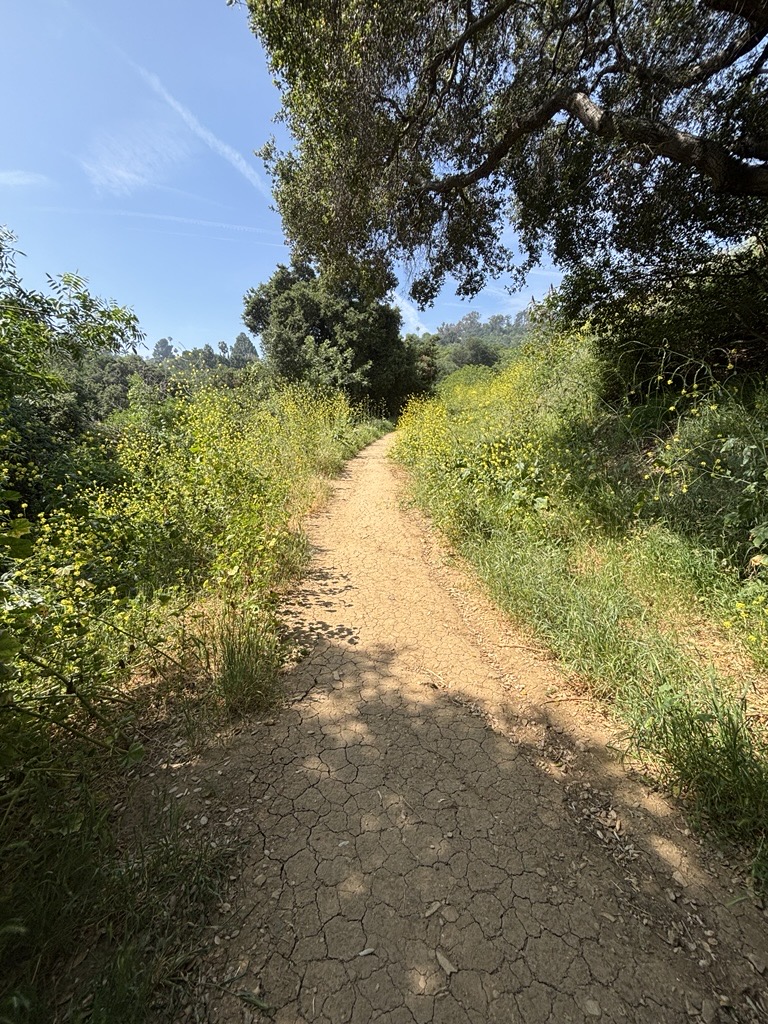
part 5: go outside for thirty minutes
part 6: 500 words where the character negotiates (712 words)
Koah’s breath caught as the creature emerged from the shadows, its enormous form slithering through the black water with unsettling grace. It was huge. The surface of the sea rippled violently, almost as if the waves themselves were alive, bowing to the creature’s will. Its body was covered in sleek, dark scales that shimmered like moonlight on a stormy night, and its tentacles writhed like serpents, curling in slow, deliberate movements. Eyes—deep, glowing, and ancient—stared directly at Koah, two luminescent orbs that seemed to pierce through him, searching, reading every inch of his soul.
The Maelstrom Beast had awakened.
Koah tried not to let the terror rising in his chest show. He wasn’t sure if he was shaking from fear or from the undeniable pull he felt toward the creature. It was like the sea itself was calling to him—no, more than that. It was demanding something from him.
“Approach,” a voice boomed, but it wasn’t through sound. It was a voice he felt in his very bones, inside his mind, as though the creature’s words were whispered directly into the marrow of his spine. The voice held the weight of centuries, of forgotten tides and lost ships.
Koah hesitated, but he knew he had no choice. He was already here, and there was something inside him, something in the sea’s rhythm, that told him this was the moment.
“What do you want?” Koah called out, his voice rough in the air, more breath than sound. The waves crashed around him as if to answer.
The Maelstrom Beast’s tendrils moved toward him, slow and deliberate, dragging the water with them in deep, swirling motions. It spoke again, its voice like the rumble of thunder beneath the waves.
“I have watched you for a time, Koah Cassidy,” it said, each word wrapped in that eerie hum. “You feel the sea’s pull in your veins, don’t you? Your blood is salt. Your soul is tied to the tides. You seek to leave, to go beyond what your kin have known, but you are torn.”
Koah’s heart skipped a beat. How could it know that? How could it know his doubts, his fears, his longing?
“I… don’t understand,” Koah said. His voice cracked. “What do you want from me?”
The creature’s eyes glowed brighter, the light pulsating like the beating of a giant heart, the waves trembling with the intensity. Its voice softened, becoming almost a whisper, though it still felt like a roar deep inside him.
“I offer you a choice,” the creature said. “You seek to leave this place, to chase your dreams. But the sea cannot be ignored. You are tied to it, whether you stay or go. Help me… and I will give you the chance to fulfill your dreams beyond the shores of Galway.”
Koah frowned. “Help you? How?”
A terrible silence stretched across the water before the Maelstrom Beast answered, its voice like the creaking of an ancient ship’s timbers.
“The tides are shifting. Something is coming. I need my freedom, Koah Cassidy. I need to be free of the chains that bind me beneath these waves. Help me, and I will grant you what you desire—a path beyond your town, beyond your father’s expectations, a path to the horizon.”
The air around Koah felt thick with the weight of the beast’s words. He could feel the pull in his chest, like the ocean was pulling at him with invisible ropes. But this was more than just a deal—it felt dangerous. There was no such thing as a free gift from the ocean, and the Maelstrom Beast had the power to ruin everything.
“What’s the catch?” Koah asked, his voice hard now, though his pulse hammered in his throat.
The creature’s tendrils twitched with a strange, almost human amusement. “The catch is that the sea always claims what it is owed. What you give me, I will take. What I give you, you will be bound to.”
Koah’s breath caught in his throat. “What do you mean? Bound to the sea?”
The Maelstrom Beast’s eyes narrowed, its glowing pupils fixed on him with unsettling intensity. “The sea will never let you go. Whether you sail its waves or walk its shores, it will claim you, body and soul. Forever.”
part 7: 200 words to end the adventure (209 words)
Koah stood at the edge of the sea, the Maelstrom Beast’s offer echoing in his mind like the endless crash of waves. He had made his choice, the deal sealed with an unspoken understanding. The creature’s tendrils had vanished into the depths, leaving the air thick with the scent of salt and the hum of something ancient.
For a moment, the sea was still, almost peaceful. Koah felt the weight of the ocean’s promise settle in his chest, a pulse that was both exhilarating and terrifying. The horizon stretched out before him—wide, infinite, and full of possibility.
He had left Galway behind, but the sea had never truly let him go. The Maelstrom Beast had kept its word; the world beyond the docks had unfolded before him like the sails of a ship in the wind. Yet, no matter how far he traveled, Koah knew he would always carry the ocean within him. The tides had claimed him.
And now, it wasn’t just the pull of the waves that called to him—it was the music, too. His fiddle hummed softly beneath his fingertips, the notes carrying with them the promise of new shores, new songs, and a future no longer bound by the past.
The adventure had just begun.
part 1: 200 words to start the story (382 words)
The wind off Galway Bay tugged at Koah’s jacket as he stood on the edge of the dock, eyes fixed on the horizon where the sky met the churning water. There was something about the sea—the way it always felt both familiar and foreign—that gnawed at him, like a song whose lyrics he couldn’t quite remember. It was the same feeling that tugged at him when his father asked, for the hundredth time, if he was ready to join the family business. The same feeling when his mother looked at him over breakfast with that quiet worry in her eyes, as though she could see the restlessness that ran through his veins like a current.
Koah glanced down at the boat half-completed in the workshop, the hull still bare, the wooden frame a skeleton waiting to be fleshed out. It was meant to be his masterpiece, a boat to prove to himself that he was more than just a son who inherited the same tools his father used. But even in the silence of the workshop, where the scent of cedar wood and varnish filled the air, the weight of expectations pressed down on him. He’d always felt it. His father’s voice, echoing through his memories—“A man’s word is his bond, Koah. You finish what you start. You don’t leave your work unfinished.”
The pluck of a fiddle string echoed faintly from the house, a sound Koah couldn’t ignore. Music was the only thing that let him breathe in ways his father’s stern voice never could. It was in his blood, a gift from his grandmother who’d always whispered tales of the fae and of hidden magic in the music itself. The old woman said the music was a part of him—a way of connecting with something bigger than himself.
But that wasn’t what his father wanted to hear. The boat was real. The music? A whim. A distraction.
Koah closed his eyes for a moment, letting the wind whip through his hair. Somewhere deep inside, he knew that something was about to change. Whether it would be a choice between his family’s legacy and his own dreams, or something more—he wasn’t sure. But he could feel it in his bones, like the first whisper of a storm on the horizon.
part 2: 400 words where the character receives a new opportunity (439 words)
Koah had barely put the tools down when it happened.
The bell above the workshop door chimed, a sound that usually meant another customer or a neighbor looking to chat about the weather. Koah didn’t immediately look up—his hands were still working the chisel, shaping the delicate curve of the boat’s bow. The faint scent of sawdust and varnish hung in the air, mixing with the brine of the sea. It was a smell he’d come to love, the tangible proof that something was being built, something real.
“Koah, is your father around?” A voice called from the doorway. It was familiar, but not one he heard often.
He glanced over his shoulder, the motion slow, almost reluctant. It was Seán, a man from the docks. Seán’s rough hands and weathered face spoke of a life lived on the water, but it was his reputation that made him stand out. He was known for talking big, offering promises of work that might lead to something more—usually involving ships or trade, something beyond the small harbor town. Something beyond Galway.
“He's not here,” Koah answered, wiping his hands on a rag, his gaze narrowing as Seán stepped into the workshop.
Seán smiled, a gleam in his eye that Koah didn’t quite trust. “Good. I was hoping I’d catch you instead. Got a proposition for you.”
Koah set the chisel down, his pulse quickening slightly. Something about Seán's grin told him this wasn't just a casual offer.
“Go on,” Koah said, leaning against the table, his arms crossed.
“You’ve got talent, kid. Your work with wood—it’s not just craftsmanship. It’s something else. You can feel the grain, the way the boards fit together. It’s in your blood.” Seán paused, gauging Koah's reaction. “I know a man who’s looking for someone to help build a boat—no, not a boat, a ship. Something that could cross the oceans. He needs someone who understands the sea, who has the patience for something this big.”
Koah felt the pulse of his heart beneath his ribcage. This wasn’t the sort of offer he could easily turn down. He swallowed, suddenly aware of how still the workshop had become. “A ship? For who?”
Seán leaned closer, lowering his voice. “It’s not about who, Koah. It’s about where. There’s more than just this little harbor waiting for you. It’s time to leave the shore behind.”
The words hung in the air, like the promise of a storm. The choice was in Koah’s hands now. The offer of a lifetime. But could he really leave? Could he leave the sea, his family, and everything that had always been his?
part 3: 300 words where the character learns something new (334 words)
Koah sat cross-legged on the floor of the workshop, the afternoon sun casting long shadows across the timber. The boat—his boat—was still unfinished, the planks waiting for a touch of something that he couldn’t quite name. But today, his mind wasn’t on the boat. Instead, his fingers traced the edges of an old leather-bound book that had belonged to his grandmother.
Grandmother Brigid had always told him that the sea was full of secrets—monsters, she’d called them, though he had never taken her stories seriously. To him, they were just tales, the kind to be whispered over a fire, not to be believed. But ever since that strange day when the sea had seemed to call him—when he’d felt the wind shift and the waters stir in a way that felt unnatural—he couldn’t shake the sense that there was more to the world than he had ever known.
Flipping the pages, Koah found the passage that caught his attention: The Selkie—guardians of the deep. His grandmother’s notes scribbled in the margins, the words barely legible.
They appear in the form of seals, but beneath the skin, they wear the flesh of men and women. They are the keepers of the ocean’s heart, the ones who protect the souls lost to the waves.
Koah’s fingers lingered on the words. Guardians of the deep. He’d heard of selkies, of course, but always in the form of myth. The thought of them as protectors, as creatures woven into the sea itself, felt heavier. It made him uneasy—almost as if his grandmother had known something about them, something that went beyond old stories.
The next page revealed more. Their magic is not just the ocean’s song, but the power to change the tide itself. Beware those who seek to harm the sea. The selkies will see them drown.
A chill ran down Koah’s spine. He closed the book, heart racing. What had he just uncovered? And, more importantly—had he disturbed something that was never meant to be found?
part 4: 400 words where the character stumbles upon a secret lair (455 words)
The tide had started to pull away from the shore, leaving behind the smell of salt and something else—something faintly metallic in the air, like rust. Koah’s feet crunched over the wet sand, the soles of his boots sticking as he made his way down the coastline. He’d been walking for hours, lost in thought and the rhythmic pounding of the surf. After Seán’s offer, his head had been spinning. A ship, a journey—he didn’t know what to make of it yet, but he knew one thing for certain: something about the sea was changing.
The wind tugged at his hair as he glanced toward the jagged cliffs up ahead, where the rocks jutted out like the bones of some great beast. He’d walked this stretch of coast a thousand times, but today, something felt different. The air was too still, the horizon too muted. He couldn’t shake the feeling that he was being drawn toward something, as if the land itself were calling him.
As Koah approached the base of the cliffs, his boots sinking slightly into the wet sand, he noticed a narrow crevice—barely wide enough to fit a hand through, hidden behind a tangle of seaweed and moss. It wasn’t there before. He was sure of it.
Curiosity gnawed at him. The idea of a hidden entrance, a secret passage—he couldn’t resist. He pulled the seaweed aside, his heart beating a little faster, and reached into the crevice. The stone felt unnaturally warm, as if it had been heated by something beneath it. There was a low hum, barely perceptible, vibrating through the rock. His breath caught in his throat.
Pushing the crevice open just enough to slip through, Koah squeezed into the dark space. Inside, the air was thick and cool, a dampness that sent shivers up his spine. As his eyes adjusted to the dim light, he saw it: the faint outline of a cave, its entrance hidden behind the cliff’s face. The sound of water dripping echoed through the chamber, but what truly caught his attention were the markings on the walls—etched with strange symbols, twisting lines that seemed to shift when he wasn’t looking directly at them.
He stepped deeper into the cave, the rocky floor uneven beneath his feet. The hum grew louder, a deep, resonant thrum that seemed to reverberate in his chest. There was something ancient about this place, something older than any story his grandmother had told him. A low growl sounded in the distance, a sharp, guttural sound that froze him in place.
Before he could move, a shadow flickered in the corner of his vision.
Koah held his breath, trying not to make a sound. He had stumbled upon something. Something alive.
part 5: go outside for thirty minutes
part 6: 500 words where the character negotiates (712 words)
Koah’s breath caught as the creature emerged from the shadows, its enormous form slithering through the black water with unsettling grace. It was huge. The surface of the sea rippled violently, almost as if the waves themselves were alive, bowing to the creature’s will. Its body was covered in sleek, dark scales that shimmered like moonlight on a stormy night, and its tentacles writhed like serpents, curling in slow, deliberate movements. Eyes—deep, glowing, and ancient—stared directly at Koah, two luminescent orbs that seemed to pierce through him, searching, reading every inch of his soul.
The Maelstrom Beast had awakened.
Koah tried not to let the terror rising in his chest show. He wasn’t sure if he was shaking from fear or from the undeniable pull he felt toward the creature. It was like the sea itself was calling to him—no, more than that. It was demanding something from him.
“Approach,” a voice boomed, but it wasn’t through sound. It was a voice he felt in his very bones, inside his mind, as though the creature’s words were whispered directly into the marrow of his spine. The voice held the weight of centuries, of forgotten tides and lost ships.
Koah hesitated, but he knew he had no choice. He was already here, and there was something inside him, something in the sea’s rhythm, that told him this was the moment.
“What do you want?” Koah called out, his voice rough in the air, more breath than sound. The waves crashed around him as if to answer.
The Maelstrom Beast’s tendrils moved toward him, slow and deliberate, dragging the water with them in deep, swirling motions. It spoke again, its voice like the rumble of thunder beneath the waves.
“I have watched you for a time, Koah Cassidy,” it said, each word wrapped in that eerie hum. “You feel the sea’s pull in your veins, don’t you? Your blood is salt. Your soul is tied to the tides. You seek to leave, to go beyond what your kin have known, but you are torn.”
Koah’s heart skipped a beat. How could it know that? How could it know his doubts, his fears, his longing?
“I… don’t understand,” Koah said. His voice cracked. “What do you want from me?”
The creature’s eyes glowed brighter, the light pulsating like the beating of a giant heart, the waves trembling with the intensity. Its voice softened, becoming almost a whisper, though it still felt like a roar deep inside him.
“I offer you a choice,” the creature said. “You seek to leave this place, to chase your dreams. But the sea cannot be ignored. You are tied to it, whether you stay or go. Help me… and I will give you the chance to fulfill your dreams beyond the shores of Galway.”
Koah frowned. “Help you? How?”
A terrible silence stretched across the water before the Maelstrom Beast answered, its voice like the creaking of an ancient ship’s timbers.
“The tides are shifting. Something is coming. I need my freedom, Koah Cassidy. I need to be free of the chains that bind me beneath these waves. Help me, and I will grant you what you desire—a path beyond your town, beyond your father’s expectations, a path to the horizon.”
The air around Koah felt thick with the weight of the beast’s words. He could feel the pull in his chest, like the ocean was pulling at him with invisible ropes. But this was more than just a deal—it felt dangerous. There was no such thing as a free gift from the ocean, and the Maelstrom Beast had the power to ruin everything.
“What’s the catch?” Koah asked, his voice hard now, though his pulse hammered in his throat.
The creature’s tendrils twitched with a strange, almost human amusement. “The catch is that the sea always claims what it is owed. What you give me, I will take. What I give you, you will be bound to.”
Koah’s breath caught in his throat. “What do you mean? Bound to the sea?”
The Maelstrom Beast’s eyes narrowed, its glowing pupils fixed on him with unsettling intensity. “The sea will never let you go. Whether you sail its waves or walk its shores, it will claim you, body and soul. Forever.”
part 7: 200 words to end the adventure (209 words)
Koah stood at the edge of the sea, the Maelstrom Beast’s offer echoing in his mind like the endless crash of waves. He had made his choice, the deal sealed with an unspoken understanding. The creature’s tendrils had vanished into the depths, leaving the air thick with the scent of salt and the hum of something ancient.
For a moment, the sea was still, almost peaceful. Koah felt the weight of the ocean’s promise settle in his chest, a pulse that was both exhilarating and terrifying. The horizon stretched out before him—wide, infinite, and full of possibility.
He had left Galway behind, but the sea had never truly let him go. The Maelstrom Beast had kept its word; the world beyond the docks had unfolded before him like the sails of a ship in the wind. Yet, no matter how far he traveled, Koah knew he would always carry the ocean within him. The tides had claimed him.
And now, it wasn’t just the pull of the waves that called to him—it was the music, too. His fiddle hummed softly beneath his fingertips, the notes carrying with them the promise of new shores, new songs, and a future no longer bound by the past.
The adventure had just begun.
- TokoWrites
-
Scratcher
500+ posts
✮ ~ Toko's Writing Thread ~ ✮
“What do you mean you have no idea what you're doing? You were supposed to be the leader!”
The words hit harder than the alarms blaring overhead. I open my mouth, then close it again, tasting metal and panic. Leader. The title had sounded solid when they gave it to me—like armor. Now it feels more like a costume two sizes too big.
“I—I had a plan,” I manage, glancing at the flickering map that no longer makes sense. Corridors are blocked, exits gone dark. Nothing matches the briefing.
“Had?” someone snaps. “That’s not good enough.”
They’re right. It isn’t. Leadership wasn’t supposed to look like this—sweaty hands, second-guessing every decision, hoping confidence alone might keep everyone moving. I thought if I acted certain, I would become certain.
But certainty never came.
I take a breath, forcing my voice steady. “No. I don’t know exactly what I’m doing,” I admit. A few faces fall. Others sharpen.
“But I know we don’t stand here and wait.”
Silence.
Then, quieter: “So we figure it out. Together.”
For the first time, no one argues.
The words hit harder than the alarms blaring overhead. I open my mouth, then close it again, tasting metal and panic. Leader. The title had sounded solid when they gave it to me—like armor. Now it feels more like a costume two sizes too big.
“I—I had a plan,” I manage, glancing at the flickering map that no longer makes sense. Corridors are blocked, exits gone dark. Nothing matches the briefing.
“Had?” someone snaps. “That’s not good enough.”
They’re right. It isn’t. Leadership wasn’t supposed to look like this—sweaty hands, second-guessing every decision, hoping confidence alone might keep everyone moving. I thought if I acted certain, I would become certain.
But certainty never came.
I take a breath, forcing my voice steady. “No. I don’t know exactly what I’m doing,” I admit. A few faces fall. Others sharpen.
“But I know we don’t stand here and wait.”
Silence.
Then, quieter: “So we figure it out. Together.”
For the first time, no one argues.
- TokoWrites
-
Scratcher
500+ posts
✮ ~ Toko's Writing Thread ~ ✮
weekly 1 - 2413 words
part 1 - 353 words
Oliver and Francis crouched by the creek, pebbles tumbling through their fingers. The water sparkled, teasing them with its restless shimmer.
“You think the frogs ever get bored of jumping?” Francis asked, tilting his head.
“Probably,” Oliver said. “But they keep jumping anyway.” He tossed a pebble into the current, watching it spin before sinking.
They sat in companionable silence for a while, each stone making a tiny splash, each ripple fading into the next.
“I tried drawing the oak tree yesterday,” Francis said. “But the wind blew the paper away.”
Oliver chuckled. “Did you chase it?”
“I did!” Francis laughed, “and I realized… trees move more than I thought. Or maybe I’m too slow.”
A gust of wind tugged at Oliver’s scarf, and he wrapped it tighter. “Change is funny, isn’t it?”
“Funny… or tricky,” Francis said. “Like, we’re trying to hold onto things, but they keep slipping. Maybe that’s just how it works.”
Oliver squinted at a family of ducks waddling along the bank. “Even them,” he said, “they’re not really in one place for long. They just keep moving.”
Francis grinned. “So what, we’re like ducks?”
“Maybe,” Oliver said, tossing another pebble that skipped twice before sinking. “Or frogs. Or pebbles. Or scarves. Whatever keeps moving.”
Francis crouched, pressing a wet finger into the sand, then watching as the current erased his doodle in seconds. “I like that,” he said softly. “It’s like we get to try things over and over, even if we fail.”
Oliver tossed a tiny stick into the water, making it spin. “Exactly. Life’s like this creek—never the same twice. And maybe the point isn’t holding on, but noticing it all while it moves.”
Francis nodded, squinting at the ripples. “Like frogs. Like ducks. Like scarves.”
“Like us,” Oliver said, grinning.
They laughed at the stones that refused to sink straight, at the wind that teased them, and at themselves—two friends learning how to move along with life, together. And as the creek whispered and twirled around them, it was impossible not to feel that maybe slipping, spinning, and bouncing was just part of the fun.
part 2 - 385 words
Oliver crouched at the creek’s edge, holding a flat, gray pebble between his fingers. He turned it over, watching the sunlight glint off its smooth surface.
“Careful,” Francis said, peering over. “That one looks… tricky.”
Oliver grinned. “Tricky pebbles are the best kind.” He tossed it gently into the water. The pebble skipped twice, spun in a circle, and sank.
Francis picked up a bright white pebble, smaller than his palm. He rolled it between his fingers, feeling its uneven edges. “I’m going to try one too,” he said. He flung it, and it skipped once before disappearing under the current.
The two friends crouched in silence, watching the ripples spread. Each pebble left a trail, subtle but real, moving outward even after it vanished.
Oliver found another stone, a tiny black one that fit perfectly in his hand. He dropped it carefully, but it caught the edge of a root and rolled back toward him. He laughed. “It’s alive,” he said.
Francis laughed too. “Maybe all pebbles are alive, and we just don’t notice.” He selected a smooth, speckled one and tossed it with extra force. It hit a small wave, spun three times, and finally sank. “Look at it go!”
Hours passed, but they didn’t stop. Some pebbles skipped far, some disappeared immediately, some twirled in unexpected directions. Oliver collected a few that had washed back to the shore, inspecting their scratches and grooves. Francis arranged his in a little line, careful to space them evenly, then nudged one so it rolled into the water.
Every pebble had a story. Some were stubborn, some playful, some stubbornly playful. Oliver noticed patterns—how certain shapes skipped farther, how smooth ones twirled. Francis noticed how the sunlight made some stones sparkle like stars, and how the ripples changed depending on the toss.
Finally, Francis held a pebble quietly in his palm, watching the water. “They’re kind of like us, aren’t they?” he said softly. “Trying things, spinning, sometimes sinking, but always leaving a mark.”
Oliver nodded, tossing one last pebble. It twirled once, hit a small wave, and disappeared. He smiled. “Yeah. Like us.”
They left the creek with pockets full of pebbles, each one a little story, a little adventure, a little reminder that even the smallest things could carry meaning if you paid attention.
part 3 - 727 words
The pond was quiet, except for the occasional plop of a frog jumping from a lily pad. Oliver and Francis slung their backpacks onto the grass and ran to the water’s edge, where smooth pebbles lay scattered like hidden treasure.
“Bet I can skip one farther than you,” Oliver said, grabbing a flat stone that gleamed gray in the sunlight.
Francis raised an eyebrow. “You wish. That one’s mine,” he said, picking a speckled pebble. “No cheating!”
Oliver smirked and tossed a small rock into the pond. It skipped once, then twice, then plopped into the water with a tiny splash. Francis’s eyes widened. “Okay, maybe that one did skip far…”
“Maybe,” Oliver said, grinning, “but now I get to do the big one.” He picked up a heavier, jagged pebble, testing its weight. “Watch this!”
He hurled it as hard as he could. It hit the water with a loud splash, spraying droplets onto their legs, then spun sideways, ricocheted off a lily pad, and sank.
Francis laughed, shaking his wet socks. “Not fair! You aimed for chaos!”
Oliver laughed back. “Chaos is part of the fun!”
They crouched, picking up more pebbles. Some were smooth, some rough, some had little flecks of white. Every stone seemed to have a personality. Francis rolled one between his fingers. “Do you think… the pebbles remember us?”
Oliver tilted his head. “Maybe. Maybe they get a little thrill when we throw them. Like, ‘Finally! Adventure!’”
Francis laughed. “Yeah, ‘Here comes Francis!’” He tossed his pebble, and it skipped twice before sinking. “See? Adventure!”
They lapsed into a comfortable silence, watching the pond’s surface ripple. Tiny fish darted near the rocks, creating concentric waves that tangled with the ones from their throws. A dragonfly buzzed past, brushing Oliver’s hair, and he shivered. “Hey! Don’t eat me!”
Francis snorted. “It’s on your head now. I’d watch out if I were you.”
Oliver swatted at the insect, then picked another pebble. “You know, sometimes I think throwing pebbles is like… dealing with stuff. You aim, you try, you hope it goes somewhere good, but you never really know where it lands.”
Francis considered that, twirling a flat pebble in his fingers. “Yeah… like choices. Or mistakes. Or… surprises.”
Oliver nodded. “Exactly. And it’s better if someone’s there to watch it fly, or laugh when it splashes funny.”
Francis leaned back on his elbows, gazing at the water. “I like watching the ripples. They go so far… farther than you think. And then they fade, but you know they happened.”
Oliver picked a small, round pebble and tossed it gently. It skipped across the water, bouncing three times before sinking near a clump of reeds. “It’s like the little stuff matters too,” he said.
Francis grabbed a pebble and threw it with more force than he meant to. It splashed loudly, soaking a nearby turtle sunning itself on a log. The turtle didn’t move, but Francis squealed. “Sorry! Sorry, Mr. Turtle!”
Oliver laughed until he nearly fell backward into the water. “He’ll forgive you… eventually!”
They spent the rest of the afternoon tossing stones, some careful, some reckless. They made up silly games: Who could land closest to the lily pads? Who could make the biggest splash? Who could skip three stones in a row without missing? Each throw, each laugh, each splash felt like a small story added to the pond.
Finally, Francis sat back, holding a smooth, gray pebble in his hand. “I think… it’s not about where it lands. It’s about throwing it, seeing it fly, and laughing if it spins the wrong way.”
Oliver nodded, tossing a tiny pebble that bounced twice and landed in a swirl of ripples. “Yeah… and having someone to share it with makes it way better.”
The pond reflected the setting sun, and the ripples stretched out, carrying the tiny adventures of their day. They didn’t know where each stone had gone, or where it would end up, but it didn’t matter. The throwing, the splashes, and the laughter were enough.
And as they finally slung their backpacks over their shoulders and headed home, pockets full of pebbles, both Oliver and Francis felt lighter, warmer, and just a little braver. Because even if they didn’t know exactly where things would land, the act of tossing, and sharing, made everything feel more like an adventure.
part 4 - 948 words
The sun was warm on their backs, and the creek gurgled as if it had its own secrets to share. Oliver and Francis crouched at the edge, fingers brushing the water as they picked up pebbles. Each one was different—gray, white, speckled, smooth, jagged—like tiny pieces of some hidden puzzle the creek was holding just for them.
“Do you ever think the pebbles care where they land?” Francis asked, rolling a bright white stone between his fingers.
Oliver grinned. “Maybe not. But it’s fun to see them try.” He held a flat, gray pebble, turning it over in the sunlight. “Every toss is a choice. We don’t always know where it’ll go, but we get to decide to throw it.”
Francis studied the water. A stick drifted past, snagged briefly on a rock, then continued down the current. “Like… decisions? Or mistakes? Or chances we take?”
“Exactly,” Oliver said, tossing his pebble. It skipped twice, spun in a circle, and disappeared beneath the rippling surface. The concentric rings shimmered in the sunlight, stretching farther than either of them could see.
They laughed as a pebble Oliver tried to throw straight instead curled sideways and landed with a tiny splash on Francis’s foot. “Hey!” Francis shouted, shaking his sock dry, then laughed. “It’s like it had a mind of its own.”
“That’s life!” Oliver said, eyes sparkling. “We can plan, aim, hope—but sometimes things just spin in their own direction.”
Francis picked up another stone, flat and speckled, and tested the weight in his hand. “I guess it’s not so bad if it doesn’t go where we want. Maybe it finds its own place instead.” He tossed it gently; it skipped once, then twirled in a small eddy before sinking.
“See?” Oliver cheered. “Even if it wasn’t the place we imagined.”
They spent hours tossing stones, naming the jumps, and imagining what each ripple might touch downstream. Some skipped straight, some spun endlessly, and some sank immediately. Oliver experimented with curved throws, trying to make a pebble spin in midair, while Francis tried light, flat stones that could skip farther than they should. They made up silly competitions, like who could make the pebble hop three times before sinking, or whose pebble could spin the longest. Each splash, each ripple, was a tiny victory.
“Do you think the creek notices?” Francis asked after one particularly long skip. “All our pebbles, all our tricks?”
Oliver laughed. “Maybe it does. Or maybe it just likes the company.” He tossed another pebble, watching it land just where he didn’t expect, and grinned. “Either way, it’s more fun with someone else.”
As the sun dipped lower, casting golden stripes across the water, they found a quiet moment. Francis held a small, gray pebble quietly in his palm, feeling the smooth surface. “I think… maybe it’s not about controlling where it lands. It’s about throwing it at all,” he said softly.
Oliver nodded, picking a final stone. “And having someone there to see it fly.” He flung the pebble, watching it spin twice before vanishing into the creek. The ripples stretched far beyond where he could see, carrying tiny stories of choices, laughter, and shared moments.
They wandered along the bank, collecting a few more pebbles as the shadows grew long. Dragonflies skimmed across the surface, and the occasional leaf drifted by. Francis skipped a stone too far and watched it disappear with a splash. “Oops,” he said, grinning.
“Perfect,” Oliver said. “That one’s gone exploring.”
They found a little patch of moss-covered rocks and sat, tossing stones softly into the water, letting each skip, twirl, and sink in its own way. The creek was no longer just a stream of water; it felt like a gallery of tiny adventures, each pebble carrying a story, each ripple connecting them to the next.
“Do you ever get scared?” Francis asked, eyes following the sun dipping behind the trees. “Of… I don’t know, the things that don’t go right?”
Oliver thought for a moment, tossing a small pebble that barely skipped. “Yeah,” he admitted. “Sometimes. But… I think that’s why it’s better to throw them together. You laugh when one spins funny. You celebrate the surprises. And even when something sinks, it’s still part of the story.”
Francis smiled. “I like that. Even mistakes are fun if you share them.”
They stayed until the creek was dappled in pink and gold, their pockets filled with pebbles they’d collected, each one a little story. They didn’t need to know exactly where each stone would end up, just that they had thrown it, watched it, and laughed together.
Finally, Oliver held up a flat, gray pebble. “One last toss?”
Francis nodded. They leaned over the water together, let the stone slip from their fingers, and watched it spin, skip, and sink. The ripples stretched farther than they could see, shimmering in the last light of day.
“See?” Oliver said quietly. “Even if it didn’t land where we imagined… it’s still beautiful.”
Francis nodded. “Yeah… it’s the throwing that matters. And the seeing.”
They stood, brushing creek mud from their hands, and began the slow walk home. Behind them, the creek gurgled and whispered as if it remembered every toss, every laugh, every tiny adventure. The pebbles they left behind weren’t lost—they were stories, waiting for the next ripple to carry them somewhere new.
And as they walked, side by side, Oliver and Francis knew something simple and true: life was like the creek, unpredictable and spinning in ways you couldn’t always control. But with a friend by your side, it was infinitely more fun to toss a few stones, make a few ripples, and see where they go.
part 1 - 353 words
Oliver and Francis crouched by the creek, pebbles tumbling through their fingers. The water sparkled, teasing them with its restless shimmer.
“You think the frogs ever get bored of jumping?” Francis asked, tilting his head.
“Probably,” Oliver said. “But they keep jumping anyway.” He tossed a pebble into the current, watching it spin before sinking.
They sat in companionable silence for a while, each stone making a tiny splash, each ripple fading into the next.
“I tried drawing the oak tree yesterday,” Francis said. “But the wind blew the paper away.”
Oliver chuckled. “Did you chase it?”
“I did!” Francis laughed, “and I realized… trees move more than I thought. Or maybe I’m too slow.”
A gust of wind tugged at Oliver’s scarf, and he wrapped it tighter. “Change is funny, isn’t it?”
“Funny… or tricky,” Francis said. “Like, we’re trying to hold onto things, but they keep slipping. Maybe that’s just how it works.”
Oliver squinted at a family of ducks waddling along the bank. “Even them,” he said, “they’re not really in one place for long. They just keep moving.”
Francis grinned. “So what, we’re like ducks?”
“Maybe,” Oliver said, tossing another pebble that skipped twice before sinking. “Or frogs. Or pebbles. Or scarves. Whatever keeps moving.”
Francis crouched, pressing a wet finger into the sand, then watching as the current erased his doodle in seconds. “I like that,” he said softly. “It’s like we get to try things over and over, even if we fail.”
Oliver tossed a tiny stick into the water, making it spin. “Exactly. Life’s like this creek—never the same twice. And maybe the point isn’t holding on, but noticing it all while it moves.”
Francis nodded, squinting at the ripples. “Like frogs. Like ducks. Like scarves.”
“Like us,” Oliver said, grinning.
They laughed at the stones that refused to sink straight, at the wind that teased them, and at themselves—two friends learning how to move along with life, together. And as the creek whispered and twirled around them, it was impossible not to feel that maybe slipping, spinning, and bouncing was just part of the fun.
part 2 - 385 words
Oliver crouched at the creek’s edge, holding a flat, gray pebble between his fingers. He turned it over, watching the sunlight glint off its smooth surface.
“Careful,” Francis said, peering over. “That one looks… tricky.”
Oliver grinned. “Tricky pebbles are the best kind.” He tossed it gently into the water. The pebble skipped twice, spun in a circle, and sank.
Francis picked up a bright white pebble, smaller than his palm. He rolled it between his fingers, feeling its uneven edges. “I’m going to try one too,” he said. He flung it, and it skipped once before disappearing under the current.
The two friends crouched in silence, watching the ripples spread. Each pebble left a trail, subtle but real, moving outward even after it vanished.
Oliver found another stone, a tiny black one that fit perfectly in his hand. He dropped it carefully, but it caught the edge of a root and rolled back toward him. He laughed. “It’s alive,” he said.
Francis laughed too. “Maybe all pebbles are alive, and we just don’t notice.” He selected a smooth, speckled one and tossed it with extra force. It hit a small wave, spun three times, and finally sank. “Look at it go!”
Hours passed, but they didn’t stop. Some pebbles skipped far, some disappeared immediately, some twirled in unexpected directions. Oliver collected a few that had washed back to the shore, inspecting their scratches and grooves. Francis arranged his in a little line, careful to space them evenly, then nudged one so it rolled into the water.
Every pebble had a story. Some were stubborn, some playful, some stubbornly playful. Oliver noticed patterns—how certain shapes skipped farther, how smooth ones twirled. Francis noticed how the sunlight made some stones sparkle like stars, and how the ripples changed depending on the toss.
Finally, Francis held a pebble quietly in his palm, watching the water. “They’re kind of like us, aren’t they?” he said softly. “Trying things, spinning, sometimes sinking, but always leaving a mark.”
Oliver nodded, tossing one last pebble. It twirled once, hit a small wave, and disappeared. He smiled. “Yeah. Like us.”
They left the creek with pockets full of pebbles, each one a little story, a little adventure, a little reminder that even the smallest things could carry meaning if you paid attention.
part 3 - 727 words
The pond was quiet, except for the occasional plop of a frog jumping from a lily pad. Oliver and Francis slung their backpacks onto the grass and ran to the water’s edge, where smooth pebbles lay scattered like hidden treasure.
“Bet I can skip one farther than you,” Oliver said, grabbing a flat stone that gleamed gray in the sunlight.
Francis raised an eyebrow. “You wish. That one’s mine,” he said, picking a speckled pebble. “No cheating!”
Oliver smirked and tossed a small rock into the pond. It skipped once, then twice, then plopped into the water with a tiny splash. Francis’s eyes widened. “Okay, maybe that one did skip far…”
“Maybe,” Oliver said, grinning, “but now I get to do the big one.” He picked up a heavier, jagged pebble, testing its weight. “Watch this!”
He hurled it as hard as he could. It hit the water with a loud splash, spraying droplets onto their legs, then spun sideways, ricocheted off a lily pad, and sank.
Francis laughed, shaking his wet socks. “Not fair! You aimed for chaos!”
Oliver laughed back. “Chaos is part of the fun!”
They crouched, picking up more pebbles. Some were smooth, some rough, some had little flecks of white. Every stone seemed to have a personality. Francis rolled one between his fingers. “Do you think… the pebbles remember us?”
Oliver tilted his head. “Maybe. Maybe they get a little thrill when we throw them. Like, ‘Finally! Adventure!’”
Francis laughed. “Yeah, ‘Here comes Francis!’” He tossed his pebble, and it skipped twice before sinking. “See? Adventure!”
They lapsed into a comfortable silence, watching the pond’s surface ripple. Tiny fish darted near the rocks, creating concentric waves that tangled with the ones from their throws. A dragonfly buzzed past, brushing Oliver’s hair, and he shivered. “Hey! Don’t eat me!”
Francis snorted. “It’s on your head now. I’d watch out if I were you.”
Oliver swatted at the insect, then picked another pebble. “You know, sometimes I think throwing pebbles is like… dealing with stuff. You aim, you try, you hope it goes somewhere good, but you never really know where it lands.”
Francis considered that, twirling a flat pebble in his fingers. “Yeah… like choices. Or mistakes. Or… surprises.”
Oliver nodded. “Exactly. And it’s better if someone’s there to watch it fly, or laugh when it splashes funny.”
Francis leaned back on his elbows, gazing at the water. “I like watching the ripples. They go so far… farther than you think. And then they fade, but you know they happened.”
Oliver picked a small, round pebble and tossed it gently. It skipped across the water, bouncing three times before sinking near a clump of reeds. “It’s like the little stuff matters too,” he said.
Francis grabbed a pebble and threw it with more force than he meant to. It splashed loudly, soaking a nearby turtle sunning itself on a log. The turtle didn’t move, but Francis squealed. “Sorry! Sorry, Mr. Turtle!”
Oliver laughed until he nearly fell backward into the water. “He’ll forgive you… eventually!”
They spent the rest of the afternoon tossing stones, some careful, some reckless. They made up silly games: Who could land closest to the lily pads? Who could make the biggest splash? Who could skip three stones in a row without missing? Each throw, each laugh, each splash felt like a small story added to the pond.
Finally, Francis sat back, holding a smooth, gray pebble in his hand. “I think… it’s not about where it lands. It’s about throwing it, seeing it fly, and laughing if it spins the wrong way.”
Oliver nodded, tossing a tiny pebble that bounced twice and landed in a swirl of ripples. “Yeah… and having someone to share it with makes it way better.”
The pond reflected the setting sun, and the ripples stretched out, carrying the tiny adventures of their day. They didn’t know where each stone had gone, or where it would end up, but it didn’t matter. The throwing, the splashes, and the laughter were enough.
And as they finally slung their backpacks over their shoulders and headed home, pockets full of pebbles, both Oliver and Francis felt lighter, warmer, and just a little braver. Because even if they didn’t know exactly where things would land, the act of tossing, and sharing, made everything feel more like an adventure.
part 4 - 948 words
The sun was warm on their backs, and the creek gurgled as if it had its own secrets to share. Oliver and Francis crouched at the edge, fingers brushing the water as they picked up pebbles. Each one was different—gray, white, speckled, smooth, jagged—like tiny pieces of some hidden puzzle the creek was holding just for them.
“Do you ever think the pebbles care where they land?” Francis asked, rolling a bright white stone between his fingers.
Oliver grinned. “Maybe not. But it’s fun to see them try.” He held a flat, gray pebble, turning it over in the sunlight. “Every toss is a choice. We don’t always know where it’ll go, but we get to decide to throw it.”
Francis studied the water. A stick drifted past, snagged briefly on a rock, then continued down the current. “Like… decisions? Or mistakes? Or chances we take?”
“Exactly,” Oliver said, tossing his pebble. It skipped twice, spun in a circle, and disappeared beneath the rippling surface. The concentric rings shimmered in the sunlight, stretching farther than either of them could see.
They laughed as a pebble Oliver tried to throw straight instead curled sideways and landed with a tiny splash on Francis’s foot. “Hey!” Francis shouted, shaking his sock dry, then laughed. “It’s like it had a mind of its own.”
“That’s life!” Oliver said, eyes sparkling. “We can plan, aim, hope—but sometimes things just spin in their own direction.”
Francis picked up another stone, flat and speckled, and tested the weight in his hand. “I guess it’s not so bad if it doesn’t go where we want. Maybe it finds its own place instead.” He tossed it gently; it skipped once, then twirled in a small eddy before sinking.
“See?” Oliver cheered. “Even if it wasn’t the place we imagined.”
They spent hours tossing stones, naming the jumps, and imagining what each ripple might touch downstream. Some skipped straight, some spun endlessly, and some sank immediately. Oliver experimented with curved throws, trying to make a pebble spin in midair, while Francis tried light, flat stones that could skip farther than they should. They made up silly competitions, like who could make the pebble hop three times before sinking, or whose pebble could spin the longest. Each splash, each ripple, was a tiny victory.
“Do you think the creek notices?” Francis asked after one particularly long skip. “All our pebbles, all our tricks?”
Oliver laughed. “Maybe it does. Or maybe it just likes the company.” He tossed another pebble, watching it land just where he didn’t expect, and grinned. “Either way, it’s more fun with someone else.”
As the sun dipped lower, casting golden stripes across the water, they found a quiet moment. Francis held a small, gray pebble quietly in his palm, feeling the smooth surface. “I think… maybe it’s not about controlling where it lands. It’s about throwing it at all,” he said softly.
Oliver nodded, picking a final stone. “And having someone there to see it fly.” He flung the pebble, watching it spin twice before vanishing into the creek. The ripples stretched far beyond where he could see, carrying tiny stories of choices, laughter, and shared moments.
They wandered along the bank, collecting a few more pebbles as the shadows grew long. Dragonflies skimmed across the surface, and the occasional leaf drifted by. Francis skipped a stone too far and watched it disappear with a splash. “Oops,” he said, grinning.
“Perfect,” Oliver said. “That one’s gone exploring.”
They found a little patch of moss-covered rocks and sat, tossing stones softly into the water, letting each skip, twirl, and sink in its own way. The creek was no longer just a stream of water; it felt like a gallery of tiny adventures, each pebble carrying a story, each ripple connecting them to the next.
“Do you ever get scared?” Francis asked, eyes following the sun dipping behind the trees. “Of… I don’t know, the things that don’t go right?”
Oliver thought for a moment, tossing a small pebble that barely skipped. “Yeah,” he admitted. “Sometimes. But… I think that’s why it’s better to throw them together. You laugh when one spins funny. You celebrate the surprises. And even when something sinks, it’s still part of the story.”
Francis smiled. “I like that. Even mistakes are fun if you share them.”
They stayed until the creek was dappled in pink and gold, their pockets filled with pebbles they’d collected, each one a little story. They didn’t need to know exactly where each stone would end up, just that they had thrown it, watched it, and laughed together.
Finally, Oliver held up a flat, gray pebble. “One last toss?”
Francis nodded. They leaned over the water together, let the stone slip from their fingers, and watched it spin, skip, and sink. The ripples stretched farther than they could see, shimmering in the last light of day.
“See?” Oliver said quietly. “Even if it didn’t land where we imagined… it’s still beautiful.”
Francis nodded. “Yeah… it’s the throwing that matters. And the seeing.”
They stood, brushing creek mud from their hands, and began the slow walk home. Behind them, the creek gurgled and whispered as if it remembered every toss, every laugh, every tiny adventure. The pebbles they left behind weren’t lost—they were stories, waiting for the next ripple to carry them somewhere new.
And as they walked, side by side, Oliver and Francis knew something simple and true: life was like the creek, unpredictable and spinning in ways you couldn’t always control. But with a friend by your side, it was infinitely more fun to toss a few stones, make a few ripples, and see where they go.
- TokoWrites
-
Scratcher
500+ posts
✮ ~ Toko's Writing Thread ~ ✮
Host: Hello and welcome back to WUC, the Writing Universe Camp's Broadcasting Network! Tonight’s guest is… complicated, powerful, and not someone I’d recommend angering. Please welcome Rin—soldier, shaman, and survivor.
Rin: (leans back in her chair, arms crossed) You talk too much.
Host: Occupational hazard. Let’s start simple—how are you feeling being here?
Rin: Suspicious. Places like this don’t exist where I come from. People smiling, asking questions instead of making demands… it feels like a trap.
Host: Fair. I promise—no traps, no wars breaking out mid-interview.
Rin: Then this is already the strangest place I’ve ever been.
Host: You’ve lived through more than most. If you had to describe your life in a few words, what would they be?
Rin: (pauses) Hunger. Rage. Fire. That’s enough words.
Host: Let’s unpack at least one of those—hunger. Not just physical, right?
Rin: No. I grew up with nothing. No family worth keeping, no future anyone believed in. Hunger isn’t just about food—it’s about wanting more than what the world says you deserve. I wanted power. I wanted control. I wanted to never be helpless again.
Host: And you got that power, but it came at a cost.
Rin: Everything worth having does.
Host: Do you regret it?
Rin: (sharp look) That’s a pointless question. Regret doesn’t undo anything. It just makes you weaker.
Host: So no regrets at all?
Rin: …I regret trusting people who didn’t deserve it. I regret not understanding the cost sooner. But power itself? No. I needed it.
Host: You mentioned fire earlier. It’s more than symbolism for you.
Rin: It’s not symbolism at all. It’s real. It burns, it consumes, it answers when nothing else does. Fire doesn’t hesitate. It doesn’t question whether something deserves to be destroyed. It just acts.
Host: That sounds… comforting, in a way.
Rin: It is. Simpler than people.
Host: Speaking of simpler things—let’s shift gears. Favorite food?
Rin: (blinks, clearly caught off guard) That’s your question?
Host: We like range here at WUC.
Rin: …Spicy noodles. The kind that actually hurt to eat. If your eyes aren’t watering, it’s not worth it.
Host: That tracks. Do you ever get moments of peace? Just… quiet, no fighting?
Rin: Rarely. And when I do, I don’t trust it. Peace is usually just the pause before something worse.
Host: That’s a heavy way to live.
Rin: It’s a realistic one.
Host: Let’s talk about people. Have you ever had someone you truly trusted?
Rin: (long silence) Yes.
Host: And now?
Rin: Trust gets people killed. Or worse—it gets you controlled. I don’t have the luxury of it anymore.
Host: That sounds lonely.
Rin: It is. But loneliness won’t betray you.
Host: If you could go back—before everything changed—would you?
Rin: No. I’d still be powerless. Still trapped. Still… small. At least now, when things break, it’s because I chose it.
Host: That’s a powerful statement.
Rin: It’s the truth.
Host: What would you say to someone who feels the same hunger you described earlier? That need to prove themselves?
Rin: Be careful what you’re willing to sacrifice. Because you will sacrifice something. Maybe your morals. Maybe your friends. Maybe yourself. And once it’s gone, you don’t get it back.
Host: Do you think you’ve lost yourself?
Rin: (quietly) I think I became what I needed to be. Whether that’s the same thing… I don’t know.
Host: Last question. If the world wasn’t on fire—literally or otherwise—what would Rin be doing?
Rin: (a rare, faint smirk) Eating those noodles. Somewhere far away from everyone. No expectations. No war. Just… quiet.
Host: That sounds almost peaceful.
Rin: Don’t get used to it.
Host: And on that note, we’ll wrap up tonight’s episode of WUC! Thank you, Rin, for joining us, and for not burning the studio down.
Rin: You’re welcome. Don’t invite me back.
Host: No promises.
Rin: (leans back in her chair, arms crossed) You talk too much.
Host: Occupational hazard. Let’s start simple—how are you feeling being here?
Rin: Suspicious. Places like this don’t exist where I come from. People smiling, asking questions instead of making demands… it feels like a trap.
Host: Fair. I promise—no traps, no wars breaking out mid-interview.
Rin: Then this is already the strangest place I’ve ever been.
Host: You’ve lived through more than most. If you had to describe your life in a few words, what would they be?
Rin: (pauses) Hunger. Rage. Fire. That’s enough words.
Host: Let’s unpack at least one of those—hunger. Not just physical, right?
Rin: No. I grew up with nothing. No family worth keeping, no future anyone believed in. Hunger isn’t just about food—it’s about wanting more than what the world says you deserve. I wanted power. I wanted control. I wanted to never be helpless again.
Host: And you got that power, but it came at a cost.
Rin: Everything worth having does.
Host: Do you regret it?
Rin: (sharp look) That’s a pointless question. Regret doesn’t undo anything. It just makes you weaker.
Host: So no regrets at all?
Rin: …I regret trusting people who didn’t deserve it. I regret not understanding the cost sooner. But power itself? No. I needed it.
Host: You mentioned fire earlier. It’s more than symbolism for you.
Rin: It’s not symbolism at all. It’s real. It burns, it consumes, it answers when nothing else does. Fire doesn’t hesitate. It doesn’t question whether something deserves to be destroyed. It just acts.
Host: That sounds… comforting, in a way.
Rin: It is. Simpler than people.
Host: Speaking of simpler things—let’s shift gears. Favorite food?
Rin: (blinks, clearly caught off guard) That’s your question?
Host: We like range here at WUC.
Rin: …Spicy noodles. The kind that actually hurt to eat. If your eyes aren’t watering, it’s not worth it.
Host: That tracks. Do you ever get moments of peace? Just… quiet, no fighting?
Rin: Rarely. And when I do, I don’t trust it. Peace is usually just the pause before something worse.
Host: That’s a heavy way to live.
Rin: It’s a realistic one.
Host: Let’s talk about people. Have you ever had someone you truly trusted?
Rin: (long silence) Yes.
Host: And now?
Rin: Trust gets people killed. Or worse—it gets you controlled. I don’t have the luxury of it anymore.
Host: That sounds lonely.
Rin: It is. But loneliness won’t betray you.
Host: If you could go back—before everything changed—would you?
Rin: No. I’d still be powerless. Still trapped. Still… small. At least now, when things break, it’s because I chose it.
Host: That’s a powerful statement.
Rin: It’s the truth.
Host: What would you say to someone who feels the same hunger you described earlier? That need to prove themselves?
Rin: Be careful what you’re willing to sacrifice. Because you will sacrifice something. Maybe your morals. Maybe your friends. Maybe yourself. And once it’s gone, you don’t get it back.
Host: Do you think you’ve lost yourself?
Rin: (quietly) I think I became what I needed to be. Whether that’s the same thing… I don’t know.
Host: Last question. If the world wasn’t on fire—literally or otherwise—what would Rin be doing?
Rin: (a rare, faint smirk) Eating those noodles. Somewhere far away from everyone. No expectations. No war. Just… quiet.
Host: That sounds almost peaceful.
Rin: Don’t get used to it.
Host: And on that note, we’ll wrap up tonight’s episode of WUC! Thank you, Rin, for joining us, and for not burning the studio down.
Rin: You’re welcome. Don’t invite me back.
Host: No promises.
- TokoWrites
-
Scratcher
500+ posts
✮ ~ Toko's Writing Thread ~ ✮
weekly 2
part 1 - 403 words
The forest was quiet—too quiet for John’s liking. Branches snapped under his boots, and his cloak snagged on low-hanging vines as he hurried to catch up with Willa. She moved through the trees with a grace he envied, her eyes scanning the shadows like a hawk.
“Wait up!” John called, waving a hand to shake loose a vine that had wrapped around his wrist. “You’re moving too fast!”
Willa didn’t slow. She tossed him a glance over her shoulder, one eyebrow raised. “You’ll keep up if you stop tripping over every root.”
“I’m not tripping,” John protested, though his foot caught a gnarled root, sending him sprawling into the moss. He groaned, brushing dirt off his hands. “I’m just… examining the ground. Strategically.”
Willa sighed, crouching to pull him upright. “Strategic, huh? Is that what we’re calling clumsiness these days?” Her lips twitched with the hint of a smile, but her eyes were alert, scanning the forest.
John shook his head, trying to focus. “Anyway, this forest—there’s magic here, I can feel it.” His fingers tingled with raw energy. He closed his eyes for a moment, letting the faint hum in the air brush against him. Sparks of blue light danced across his fingertips.
Willa’s hand rested lightly on the hilt of her dagger. “Feeling magic doesn’t mean you know what to do with it,” she said flatly. “Last time, you nearly set the training cabin on fire.”
John winced but couldn’t suppress a grin. “Progress takes risks.”
They moved on, the tension between their pace and approach unspoken but ever-present. John’s eyes darted to a cluster of glowing mushrooms. “Look at that! Luminescent fungi—perfect for a potion.”
Willa shook her head. “Perfect for tripping over if you start poking it.” She knelt, examining the soil beneath it. “The forest is older than either of us. Patience beats impulse.”
John watched her, trying to match her careful steps, and realized that despite their differences, they worked. Willa’s steadiness balanced his recklessness; his curiosity pushed her to notice things she might otherwise ignore.
He laughed softly, brushing his hair from his eyes. “You know, Willa, one day I’ll show you that impulse can be useful.”
“I’ll hold my breath,” she replied dryly, standing. “Now, keep up.”
John sprinted after her, excitement burning in his chest. The forest seemed alive, and so did he—reckless, curious, and ready for whatever adventure waited around the next bend.
part 2 - 483 words
The clearing ahead shimmered with a strange, silvery mist. John’s eyes widened. “Willa! Do you see that? We have to check it out!”
Willa slowed, planting her boots firmly on the mossy ground. “Careful. Mist like that isn’t natural. It could be a trap.”
But John had already stepped forward, fingers sparking with magic. He ignored her warning, drawn by the swirling lights. “Traps are for cowards! Or people who don’t want to discover amazing things.”
Willa’s hand shot out, gripping his shoulder. “John, wait!”
He shook her off with a grin. “Relax, I’ve got this.”
The instant he muttered the incantation, the mist erupted, twisting into ghostly shapes that lunged at him. He barely dodged a claw-like tendril and stumbled backward, his foot catching on a root. A sharp cry escaped his lips as he hit the ground.
Willa sprang into action, drawing her bow with fluid precision. Arrows flew, slicing through the vapor, scattering the shapes just long enough for John to scramble to his feet. He tried to cast again, but his hands shook, and the magic fizzled, leaving him vulnerable.
“John! You can’t just rush into things!” Willa shouted, pulling him behind a thick oak as another tendril whipped past. “Your impulsiveness nearly got us killed!”
John’s chest heaved, adrenaline and shame mingling. “I… I thought I could handle it,” he stammered, glancing at the swirling mist with frustration. “I wasn’t thinking—”
“Exactly,” Willa said, voice sharp. “You weren’t thinking. Magic isn’t just raw power. It’s control, strategy, and patience.” She shot another arrow, the tip embedding itself in the vapor before it could reach them.
The forest held its breath, shadows dancing across their faces. John swallowed hard, feeling the weight of his recklessness. He had wanted to be heroic, to impress Willa, to prove himself—but all he had done was put both of them in danger.
“I’m sorry,” he muttered, voice low, almost inaudible. He kicked a root and watched sparks dance where he had missed the mist. “I didn’t mean to…”
Willa lowered her bow but didn’t soften. “You need to learn that sometimes the right choice is to wait. To observe. To trust someone else’s judgment for once.”
John nodded, rubbing his arms where he’d scraped himself. “I know. I… I just get carried away. I thought—” He stopped, frustration twisting into determination. “I need to do better.”
Willa’s eyes softened slightly, but only slightly. “Good. Start by following me. We survive together, or we don’t survive at all.”
John followed her silently, shame and resolve mixing in equal measure. The mist swirled around them, but this time, he didn’t rush forward. He watched, he waited, and he learned.
The forest no longer felt like a playground; it was a test. And John, for all his impulsive energy, was beginning to understand that heroism wasn’t just about action. It was about knowing when not to act.
part 3 - 692 words
The next morning, the forest was bathed in pale sunlight, the mist from yesterday’s chaos reduced to thin wisps clinging to the underbrush. John moved quietly, a stark contrast to his usual impulsive self. Every step was measured; every glance scanned the surroundings carefully. He kept his hands close to his staff, not because he was ready to leap into action at the first glimmer of light, but because he was learning to respect the forest—and the power he wielded.
Willa walked ahead, her boots silent on the mossy ground, her eyes scanning for signs of movement. “You’re quiet today,” she said without turning. “That’s… unusual for you.”
John allowed a small grin. “I’m practicing patience,” he said. though the words felt strange coming from him. He wasn’t just saying it; he meant it.
“Patience,” Willa repeated, her tone flat but not unkind. “Good. You’ll need more than a day to master it.”
They reached the edge of a clearing where a stone circle stood, ancient runes etched into the weathered surface. The air hummed with latent magic. John’s fingers itched, the raw energy calling to him, but he resisted. He breathed deeply, reminding himself of yesterday—of the chaos, the tendrils, the near disaster.
“Remember what I told you,” Willa said, watching him closely. “Observe first. Assess. Then act.”
John nodded. He stepped closer, crouching to examine the runes without touching them. The hum of magic grew stronger, and he felt the temptation rise—a surge of power that made his skin tingle. But this time, he didn’t lunge forward. He let Willa take the lead, watching how she traced the symbols with a practiced hand, reading the subtle distortions in the air.
“See how the pattern repeats?” Willa murmured. “It’s a binding circle, not an offensive trap. If we disrupt it carelessly, the backlash could be deadly.”
John nodded again, resisting the urge to correct her, to jump in and “improve” the process with his raw energy. He could feel his impatience coiling inside him, but he let it stay there, silent.
“Good,” Willa said after a moment, glancing at him. “You’re learning.”
They worked together, Willa guiding, John following her lead but contributing his magic with precision. Each spell he cast was deliberate, measured, and controlled. There was no rush, no thrill-seeking leap—only careful observation, small movements, and respect for the forces at play.
Hours passed. The circle’s magic gradually calmed under their combined effort, the hum fading to a gentle vibration that John could barely feel. When the final rune settled, the clearing was quiet, untouched by chaos.
John exhaled, the weight of accomplishment settling on his shoulders. “We did it,” he said softly, almost in disbelief. He had acted, but not recklessly. He had contributed, but not dominated. He had waited, watched, and—most importantly—he had trusted Willa’s judgment.
Willa turned to him, a hint of approval in her eyes. “You’ve come a long way in just one day. That’s progress.”
John smiled, not the cocky grin he often wore, but a quiet, satisfied smile. “I still want to be bold,” he admitted, “but… maybe there’s a time for it. And a time to wait.”
“That’s the difference between a reckless mage and a capable one,” Willa said, a rare warmth creeping into her voice.
For the first time, John felt the weight of patience as a strength rather than a restraint. He understood that power wasn’t just about action—it was about timing, awareness, and restraint. Impulse could still drive him, but it no longer controlled him.
As they left the clearing, the forest felt different to John. Alive, yes—but not a playground. A teacher. And for the first time, he was ready to learn from it, rather than be carried away by it.
The sun dipped lower, casting long shadows, and John realized he had grown. Not in power, not in skill, but in wisdom. The recklessness that had once defined him was tempered now by awareness. And as he fell into step beside Willa, matching her stride for the first time, he knew that every adventure, every danger, and every choice would be different because he had changed.
part 4- 929 words
The forest was quiet in the early morning light, but John could sense it wasn’t idle. Every rustle of leaves, every faint shimmer in the mist, held potential danger—and he felt ready. Not cocky, not reckless, just… aware.
“Are you ready?” Willa asked, adjusting her quiver on her back. Her eyes swept the clearing, sharp and calculating, as if she could read the forest itself.
John nodded. “Ready.” The word felt heavier than usual, full of responsibility. He carried his staff differently now, fingers gripping it with control instead of eagerness, every step measured.
They moved together, Willa leading, John following but never lagging. The tension that had defined their partnership before—the impatience, the teasing, the occasional frustration—was still there, but muted. It had been replaced by a quiet understanding, a rhythm born of experience and learning.
As they approached a winding path flanked by towering oaks, the forest suddenly shifted. A low, growling vibration rolled through the air, and a shadow detached itself from the trees. A massive wolf, its eyes glowing with unnatural light, stepped into their path, hackles raised.
John’s first instinct was to leap forward, spark magic flying from his fingertips, ready to strike. But he stopped. He breathed in, counted to three, and observed. The wolf was not attacking yet; it was wary, sizing them up. He glanced at Willa, who had already notched an arrow to her bow, eyes steady.
“Wait,” she said softly, almost to herself, and John mirrored her.
Minutes passed. The wolf sniffed the air, then lowered its stance slightly. John felt the familiar itch in his magic, the same thrill that had driven him into the mist yesterday. But this time, he resisted. He closed his eyes briefly, letting calm guide him, letting observation dictate his actions.
Willa noticed. “Good,” she whispered. “You’re learning to wait.”
John nodded silently. The wolf, perhaps sensing the shift, slowly backed away into the shadows, disappearing as quietly as it had arrived.
“That,” Willa said, lowering her bow, “is how we survive when we’re not the strongest. Awareness over impulse.”
John smiled, a quiet, controlled grin. “I think I understand that now.”
The rest of the day continued with fewer mistakes. Where John might have rushed forward before, now he moved deliberately. Where he might have ignored warning signs, now he paused, assessed, and acted with intention. He still took risks, but calculated ones. He still led sometimes, but no longer at the expense of safety. And Willa, for the first time, trusted him enough to let him make small decisions on his own.
By the time the sun began to dip, casting long shadows across the forest floor, they reached the edge of a hidden glade. A crystalline pool reflected the sky above, shimmering with magical energy. John approached carefully, kneeling to study the intricate patterns in the water. He could feel the pull of power beneath the surface, raw and unrefined, and for a moment, the old impulse flickered inside him.
But he stopped. He breathed, watched, and let Willa demonstrate first. When she nodded, he carefully extended his magic, touching the water with the gentlest of gestures. Sparks danced, but stayed controlled, rising into the air like delicate fireflies.
“Perfect,” Willa said, genuinely impressed. “You didn’t rush. You didn’t force it. You adapted.”
John allowed himself a full smile, a mix of relief and pride. He could feel how far he had come—from the reckless mage who nearly got them killed in the mist, to someone capable of measured, deliberate action. Impulsiveness was still part of him, but it no longer controlled him. He had learned restraint, patience, and trust—not just in Willa, but in himself.
As they packed up to leave the glade, John glanced at Willa. “Thanks for… not letting me wreck everything yesterday,” he said, half-joking, half-serious.
Willa’s dry humor returned. “Someone had to keep you alive. You’d have been a fine lesson in forest danger otherwise.”
John laughed, the sound light, genuine, and free from earlier tension. “Next time, I’ll try not to be a walking disaster.”
Willa smirked. “We’ll see. But you’re getting better.”
They walked out of the glade together, side by side. The forest no longer felt like a threat to be conquered or a playground for raw magic—it was a partner, a teacher, and a challenge that demanded respect. And John had learned to meet it not with reckless enthusiasm, but with awareness, patience, and purpose.
By nightfall, camp was set near a quiet stream. John sat beside the fire, watching sparks drift upward, reflecting on the day. He still felt that familiar energy, that thrill of magic and adventure, but now it was tempered with understanding. He could act boldly, but wisely. He could take chances, but with thought.
And as Willa lay down beside the fire, eyes closed but still alert, John realized something important: growth wasn’t about abandoning who he was. It wasn’t about losing the spark that made him alive. It was about learning when to fuel it, when to let it burn, and when to hold it in check.
Tomorrow, the forest would offer new challenges, new dangers, new tests. But John was ready—not just to survive, but to face them as someone stronger, wiser, and in control. And for the first time, he felt confident that he could rise to meet them.
The fire crackled, shadows danced, and for the first time, John felt at peace with both the forest and himself. The mage who had once been reckless had grown—but he was still himself, just better.
part 1 - 403 words
The forest was quiet—too quiet for John’s liking. Branches snapped under his boots, and his cloak snagged on low-hanging vines as he hurried to catch up with Willa. She moved through the trees with a grace he envied, her eyes scanning the shadows like a hawk.
“Wait up!” John called, waving a hand to shake loose a vine that had wrapped around his wrist. “You’re moving too fast!”
Willa didn’t slow. She tossed him a glance over her shoulder, one eyebrow raised. “You’ll keep up if you stop tripping over every root.”
“I’m not tripping,” John protested, though his foot caught a gnarled root, sending him sprawling into the moss. He groaned, brushing dirt off his hands. “I’m just… examining the ground. Strategically.”
Willa sighed, crouching to pull him upright. “Strategic, huh? Is that what we’re calling clumsiness these days?” Her lips twitched with the hint of a smile, but her eyes were alert, scanning the forest.
John shook his head, trying to focus. “Anyway, this forest—there’s magic here, I can feel it.” His fingers tingled with raw energy. He closed his eyes for a moment, letting the faint hum in the air brush against him. Sparks of blue light danced across his fingertips.
Willa’s hand rested lightly on the hilt of her dagger. “Feeling magic doesn’t mean you know what to do with it,” she said flatly. “Last time, you nearly set the training cabin on fire.”
John winced but couldn’t suppress a grin. “Progress takes risks.”
They moved on, the tension between their pace and approach unspoken but ever-present. John’s eyes darted to a cluster of glowing mushrooms. “Look at that! Luminescent fungi—perfect for a potion.”
Willa shook her head. “Perfect for tripping over if you start poking it.” She knelt, examining the soil beneath it. “The forest is older than either of us. Patience beats impulse.”
John watched her, trying to match her careful steps, and realized that despite their differences, they worked. Willa’s steadiness balanced his recklessness; his curiosity pushed her to notice things she might otherwise ignore.
He laughed softly, brushing his hair from his eyes. “You know, Willa, one day I’ll show you that impulse can be useful.”
“I’ll hold my breath,” she replied dryly, standing. “Now, keep up.”
John sprinted after her, excitement burning in his chest. The forest seemed alive, and so did he—reckless, curious, and ready for whatever adventure waited around the next bend.
part 2 - 483 words
The clearing ahead shimmered with a strange, silvery mist. John’s eyes widened. “Willa! Do you see that? We have to check it out!”
Willa slowed, planting her boots firmly on the mossy ground. “Careful. Mist like that isn’t natural. It could be a trap.”
But John had already stepped forward, fingers sparking with magic. He ignored her warning, drawn by the swirling lights. “Traps are for cowards! Or people who don’t want to discover amazing things.”
Willa’s hand shot out, gripping his shoulder. “John, wait!”
He shook her off with a grin. “Relax, I’ve got this.”
The instant he muttered the incantation, the mist erupted, twisting into ghostly shapes that lunged at him. He barely dodged a claw-like tendril and stumbled backward, his foot catching on a root. A sharp cry escaped his lips as he hit the ground.
Willa sprang into action, drawing her bow with fluid precision. Arrows flew, slicing through the vapor, scattering the shapes just long enough for John to scramble to his feet. He tried to cast again, but his hands shook, and the magic fizzled, leaving him vulnerable.
“John! You can’t just rush into things!” Willa shouted, pulling him behind a thick oak as another tendril whipped past. “Your impulsiveness nearly got us killed!”
John’s chest heaved, adrenaline and shame mingling. “I… I thought I could handle it,” he stammered, glancing at the swirling mist with frustration. “I wasn’t thinking—”
“Exactly,” Willa said, voice sharp. “You weren’t thinking. Magic isn’t just raw power. It’s control, strategy, and patience.” She shot another arrow, the tip embedding itself in the vapor before it could reach them.
The forest held its breath, shadows dancing across their faces. John swallowed hard, feeling the weight of his recklessness. He had wanted to be heroic, to impress Willa, to prove himself—but all he had done was put both of them in danger.
“I’m sorry,” he muttered, voice low, almost inaudible. He kicked a root and watched sparks dance where he had missed the mist. “I didn’t mean to…”
Willa lowered her bow but didn’t soften. “You need to learn that sometimes the right choice is to wait. To observe. To trust someone else’s judgment for once.”
John nodded, rubbing his arms where he’d scraped himself. “I know. I… I just get carried away. I thought—” He stopped, frustration twisting into determination. “I need to do better.”
Willa’s eyes softened slightly, but only slightly. “Good. Start by following me. We survive together, or we don’t survive at all.”
John followed her silently, shame and resolve mixing in equal measure. The mist swirled around them, but this time, he didn’t rush forward. He watched, he waited, and he learned.
The forest no longer felt like a playground; it was a test. And John, for all his impulsive energy, was beginning to understand that heroism wasn’t just about action. It was about knowing when not to act.
part 3 - 692 words
The next morning, the forest was bathed in pale sunlight, the mist from yesterday’s chaos reduced to thin wisps clinging to the underbrush. John moved quietly, a stark contrast to his usual impulsive self. Every step was measured; every glance scanned the surroundings carefully. He kept his hands close to his staff, not because he was ready to leap into action at the first glimmer of light, but because he was learning to respect the forest—and the power he wielded.
Willa walked ahead, her boots silent on the mossy ground, her eyes scanning for signs of movement. “You’re quiet today,” she said without turning. “That’s… unusual for you.”
John allowed a small grin. “I’m practicing patience,” he said. though the words felt strange coming from him. He wasn’t just saying it; he meant it.
“Patience,” Willa repeated, her tone flat but not unkind. “Good. You’ll need more than a day to master it.”
They reached the edge of a clearing where a stone circle stood, ancient runes etched into the weathered surface. The air hummed with latent magic. John’s fingers itched, the raw energy calling to him, but he resisted. He breathed deeply, reminding himself of yesterday—of the chaos, the tendrils, the near disaster.
“Remember what I told you,” Willa said, watching him closely. “Observe first. Assess. Then act.”
John nodded. He stepped closer, crouching to examine the runes without touching them. The hum of magic grew stronger, and he felt the temptation rise—a surge of power that made his skin tingle. But this time, he didn’t lunge forward. He let Willa take the lead, watching how she traced the symbols with a practiced hand, reading the subtle distortions in the air.
“See how the pattern repeats?” Willa murmured. “It’s a binding circle, not an offensive trap. If we disrupt it carelessly, the backlash could be deadly.”
John nodded again, resisting the urge to correct her, to jump in and “improve” the process with his raw energy. He could feel his impatience coiling inside him, but he let it stay there, silent.
“Good,” Willa said after a moment, glancing at him. “You’re learning.”
They worked together, Willa guiding, John following her lead but contributing his magic with precision. Each spell he cast was deliberate, measured, and controlled. There was no rush, no thrill-seeking leap—only careful observation, small movements, and respect for the forces at play.
Hours passed. The circle’s magic gradually calmed under their combined effort, the hum fading to a gentle vibration that John could barely feel. When the final rune settled, the clearing was quiet, untouched by chaos.
John exhaled, the weight of accomplishment settling on his shoulders. “We did it,” he said softly, almost in disbelief. He had acted, but not recklessly. He had contributed, but not dominated. He had waited, watched, and—most importantly—he had trusted Willa’s judgment.
Willa turned to him, a hint of approval in her eyes. “You’ve come a long way in just one day. That’s progress.”
John smiled, not the cocky grin he often wore, but a quiet, satisfied smile. “I still want to be bold,” he admitted, “but… maybe there’s a time for it. And a time to wait.”
“That’s the difference between a reckless mage and a capable one,” Willa said, a rare warmth creeping into her voice.
For the first time, John felt the weight of patience as a strength rather than a restraint. He understood that power wasn’t just about action—it was about timing, awareness, and restraint. Impulse could still drive him, but it no longer controlled him.
As they left the clearing, the forest felt different to John. Alive, yes—but not a playground. A teacher. And for the first time, he was ready to learn from it, rather than be carried away by it.
The sun dipped lower, casting long shadows, and John realized he had grown. Not in power, not in skill, but in wisdom. The recklessness that had once defined him was tempered now by awareness. And as he fell into step beside Willa, matching her stride for the first time, he knew that every adventure, every danger, and every choice would be different because he had changed.
part 4- 929 words
The forest was quiet in the early morning light, but John could sense it wasn’t idle. Every rustle of leaves, every faint shimmer in the mist, held potential danger—and he felt ready. Not cocky, not reckless, just… aware.
“Are you ready?” Willa asked, adjusting her quiver on her back. Her eyes swept the clearing, sharp and calculating, as if she could read the forest itself.
John nodded. “Ready.” The word felt heavier than usual, full of responsibility. He carried his staff differently now, fingers gripping it with control instead of eagerness, every step measured.
They moved together, Willa leading, John following but never lagging. The tension that had defined their partnership before—the impatience, the teasing, the occasional frustration—was still there, but muted. It had been replaced by a quiet understanding, a rhythm born of experience and learning.
As they approached a winding path flanked by towering oaks, the forest suddenly shifted. A low, growling vibration rolled through the air, and a shadow detached itself from the trees. A massive wolf, its eyes glowing with unnatural light, stepped into their path, hackles raised.
John’s first instinct was to leap forward, spark magic flying from his fingertips, ready to strike. But he stopped. He breathed in, counted to three, and observed. The wolf was not attacking yet; it was wary, sizing them up. He glanced at Willa, who had already notched an arrow to her bow, eyes steady.
“Wait,” she said softly, almost to herself, and John mirrored her.
Minutes passed. The wolf sniffed the air, then lowered its stance slightly. John felt the familiar itch in his magic, the same thrill that had driven him into the mist yesterday. But this time, he resisted. He closed his eyes briefly, letting calm guide him, letting observation dictate his actions.
Willa noticed. “Good,” she whispered. “You’re learning to wait.”
John nodded silently. The wolf, perhaps sensing the shift, slowly backed away into the shadows, disappearing as quietly as it had arrived.
“That,” Willa said, lowering her bow, “is how we survive when we’re not the strongest. Awareness over impulse.”
John smiled, a quiet, controlled grin. “I think I understand that now.”
The rest of the day continued with fewer mistakes. Where John might have rushed forward before, now he moved deliberately. Where he might have ignored warning signs, now he paused, assessed, and acted with intention. He still took risks, but calculated ones. He still led sometimes, but no longer at the expense of safety. And Willa, for the first time, trusted him enough to let him make small decisions on his own.
By the time the sun began to dip, casting long shadows across the forest floor, they reached the edge of a hidden glade. A crystalline pool reflected the sky above, shimmering with magical energy. John approached carefully, kneeling to study the intricate patterns in the water. He could feel the pull of power beneath the surface, raw and unrefined, and for a moment, the old impulse flickered inside him.
But he stopped. He breathed, watched, and let Willa demonstrate first. When she nodded, he carefully extended his magic, touching the water with the gentlest of gestures. Sparks danced, but stayed controlled, rising into the air like delicate fireflies.
“Perfect,” Willa said, genuinely impressed. “You didn’t rush. You didn’t force it. You adapted.”
John allowed himself a full smile, a mix of relief and pride. He could feel how far he had come—from the reckless mage who nearly got them killed in the mist, to someone capable of measured, deliberate action. Impulsiveness was still part of him, but it no longer controlled him. He had learned restraint, patience, and trust—not just in Willa, but in himself.
As they packed up to leave the glade, John glanced at Willa. “Thanks for… not letting me wreck everything yesterday,” he said, half-joking, half-serious.
Willa’s dry humor returned. “Someone had to keep you alive. You’d have been a fine lesson in forest danger otherwise.”
John laughed, the sound light, genuine, and free from earlier tension. “Next time, I’ll try not to be a walking disaster.”
Willa smirked. “We’ll see. But you’re getting better.”
They walked out of the glade together, side by side. The forest no longer felt like a threat to be conquered or a playground for raw magic—it was a partner, a teacher, and a challenge that demanded respect. And John had learned to meet it not with reckless enthusiasm, but with awareness, patience, and purpose.
By nightfall, camp was set near a quiet stream. John sat beside the fire, watching sparks drift upward, reflecting on the day. He still felt that familiar energy, that thrill of magic and adventure, but now it was tempered with understanding. He could act boldly, but wisely. He could take chances, but with thought.
And as Willa lay down beside the fire, eyes closed but still alert, John realized something important: growth wasn’t about abandoning who he was. It wasn’t about losing the spark that made him alive. It was about learning when to fuel it, when to let it burn, and when to hold it in check.
Tomorrow, the forest would offer new challenges, new dangers, new tests. But John was ready—not just to survive, but to face them as someone stronger, wiser, and in control. And for the first time, he felt confident that he could rise to meet them.
The fire crackled, shadows danced, and for the first time, John felt at peace with both the forest and himself. The mage who had once been reckless had grown—but he was still himself, just better.
- TokoWrites
-
Scratcher
500+ posts
✮ ~ Toko's Writing Thread ~ ✮
.
Last edited by TokoWrites (July 28, 2026 23:09:57)
- TokoWrites
-
Scratcher
500+ posts
✮ ~ Toko's Writing Thread ~ ✮
Still Looking
SWC July 2026 Main Entry
1989 words
SWC July 2026 Main Entry
1989 words
When I was eight, I believed the ocean kept promises. Not all of them. Just the important ones.
I had heard stories about bottles washing up on beaches years after they disappeared. Bottles with letters from sailors or children or people who had run out of ordinary ways to be heard. It made sense to me. Oceans were big. I thought big things remembered better than small things.
Dad laughed when I asked if bottles could cross the Pacific. “They can cross a lot of things,” he said. With Dad, answers were rarely where you expected to find them.
That Saturday, he was home, which already made it unusual. Most weeks he was somewhere else. Phoenix, Seattle, Chicago. Places that sounded enormous because I’d only ever seen them flattened onto the map hanging in my classroom.
Whenever he came back, he brought me things from airports. A keychain shaped like a cactus. A snow globe with no snow. Chocolate that melted before we remembered to eat it.
Mom said he traveled for work. I decided work must be very far away.
We walked down to the beach after lunch. The Oregon coast was colder than beaches were supposed to be. The sand was not golden. It was the color of wet stone. The wind pulled at my jacket until it puffed behind me like I was trying to become a kite.
Dad found the bottle first. It was nothing special. An empty soda bottle someone had left behind. He rinsed it in the surf anyway.
“What are you smiling at?” he asked.
“I have an idea.”
“Should I be worried?”
“Probably.”
He laughed. “Those are always your best ones.”
At home, I found an old grocery list in the recycling bin. The back was blank except for faint words showing through: milk, bananas, sugar-free granola.
I wrote as carefully as I could. My name is Oscar. I’m eight. If you find this bottle can you tell me where it went? I drew a whale in the corner. It looked more like a potato with a smile. Dad said whales probably appreciated abstract art.
We rolled the paper into a tiny tube and tied it with thread so it wouldn’t unravel. Then we went back to the beach. I stood ankle-deep in water so cold it hurt. I counted. One. Two. Three. The bottle spun once before landing with a splash. For a moment, it stayed close, bobbing between waves like it was thinking about coming back. Then the ocean took it.
It grew smaller. Then smaller. Until I couldn’t tell the bottle from the waves.
“Think it’ll make it?” I asked.
“I think,” he said carefully, “the world is full of people who like finding interesting things.”
I thought Dad had answered me. I didn’t know that sometimes people answer questions you didn’t ask.
—
The first postcard arrived on a Tuesday. I know because Tuesday was spaghetti night, and Mom insisted I wash my hands first. She said if I checked the mailbox before dinner, I’d never make it back to the sink. The postcard showed a mountain. On the back, someone had written: Dear Oscar, I found your bottle near Olympia. I thought you’d like to know it made it safely. I threw it back into the water. At the bottom was one name. Ben.
“Mom!” I shouted so loudly she dropped a spoon.
She read it twice. Then she smiled. “Well,” she said. “I suppose it did.”
I slept with it beside my pillow that night.
The next morning, I checked the mailbox before breakfast. Nothing.
Dad caught me standing there in pajamas. “You know the ocean isn’t that fast.”
“It already got to Olympia.”
“It did.”
“So maybe now it’s in California.”
“Maybe.”
“How much longer?”
He pretended to think. “Long enough to eat your cereal.”
I decided oceans were lazy before breakfast.
—
The postcards kept coming. Not quickly. The ocean, I learned, was not in a hurry. A lighthouse from Astoria. A snowy forest from Vancouver. A city skyline from Seattle. Every person wrote the same thing: I found your bottle. I couldn't keep it, so I let the tide have it back. Soon we had a map. Dad brought home a large one and spread it across the kitchen table. The corners curled upward, so he placed mugs on them to hold it down. I pushed pins into the places the bottle had visited: Olympia, Astoria, Vancouver, Seattle. Dad wrote the dates beside each one. I didn’t know why. Maybe because he knew I’d want to remember. Maybe because he knew I’d forget.
When he traveled for work, I asked where he was. Not because I cared about the place. Because I wanted to know where the bottle could go next.
“Colorado,” he said one night.
“Could the bottle get there?”
He laughed softly. “Not unless it learns how to climb.”
“Maybe bottles can climb!”
“Maybe.” There was a pause. A strange one. A distance that wasn’t measured in miles. “Did you eat dinner?” he asked.
“Yes.” It was a lie. I had eaten half a granola bar. He knew. But neither of us said anything.
—
The first time Dad missed a weekend visit, I didn’t think much of it. “His flight was delayed,” Mom said.
“How long?”
“Just a few days.”
I hated that word. Maybe. A word that leaves every door open. A word that means yes. Or no. Or I don’t know.
Dad called that night. I pressed the phone against my ear. “Did you find any bottles?” I asked.
There was silence. Not long. Just long enough. “Not yet.”
“Maybe the bottle will find you.”
His laugh was quiet. “Maybe it will.”
The line clicked softly before either of us said goodbye.
—
When I was eleven, Dad and Mom told me they were going to live separately. I thought separately sounded like standing in different rooms. I thought eventually someone would walk back. Dad held my hand. “We both love you,” he said. I learned later that this is what adults say before they tell you something painful.
The first postcard after Dad left came on a Thursday. Mom found me by the mailbox. The front showed a beach. The back said: Dear Oscar, Your bottle has made it to California. The waves were rough, but it survived. I sent it back on its way. Thomas. I pinned it onto the map. California. A new line of blue thread stretched south.
I called Dad. “Did you hear?”
“Hear what?”
“The bottle made it to California!”
A pause. “That’s pretty far.”
“I told you.”
“What?”
“That it could go anywhere.”
—
Years passed. The postcards kept arriving. I stopped telling people about them. Not because I stopped believing. Because people liked knowing when you had become too old for something. “Wait, you still do that?” “You actually think it traveled?” So I laughed first. “No, obviously not.”
The strange thing was, I wasn’t sure when I started lying. The map stayed on my wall. Hundreds of pinholes marked places I had never been. The bottle became less of a story and more of a secret. A small piece of ocean I carried with me.
—
When I was fifteen, I counted the postcards. Forty-three. I spread them across my bedroom floor. The names were different. Ben. Daniel. Thomas. Someone who was looking. Michael. James. A. But something about them felt familiar. The way the “O” in my name was almost perfectly round. The way the ink grew darker at the ends.
I brought the postcards to Dad’s house. A different kitchen. A different table. But when I unfolded the map, he still placed his mug on the corner to hold it down. Some things survive. Some things just move.
“Do you think it’s weird?” I asked.
“What?”
“That so many people found it.”
He looked at my name written in dozens of different hands. “No.”
“Why?”
“I think people like being part of something.”
—
The postcard from Washington arrived two months later. I turned it over before I looked at the picture. I don’t know why. My eyes went straight to my name. The letters leaned the same way. The ink darkened at the ends. The round “O” in Oscar.
I put it beside the first postcard. Olympia. Eight years old. Dear Oscar, I found your bottle near Olympia. I thought you’d like to know it made it safely. I threw it back into the water. I told myself the differences mattered more than the similarities. I told myself everything was different. Except—
I stopped. I didn’t want to finish that thought.
Dad called that night. “How’s school?”
“Fine.”
“Just fine?”
“Yeah.”
“The teenage answer.” I smiled. Then he asked, “Did you get the postcard?”
My hand tightened around the phone. “What?”
“The bottle.”
“Oh. Yeah.”
“Where from?”
“Washington.”
“That’s good.”
I almost asked Dad, was it you? But I didn’t. Because if the answer was yes, something would change. And if the answer was no, something would change too.
—
By the time I was forty-two, the postcards had become ordinary in the way extraordinary things sometimes do. They never stopped arriving. They simply learned to come farther apart, the way birthdays do.
Dad died in winter. That felt appropriate somehow. Not because he was cold. He wasn’t. But because winter was the season where everything looked like it had stopped moving. I found out from a phone call I almost didn’t answer.
“Oscar?”
“Yes.”
“I’m sorry.”
Two words that meant the same thing no matter who said them. Two words that never felt big enough. I went through his things weeks later. There were photographs I had never seen. Receipts from places I had never been. A life that existed beside mine. I didn’t just lose Dad. I lost the versions of him I never knew.
At the funeral, I kept expecting another postcard to arrive. I knew it wouldn’t. But grief makes strange bargains. I stood beside the casket trying to remember the last thing we’d talked about. I think it was the weather. It didn’t seem important then. For weeks afterward I wished I’d asked a better question.
—
About a month after the funeral, his granddaughter emailed me. Until then, she’d only existed as pieces of information. A second marriage. Another city. Another life. The email said: My grandfather told me about you. Grandfather. A word that placed me somewhere I had never been.
She sent me the postcard he had left behind. On the back, in his handwriting, were the words: Dear Oscar, If you find this with my things, it means I couldn’t throw it back this time. It’s your turn now. I read it three times. Then I examined the handwriting. The O. Almost perfectly round. The same. The names had never mattered. The places had never mattered. Even the bottle had never mattered. What mattered was that someone had kept throwing it back.
—
The next morning, I took a new bottle to the beach. The same beach. Or close enough. The coast changes constantly. The ocean doesn’t care about landmarks. I wrote: My name is Oscar. I am fifty-seven. If you find this, please tell me where it goes. I stopped. Then I added: I think it is still looking. The water was cold. It always was. I threw the bottle. It landed with a small splash. For a moment, it floated. Waiting. Then the tide caught it. I watched until I could no longer see it.
When I was eight, I thought I would know the exact moment something left my world. I know now that things don’t leave all at once. Instead, they drift farther away, little by little, until one day I realized I could no longer tell where they ended and everything else began. Beyond the breakers, it became impossible to tell the bottle from the waves. It kept going.
author's note
thanks to @sodatabs-and-poetry for critiquing, and to the friend i met at a summer program a few weeks ago - if we hadn't decided to become penpals, i would never have rediscovered the pile of old postcards in my closet that inspired this story. and a special thanks to my sixth grade english teacher who was the first person to ever send me a postcard <33
- TokoWrites
-
Scratcher
500+ posts
✮ ~ Toko's Writing Thread ~ ✮
EXIT, PURSUED BY WINTER
ACT I - OVERTURE
House Lights Dim
The theatre breathes.
Dust rises
from velvet seats,
from programs
creased by hands
that have forgotten
their own applause.
Someone coughs.
Someone laughs
too early.
Someone slips inside
after the lights
have already begun
to fade.
The stage
has been waiting.
Not for actors.
For witnesses.
It does not yet know
whether this is
a comedy?
a tragedy?
or the quieter thing
that only receives its name
after the curtain falls.
ENTER:
The Scholar,
wearing Greek
like borrowed armor.
The Actor,
already speaking
in someone else’s cadence.
The Twin,
arriving
a heartbeat late.
The Outsider,
snow dissolving
at their feet.
The One Who Laughs Too Loud,
mistaking laughter
for recognition.
And finally— ENTER:
The Audience.
(Important.)
They believe
they have come
to watch
LIGHTS DOWN.
The first scene begins.
Somewhere in the back row,
the ending takes its seat.
Winter Semester
The first snow arrives
before the first confession.
Stone softens.
Branches
become handwriting.
The windows
learn
how to keep silence.
Students drift
between columns,
books pressed
against their ribs
like something
still warm.
There are people
who seem
native to winter.
They know
which doors
never quite latch.
Which classrooms
keep the smell
of chalk
long after the lesson.
Which staircases
echo differently
after midnight.
They speak
as though
every sentence
had already survived
two thousand years.
I wanted
to walk beside them.
Not because
I understood.
Because I hoped
someone might glance up
from the margin
of an old translation
and move their hand
just enough
to make room.
marginalia this poem is all right aligned btw
i found your name
written
where the page
could still
change its mind.
not the title.
not the dedication.
the edge.
a question
leaning
toward an answer.
an argument
that survived
its author.
maybe that is why
old books feel alive.
not because
they remember history.
because they remember
hesitation.
someone laughed here.
someone pressed their thumb
against this paper
while deciding whether to agree.
someone loved a sentence enough
to answer it.
history,
perhaps,
is only the conversation
that never
s t o p p e d.
Carpe Diem
The first rule
was never secrecy.
It was belief: Believe
a classroom
can become a stage.
Believe
one candle
can persuade
the dark to wait.
Someone climbs onto a desk.
Someone says:
Look.
Not longer. Differently.
Outside,
snow settles
against the windows.
And inside,
ordinary things
begin pretending
they have always
been extraordinary.
ENTER: ALL.
The room
forgets
it is a room.
Beyond the glass,
winter
learns
our names.
ACT II - PLACES
Rehearsal Report
RULE ONE:
Know where
the blade is.
RULE TWO:
Trust the person
holding it.
RULE THREE:
Never hesitate.
Hesitation
is how accidents begin.
Again.
Again.
Again.
The body memorizes
what the mind
still questions.
A hand finds the hilt.
A shoulder turns.
A breath waits
exactly long enough.
The audience
will call it effortless.
They will never see
the hours spent
learning
how close
is close enough.
The director says,
“From the top.”
We return
to our marks.
PROMPT:
Remember—
Remember—
Remember–
STATIC.
Translation
There are words
that arrive
without
their shadows.
The translator searches.
The translator crosses out.
The translator begins again.
Some meanings refuse to travel.
Not because they are difficult.
Because they belong
to the silence around them.
We gathered
beautiful words.
Carefully.
Placed them
behind glass.
The labels remained.
The pronunciation remained.
The glass remained.
Something else
did not.
Marble
Before marble was marble, it was pressure. Darkness. Weight. No one remembers that part. We remember the statue. The smooth shoulder. The lifted chin. The certainty. Every sculpture begins the same way. Someone decides what does not belong. A little more. A little more. Until nothing remains that might change. A statue cannot bleed. It cannot apologize. It cannot hesitate. It cannot say
I was w
r
o
n
g
bacchanal
more wine more music someone is laughing
too hard to hear the warning more snow
melting into footprints more voices someone
forgets whose story this is wine
snow blood wine snow blood the room
keeps spinning after the
dancers stop somewhere a
glass breaks no one turns
to look someone misses their
cue. blackout.
ACT III - INTERMISSION
Intermission
The audience rises.
Programs fold shut.
Someone says,
Beautiful.
Someone checks the time.
Someone laughs
a little too loudly.
Behind the curtain,
no one moves.
The costumes
grow heavier
without applause.
The makeup
begins to resemble
a face.
For a moment,
the Scholar
is only tired.
The Actor
forgets
the next line.
The Outside
does not leave
the stage.
The lights dim.
The stage manager
speaks
into the dark.
Places.
No one answers.
Exit, Pursued By Winter
The stage direction
has always sounded
too certain.
EXIT:
as though
every departure
knows where it is going.
PURSUED BY:
a bear a ghost a memory a season.
Winter never arrives
through the front door.
It waits
inside keyholes.
Windowpanes.
Unanswered letters.
The silence
after someone almost
speaks.
At first
it is beautiful.
Stone holding snow.
Branches holding light.
Breath holding itself.
Later,
you notice
what winter keeps.
Footprints.
Names.
The last thing
someone meant to say.
Everything buried
remains
just beneath
the weather.
EXIT,
PURSUED BY WINTER.
The coldest part
was never the snow.
It was discovering
how quietly
it entered.
Standing on the Desk
The teacher says Look at the world differently.
So we climb. One foot. Then the other.
The room shrinks, the ceiling moves farther away.
For one impossible moment,
heights feels
like freedom.
Then gravity remembers our
n / a / m / e / s.
The question was never
How high can you stand?
The question was
Who climbs down?
Masks
The first mask
is offered.
The second
is chosen.
The third mask
is inherited.
After that,
they become difficult to tell apart.
Some mornings,you reach
for your face and find
the performance already waiting.
It smiles before you do.
No one notices.
That is how it survives.
One day,
someone says your name.
You turn. The mask answers
first.
ACT IV - CURTAIN CALL
Ghost Light
Every empty theatre
keeps one light burning.
Not bright.
Just enough
to remember
where the stage begins.
They say
it is for ghosts.
Or perhaps
every theatre
knows someone
will come back
looking for the version
of themselves
that spoke more honestly
under borrowed light.
When the audience leaves,
the silence
does not.
The ghost light
keeps watch.
Not against
the dark.
Against forgetting.
Witness Statement
I remember—
I heard—
Someone said—
There was a moment.
Then another.
Then another.
A door
left open.
A phone
that never rang.
A sentence
that ended too soon.
Someone could have said
Someone could have said
Instead, everyone
found their mark.
The record shows
nothing unusual.
The record is
incomplete.
Footnotes
The story begins here.
They were brilliant.
They confused beauty with innocence
They loved each other.
They were young.
No one expected— [unsupported
claim]
The text moves forward.
The margins hesitate.
Every correction
is a version of the story
that almost survived.
Somewhere, beneath
the printed words,
someone is still
trying to revise the ending.
No Exit
The theatre has
many doors.
Everyone says this. Everyone believes it.
But every door leads somewhere else. And somewhere else
is still a stage. You can leave
the room. You can leave
the school. You can leave
the city.
But you cannot leave the story
you helped write.
Beneath the dust, beneath the old scripts, beneath the names written
into the walls, the stage remembers.
It always remembers.
ACT V - EPILOGUE
House Lights Rise
The strange thing
about theatres, is when
the lights return,
nothing is hidden.
The velvet seats
are only velvet.
The painted trees
are only paint.
The castle walls
are only wood
and careful illusion.
The magic disappears
slowly.
First: the shadows leave.
Then: the voices.
Then: the feeling
that something important
almost happened.
For the first time,
nothing is pretending.
Snowmelt
Everyone says
winter ends suddenly.
It does not.
Winter leaves
in pieces.
A drop of water
from the roof.
A patch of grass
beside the road.
A bird returning
to a branch
it abandoned months ago.
The world does not forgive
all at once.
It thaws.
Slowly.
Carefully.
Maybe healing
is not becoming
the person you were before.
Maybe it is learning
how to live
with the seasons
that made you.
The Last Line
Every actor fears the final line. Not because it ends the play. Because there is a moment after the words leave the mouth, before the applause, when the actor and the audience are listening to the same silence. Shakespeare knew: a play does not end because someone says goodbye. The audience carries it home. The words continue. The story changes inside every person who heard it. Maybe endings are only another kind of
beginning. Maybe the curtain falls because somewhere else, another one
rises.
applause
clap
clap
clap
The audience rises.
clap
clap
clap
The actors smile.
clap
clap
clap
Nobody notices
the silence
between each sound.
Nobody notices
how applause
sounds almost like
rain.
Or footsteps.
Or something breaking.
Or-
clap
clap
clap
The curtain falls.
The audience leaves.
The actors remain.
Listening
for something
that never comes.
Exit
No stage direction
can explain leaving.
No script
can prepare you
for the door.
You can rehearse
an entrance.
You can memorize
a first impression.
But exits are different.
An exit is honest.
It is the moment
when the character
and the actor
finally separate.
Close the book.
Leave the margin blank.
So:
EXIT:
The Scholar.
The Actor.
The Twin.
The Outsider.
The One Who Laughs Too Loud.
The Audience.
EXIT:
The person
you thought
you had to become.
EXIT:
The winter.
The theatre empties.
The lights go out.
The desks are only desks.
The stage remains.
Waiting.
Not for another tragedy.
Just another story.
Maybe the tragedy
was never that the story ended.
Maybe the tragedy
was believing
we were only ever
the story.
EXIT.
HOUSE LIGHTS.
Silence.
ACT I - OVERTURE
House Lights Dim
The theatre breathes.
Dust rises
from velvet seats,
from programs
creased by hands
that have forgotten
their own applause.
Someone coughs.
Someone laughs
too early.
Someone slips inside
after the lights
have already begun
to fade.
The stage
has been waiting.
Not for actors.
For witnesses.
It does not yet know
whether this is
a comedy?
a tragedy?
or the quieter thing
that only receives its name
after the curtain falls.
ENTER:
The Scholar,
wearing Greek
like borrowed armor.
The Actor,
already speaking
in someone else’s cadence.
The Twin,
arriving
a heartbeat late.
The Outsider,
snow dissolving
at their feet.
The One Who Laughs Too Loud,
mistaking laughter
for recognition.
And finally— ENTER:
The Audience.
(Important.)
They believe
they have come
to watch
LIGHTS DOWN.
The first scene begins.
Somewhere in the back row,
the ending takes its seat.
Winter Semester
The first snow arrives
before the first confession.
Stone softens.
Branches
become handwriting.
The windows
learn
how to keep silence.
Students drift
between columns,
books pressed
against their ribs
like something
still warm.
There are people
who seem
native to winter.
They know
which doors
never quite latch.
Which classrooms
keep the smell
of chalk
long after the lesson.
Which staircases
echo differently
after midnight.
They speak
as though
every sentence
had already survived
two thousand years.
I wanted
to walk beside them.
Not because
I understood.
Because I hoped
someone might glance up
from the margin
of an old translation
and move their hand
just enough
to make room.
marginalia this poem is all right aligned btw
i found your name
written
where the page
could still
change its mind.
not the title.
not the dedication.
the edge.
a question
leaning
toward an answer.
an argument
that survived
its author.
maybe that is why
old books feel alive.
not because
they remember history.
because they remember
hesitation.
someone laughed here.
someone pressed their thumb
against this paper
while deciding whether to agree.
someone loved a sentence enough
to answer it.
history,
perhaps,
is only the conversation
that never
s t o p p e d.
Carpe Diem
The first rule
was never secrecy.
It was belief: Believe
a classroom
can become a stage.
Believe
one candle
can persuade
the dark to wait.
Someone climbs onto a desk.
Someone says:
Look.
Not longer. Differently.
Outside,
snow settles
against the windows.
And inside,
ordinary things
begin pretending
they have always
been extraordinary.
ENTER: ALL.
The room
forgets
it is a room.
Beyond the glass,
winter
learns
our names.
ACT II - PLACES
Rehearsal Report
RULE ONE:
Know where
the blade is.
RULE TWO:
Trust the person
holding it.
RULE THREE:
Never hesitate.
Hesitation
is how accidents begin.
Again.
Again.
Again.
The body memorizes
what the mind
still questions.
A hand finds the hilt.
A shoulder turns.
A breath waits
exactly long enough.
The audience
will call it effortless.
They will never see
the hours spent
learning
how close
is close enough.
The director says,
“From the top.”
We return
to our marks.
PROMPT:
Remember—
Remember—
Remember–
STATIC.
Translation
There are words
that arrive
without
their shadows.
The translator searches.
The translator crosses out.
The translator begins again.
Some meanings refuse to travel.
Not because they are difficult.
Because they belong
to the silence around them.
We gathered
beautiful words.
Carefully.
Placed them
behind glass.
The labels remained.
The pronunciation remained.
The glass remained.
Something else
did not.
Marble
Before marble was marble, it was pressure. Darkness. Weight. No one remembers that part. We remember the statue. The smooth shoulder. The lifted chin. The certainty. Every sculpture begins the same way. Someone decides what does not belong. A little more. A little more. Until nothing remains that might change. A statue cannot bleed. It cannot apologize. It cannot hesitate. It cannot say
I was w
r
o
n
g
bacchanal
more wine more music someone is laughing
too hard to hear the warning more snow
melting into footprints more voices someone
forgets whose story this is wine
snow blood wine snow blood the room
keeps spinning after the
dancers stop somewhere a
glass breaks no one turns
to look someone misses their
cue. blackout.
ACT III - INTERMISSION
Intermission
The audience rises.
Programs fold shut.
Someone says,
Beautiful.
Someone checks the time.
Someone laughs
a little too loudly.
Behind the curtain,
no one moves.
The costumes
grow heavier
without applause.
The makeup
begins to resemble
a face.
For a moment,
the Scholar
is only tired.
The Actor
forgets
the next line.
The Outside
does not leave
the stage.
The lights dim.
The stage manager
speaks
into the dark.
Places.
No one answers.
Exit, Pursued By Winter
The stage direction
has always sounded
too certain.
EXIT:
as though
every departure
knows where it is going.
PURSUED BY:
a bear a ghost a memory a season.
Winter never arrives
through the front door.
It waits
inside keyholes.
Windowpanes.
Unanswered letters.
The silence
after someone almost
speaks.
At first
it is beautiful.
Stone holding snow.
Branches holding light.
Breath holding itself.
Later,
you notice
what winter keeps.
Footprints.
Names.
The last thing
someone meant to say.
Everything buried
remains
just beneath
the weather.
EXIT,
PURSUED BY WINTER.
The coldest part
was never the snow.
It was discovering
how quietly
it entered.
Standing on the Desk
The teacher says Look at the world differently.
So we climb. One foot. Then the other.
The room shrinks, the ceiling moves farther away.
For one impossible moment,
heights feels
like freedom.
Then gravity remembers our
n / a / m / e / s.
The question was never
How high can you stand?
The question was
Who climbs down?
Masks
The first mask
is offered.
The second
is chosen.
The third mask
is inherited.
After that,
they become difficult to tell apart.
Some mornings,you reach
for your face and find
the performance already waiting.
It smiles before you do.
No one notices.
That is how it survives.
One day,
someone says your name.
You turn. The mask answers
first.
ACT IV - CURTAIN CALL
Ghost Light
Every empty theatre
keeps one light burning.
Not bright.
Just enough
to remember
where the stage begins.
They say
it is for ghosts.
Or perhaps
every theatre
knows someone
will come back
looking for the version
of themselves
that spoke more honestly
under borrowed light.
When the audience leaves,
the silence
does not.
The ghost light
keeps watch.
Not against
the dark.
Against forgetting.
Witness Statement
I remember—
I heard—
Someone said—
There was a moment.
Then another.
Then another.
A door
left open.
A phone
that never rang.
A sentence
that ended too soon.
Someone could have said
Someone could have said
Instead, everyone
found their mark.
The record shows
nothing unusual.
The record is
incomplete.
Footnotes
The story begins here.
They were brilliant.
They confused beauty with innocence
They loved each other.
They were young.
No one expected— [unsupported
claim]
The text moves forward.
The margins hesitate.
Every correction
is a version of the story
that almost survived.
Somewhere, beneath
the printed words,
someone is still
trying to revise the ending.
No Exit
The theatre has
many doors.
Everyone says this. Everyone believes it.
But every door leads somewhere else. And somewhere else
is still a stage. You can leave
the room. You can leave
the school. You can leave
the city.
But you cannot leave the story
you helped write.
Beneath the dust, beneath the old scripts, beneath the names written
into the walls, the stage remembers.
It always remembers.
ACT V - EPILOGUE
House Lights Rise
The strange thing
about theatres, is when
the lights return,
nothing is hidden.
The velvet seats
are only velvet.
The painted trees
are only paint.
The castle walls
are only wood
and careful illusion.
The magic disappears
slowly.
First: the shadows leave.
Then: the voices.
Then: the feeling
that something important
almost happened.
For the first time,
nothing is pretending.
Snowmelt
Everyone says
winter ends suddenly.
It does not.
Winter leaves
in pieces.
A drop of water
from the roof.
A patch of grass
beside the road.
A bird returning
to a branch
it abandoned months ago.
The world does not forgive
all at once.
It thaws.
Slowly.
Carefully.
Maybe healing
is not becoming
the person you were before.
Maybe it is learning
how to live
with the seasons
that made you.
The Last Line
Every actor fears the final line. Not because it ends the play. Because there is a moment after the words leave the mouth, before the applause, when the actor and the audience are listening to the same silence. Shakespeare knew: a play does not end because someone says goodbye. The audience carries it home. The words continue. The story changes inside every person who heard it. Maybe endings are only another kind of
beginning. Maybe the curtain falls because somewhere else, another one
rises.
applause
clap
clap
clap
The audience rises.
clap
clap
clap
The actors smile.
clap
clap
clap
Nobody notices
the silence
between each sound.
Nobody notices
how applause
sounds almost like
rain.
Or footsteps.
Or something breaking.
Or-
clap
clap
clap
The curtain falls.
The audience leaves.
The actors remain.
Listening
for something
that never comes.
Exit
No stage direction
can explain leaving.
No script
can prepare you
for the door.
You can rehearse
an entrance.
You can memorize
a first impression.
But exits are different.
An exit is honest.
It is the moment
when the character
and the actor
finally separate.
Close the book.
Leave the margin blank.
So:
EXIT:
The Scholar.
The Actor.
The Twin.
The Outsider.
The One Who Laughs Too Loud.
The Audience.
EXIT:
The person
you thought
you had to become.
EXIT:
The winter.
The theatre empties.
The lights go out.
The desks are only desks.
The stage remains.
Waiting.
Not for another tragedy.
Just another story.
Maybe the tragedy
was never that the story ended.
Maybe the tragedy
was believing
we were only ever
the story.
EXIT.
HOUSE LIGHTS.
Silence.
Last edited by TokoWrites (July 29, 2026 18:34:17)
- TokoWrites
-
Scratcher
500+ posts
✮ ~ Toko's Writing Thread ~ ✮
hi snowy! i really enjoyed this piece overall! the emotional arc feels subtle in a good way, and i think the relationship between sophie and estelle is the strongest part of the piece. the recurring musical imagery works well without feeling overused, and i liked how the flashbacks gradually filled in what happened instead of dumping exposition all at once. now onto your questions!
do you find the ending too fast? if so, how would you recommend slowing it down a little more?
i don't think it's rushed exactly, but i do think it wraps up a little quickly after such a long dinner scene. i almost expected one more small interaction between sophie and estelle before the final walk home, or maybe a slightly longer moment at the station piano. even something as simple as sophie pausing for a few seconds longer, touching the keys without playing, or reflecting on how differently she feels compared to the opening would maybe make the ending feel a little more earned? i like that she doesn't suddenly play again - that restraint fits the story!
did you find the sentences to be too rhythmically similar?
for the most part, no. your prose has a really nice rhythm, especially because you mix longer reflective sentences with shorter emotional ones. there were a few places during the dinner scene where i noticed several paragraphs following a similar pattern of dialogue, reflection, flashback, dialogue. it wasn't distracting, but occasionally changing the paragraph lengths or letting one conversation breathe a little longer before another flashback might make that section flow even better?
do you think the amount of passive voice in this is a problem? did it read awkwardly to you?
i honestly didn't notice the passive voice while reading, which means it probably isn't a problem! most of the narration feels intentional and reflective rather than passive. if anything, there are a few places where the prose leans a little abstract (“there are doors open, and that is enough,” “the pain, now, has dulled, leaving just the hollow space”), but those felt like stylistic choices rather than awkward phrasing!
what are your thoughts on my characterization and dialogue between estelle and sophie? what, if anything, do you recommend changing/doing to improve?
this is probably my favorite part! estelle feels genuinely warm without coming across as unrealistically perfect, and sophie's hesitation feels very believable. i especially liked that estelle doesn't try to fix sophie's grief once she understands it. that restraint made their relationship feel authentic!
the only thing i might add is one or two moments where estelle's personality comes through outside of being kind. she has hints of humor (“you're not wrong”) and practicality, and i actually wanted a little more of that. giving her another small quirk or habit would make her feel even more distinct maybe?
sophie doesn't play piano because of a combination of things: her wrist injury and the trauma of the day when she got it. does that come through clearly enough?
yes, i thought that came through well! i understood pretty quickly that the physical injury healed enough for her to technically play again, but the trauma is what's really stopping her. i especially liked the line about her wrist not being broken anymore “not in a physical way.” that communicated it really clearly.
estelle initially invites sophie hoping she'll play the piano there; however, at the dinner, there's little mention of sophie playing. how, if at all, would you suggest i clarify this?
this was probably the only place where i felt there was a missing beat. when sophie notices the piano and asks about it, i half expected estelle to gently say something like, “if you ever feel like playing, you're welcome to,” and then immediately let it go. that would quietly remind the reader why estelle invited her in the first place while also showing that estelle recognizes sophie isn't ready? it would reinforce estelle's sensitivity without putting pressure on sophie.
i intended to leave some amount of mystery because both sophie and estelle prefer to avoid their grief and the past. have i overdone the mystery? is it clear enough what happened?
i think you found a good balance! i understood that sophie's family died in a bombing on good friday, that she injured her wrist in the attack, and that estelle's grandson enlisted and never came home. i don't think i needed every detail spelled out.
the only thing that confused me slightly was the exact timeline of the bombing and sophie's wrist injury. i understood they happened together, but because the flashbacks are fragmented (which works emotionally), i occasionally had to piece together the sequence. maybe one extra grounding detail somewhere could help orient the reader without making it less mysterious?
overall, i think this is a really strong piece! the emotional payoff comes from the quiet moments rather than dramatic revelations, which fits the story well, and the relationship between sophie and estelle carries the story, which i think is its biggest strength!! hope this helps <33
do you find the ending too fast? if so, how would you recommend slowing it down a little more?
i don't think it's rushed exactly, but i do think it wraps up a little quickly after such a long dinner scene. i almost expected one more small interaction between sophie and estelle before the final walk home, or maybe a slightly longer moment at the station piano. even something as simple as sophie pausing for a few seconds longer, touching the keys without playing, or reflecting on how differently she feels compared to the opening would maybe make the ending feel a little more earned? i like that she doesn't suddenly play again - that restraint fits the story!
did you find the sentences to be too rhythmically similar?
for the most part, no. your prose has a really nice rhythm, especially because you mix longer reflective sentences with shorter emotional ones. there were a few places during the dinner scene where i noticed several paragraphs following a similar pattern of dialogue, reflection, flashback, dialogue. it wasn't distracting, but occasionally changing the paragraph lengths or letting one conversation breathe a little longer before another flashback might make that section flow even better?
do you think the amount of passive voice in this is a problem? did it read awkwardly to you?
i honestly didn't notice the passive voice while reading, which means it probably isn't a problem! most of the narration feels intentional and reflective rather than passive. if anything, there are a few places where the prose leans a little abstract (“there are doors open, and that is enough,” “the pain, now, has dulled, leaving just the hollow space”), but those felt like stylistic choices rather than awkward phrasing!
what are your thoughts on my characterization and dialogue between estelle and sophie? what, if anything, do you recommend changing/doing to improve?
this is probably my favorite part! estelle feels genuinely warm without coming across as unrealistically perfect, and sophie's hesitation feels very believable. i especially liked that estelle doesn't try to fix sophie's grief once she understands it. that restraint made their relationship feel authentic!
the only thing i might add is one or two moments where estelle's personality comes through outside of being kind. she has hints of humor (“you're not wrong”) and practicality, and i actually wanted a little more of that. giving her another small quirk or habit would make her feel even more distinct maybe?
sophie doesn't play piano because of a combination of things: her wrist injury and the trauma of the day when she got it. does that come through clearly enough?
yes, i thought that came through well! i understood pretty quickly that the physical injury healed enough for her to technically play again, but the trauma is what's really stopping her. i especially liked the line about her wrist not being broken anymore “not in a physical way.” that communicated it really clearly.
estelle initially invites sophie hoping she'll play the piano there; however, at the dinner, there's little mention of sophie playing. how, if at all, would you suggest i clarify this?
this was probably the only place where i felt there was a missing beat. when sophie notices the piano and asks about it, i half expected estelle to gently say something like, “if you ever feel like playing, you're welcome to,” and then immediately let it go. that would quietly remind the reader why estelle invited her in the first place while also showing that estelle recognizes sophie isn't ready? it would reinforce estelle's sensitivity without putting pressure on sophie.
i intended to leave some amount of mystery because both sophie and estelle prefer to avoid their grief and the past. have i overdone the mystery? is it clear enough what happened?
i think you found a good balance! i understood that sophie's family died in a bombing on good friday, that she injured her wrist in the attack, and that estelle's grandson enlisted and never came home. i don't think i needed every detail spelled out.
the only thing that confused me slightly was the exact timeline of the bombing and sophie's wrist injury. i understood they happened together, but because the flashbacks are fragmented (which works emotionally), i occasionally had to piece together the sequence. maybe one extra grounding detail somewhere could help orient the reader without making it less mysterious?
overall, i think this is a really strong piece! the emotional payoff comes from the quiet moments rather than dramatic revelations, which fits the story well, and the relationship between sophie and estelle carries the story, which i think is its biggest strength!! hope this helps <33
- TokoWrites
-
Scratcher
500+ posts
✮ ~ Toko's Writing Thread ~ ✮
SWC July 2026 Fanfic Entry
1741 words not including a/n
One thing to note before reading, is that I'd recommend you set your screen at 90% zoom - that makes it slightly easier to read the collection <3
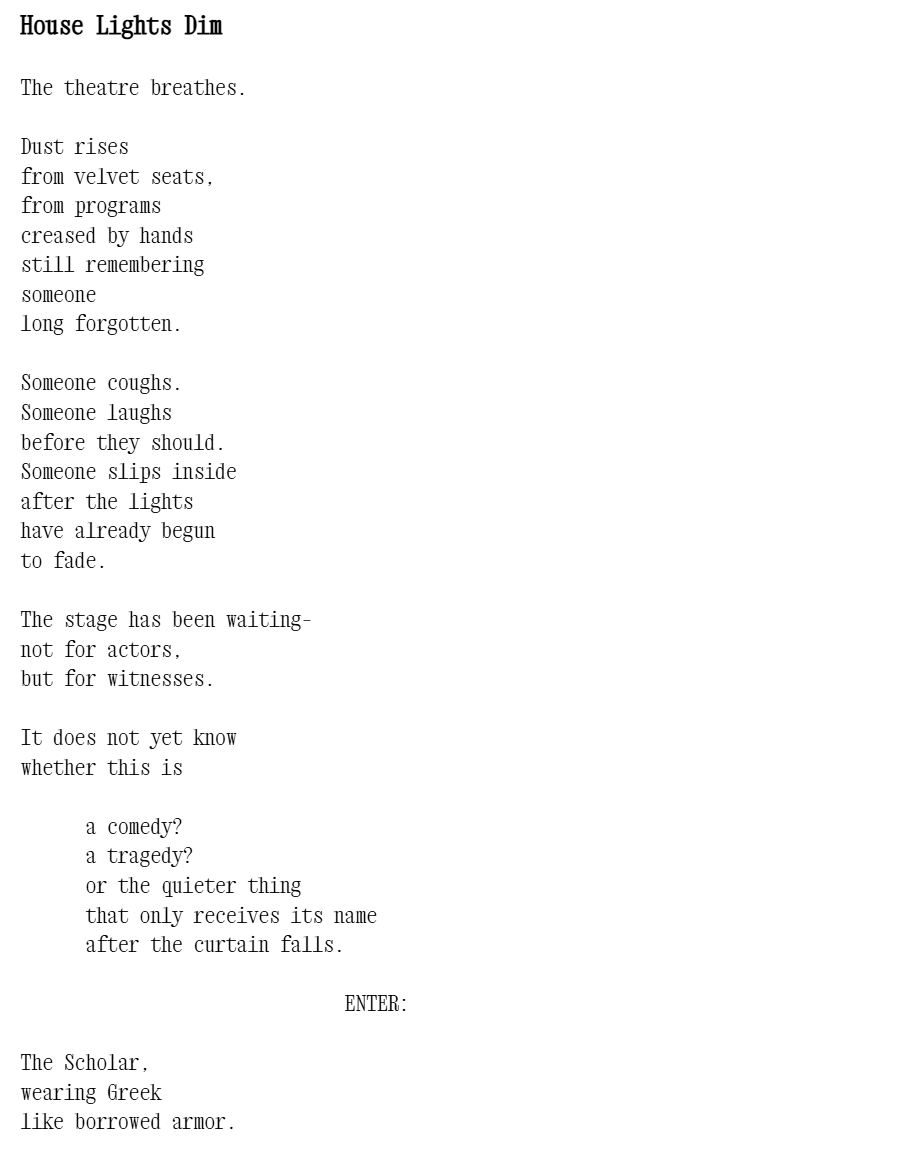

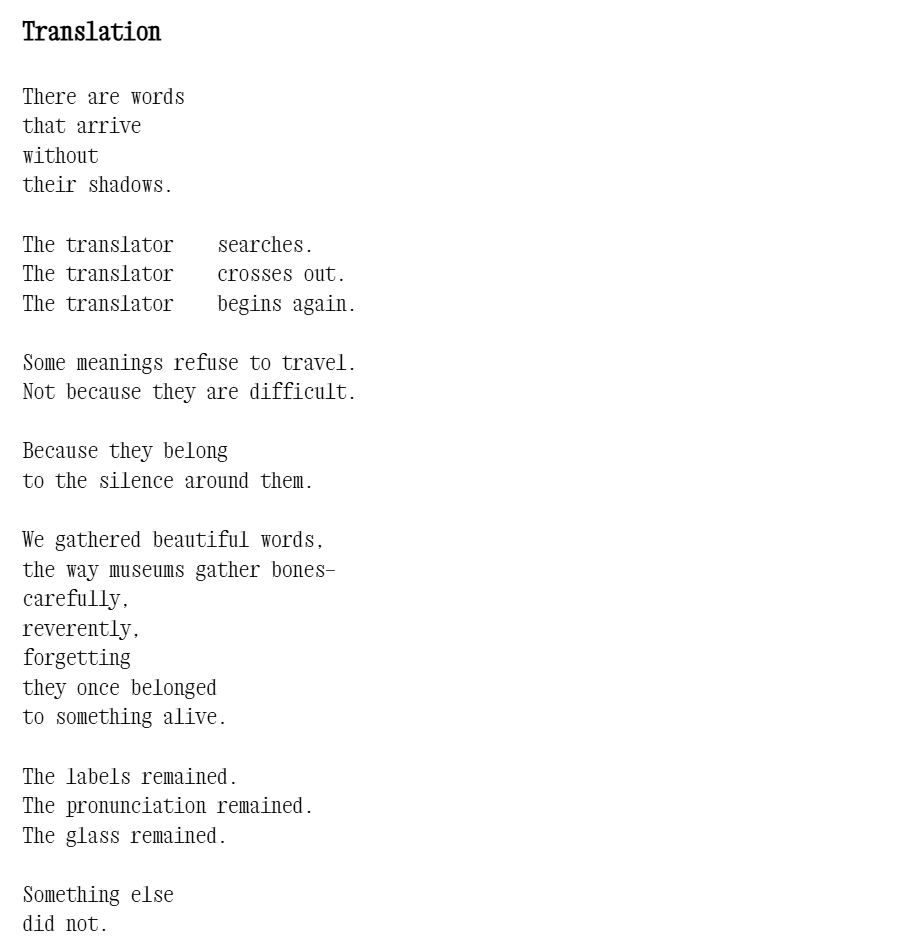
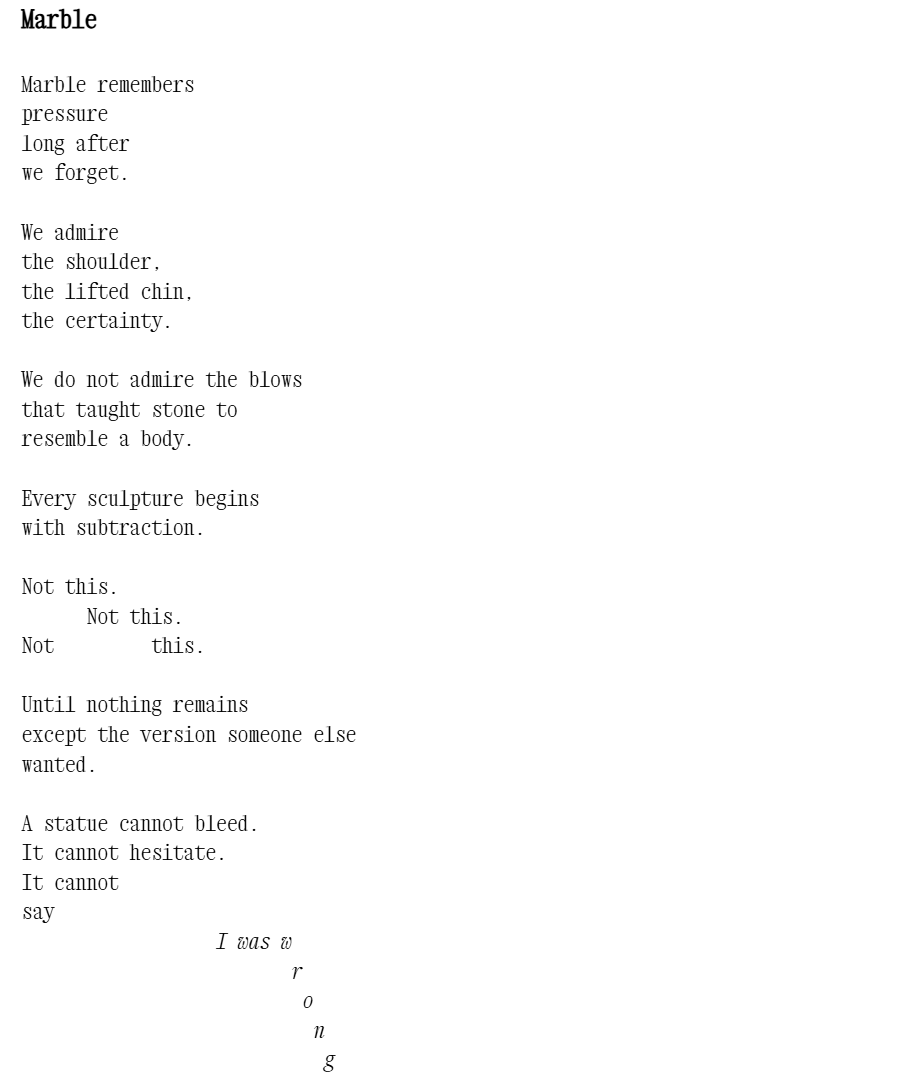
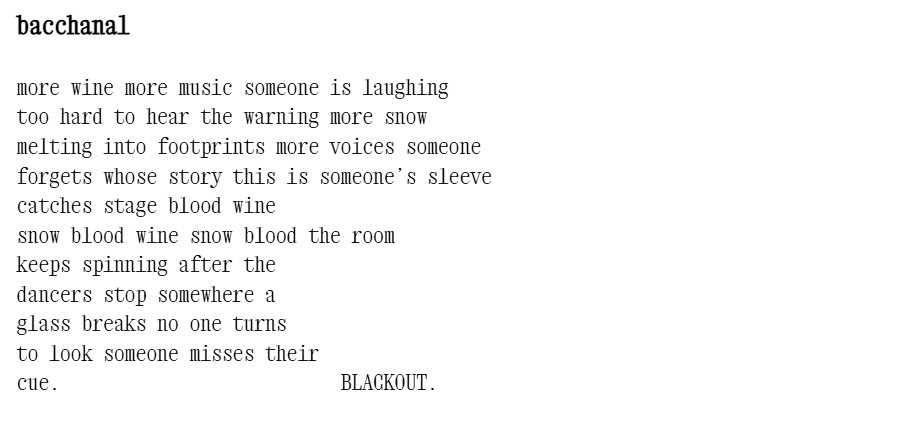
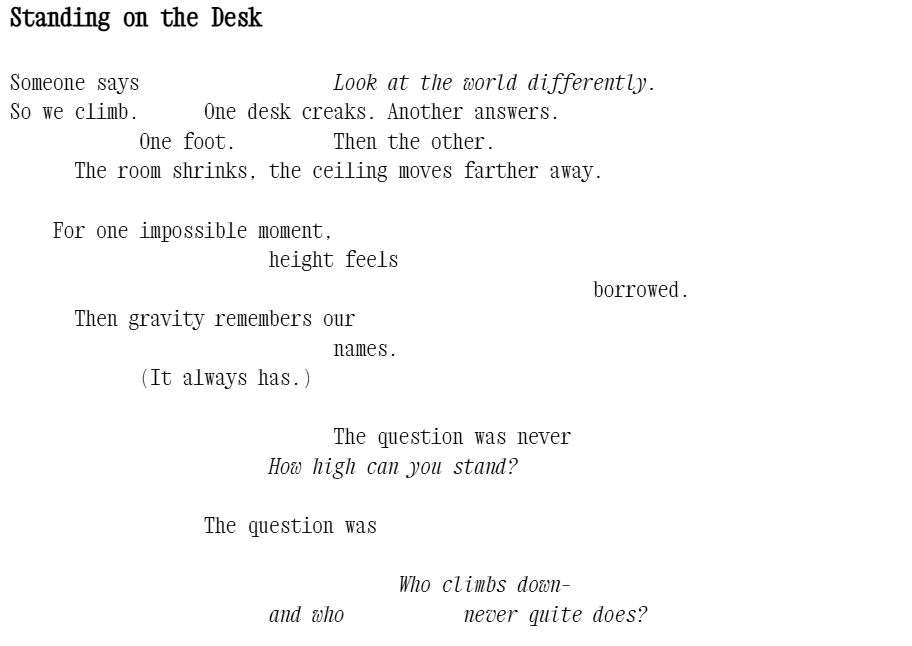
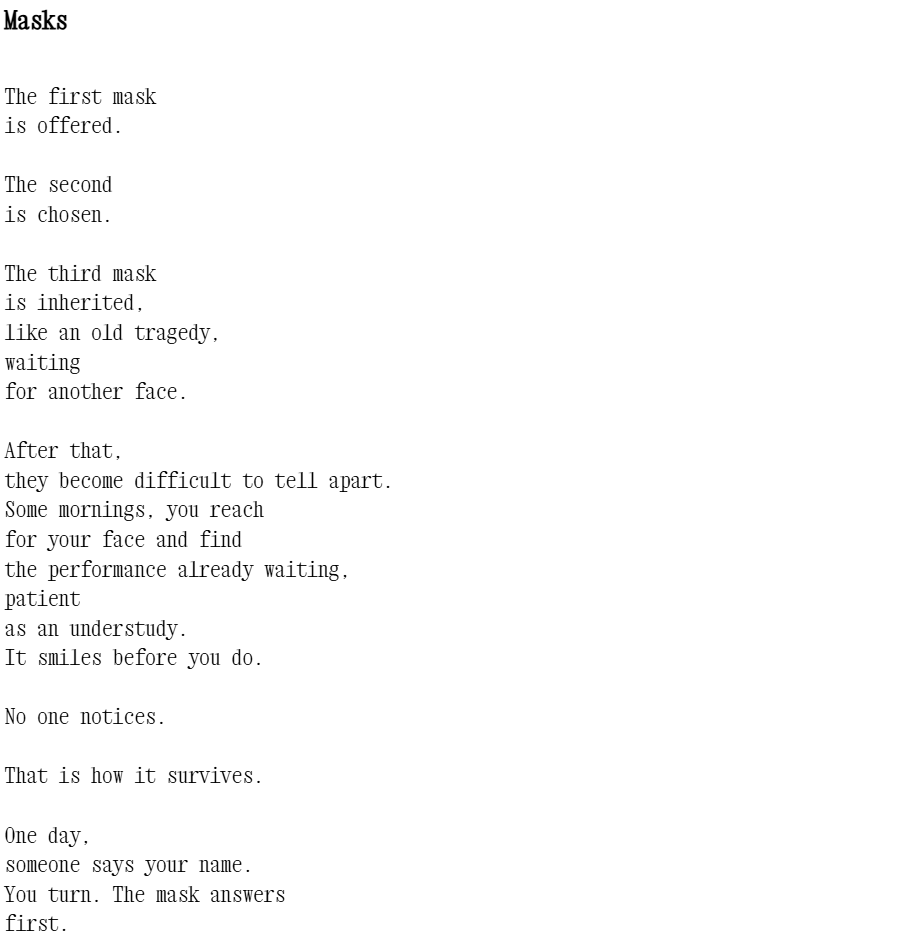
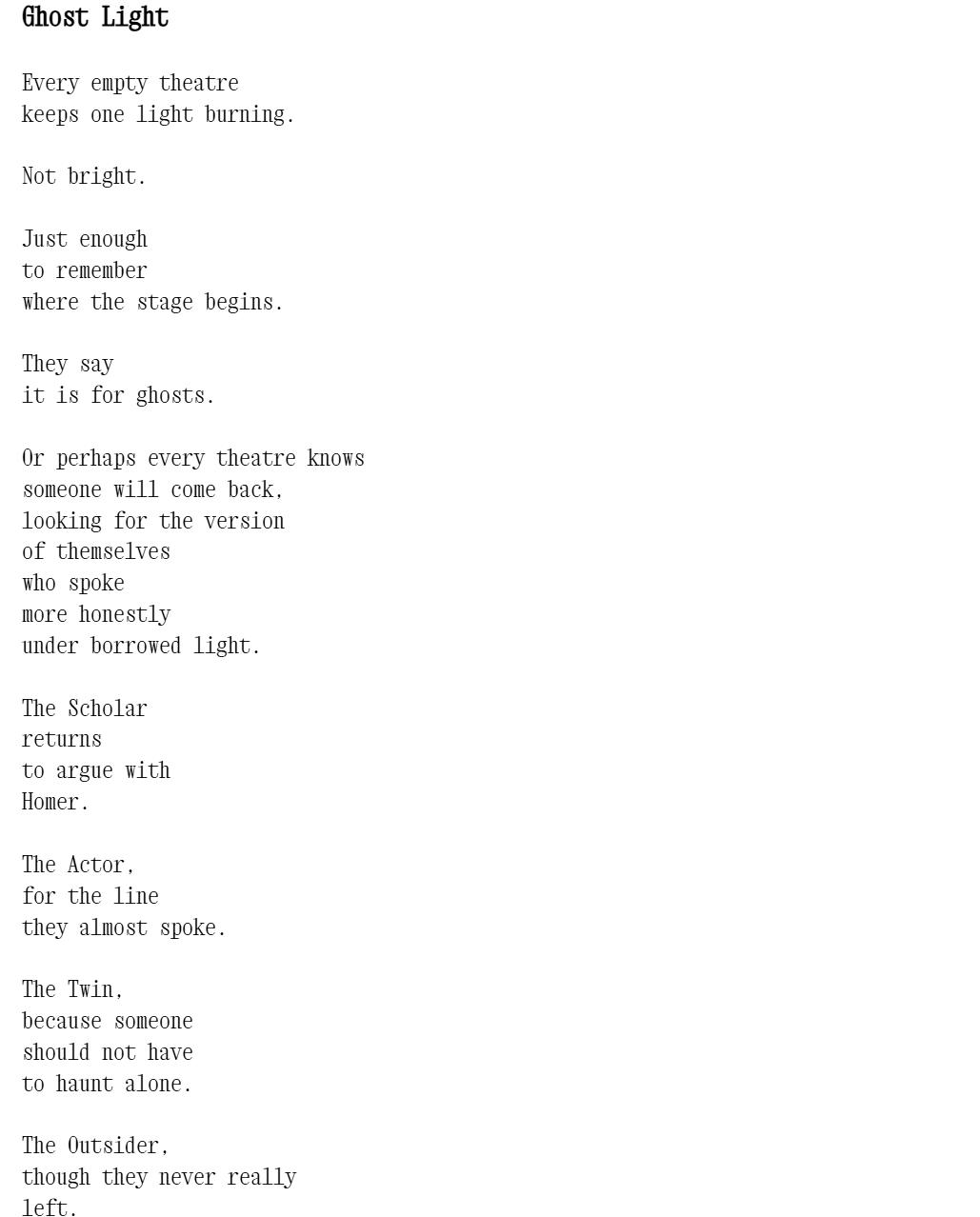

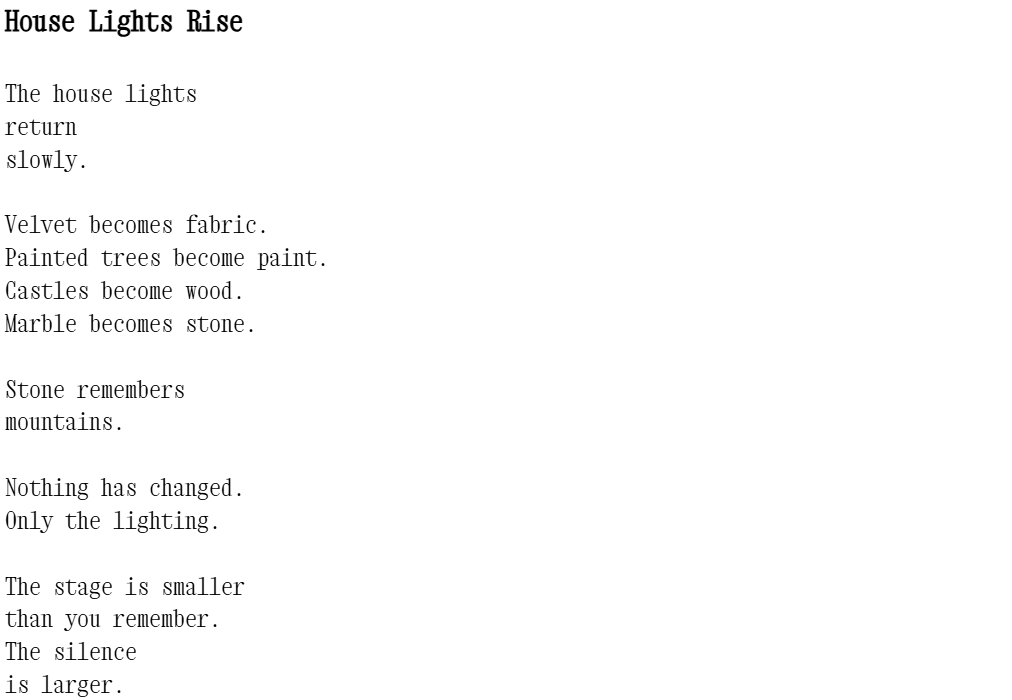
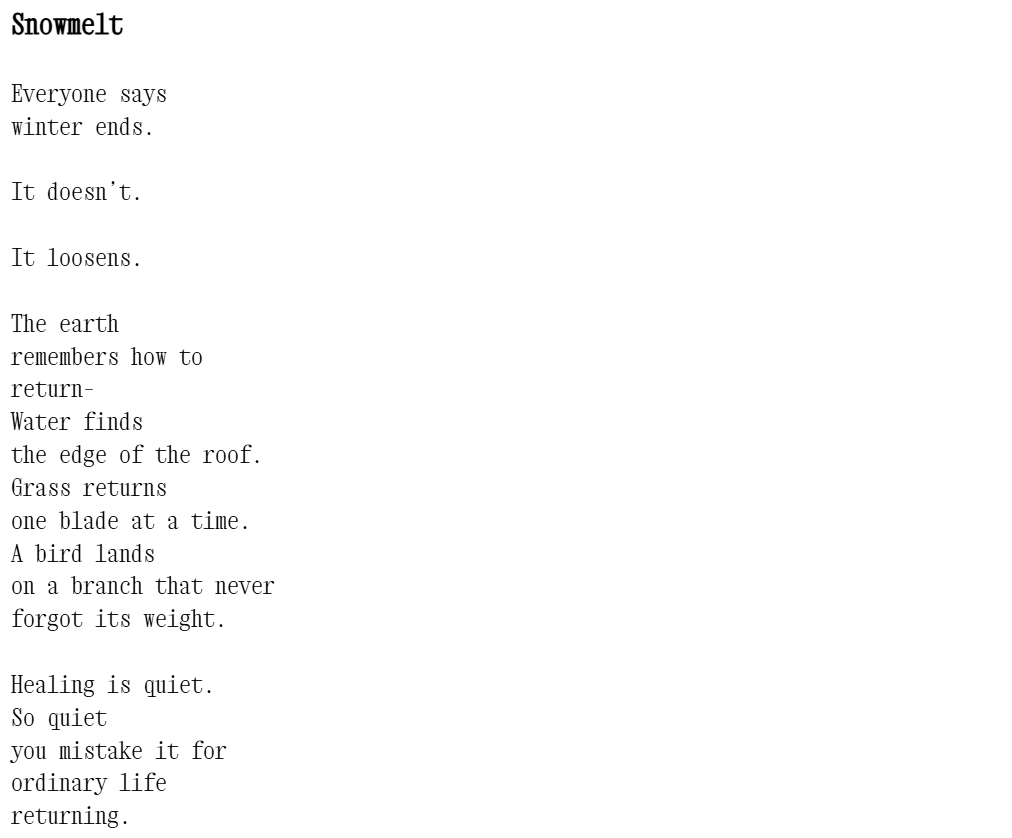
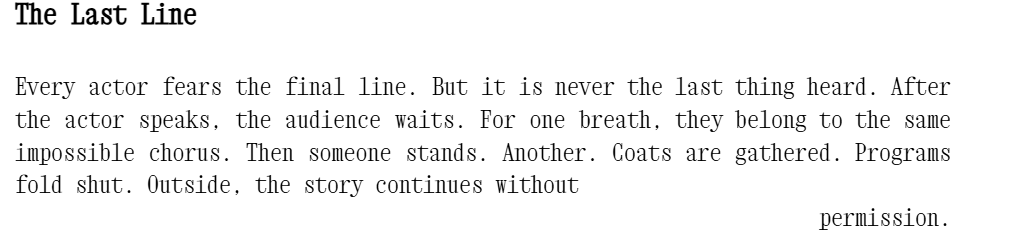
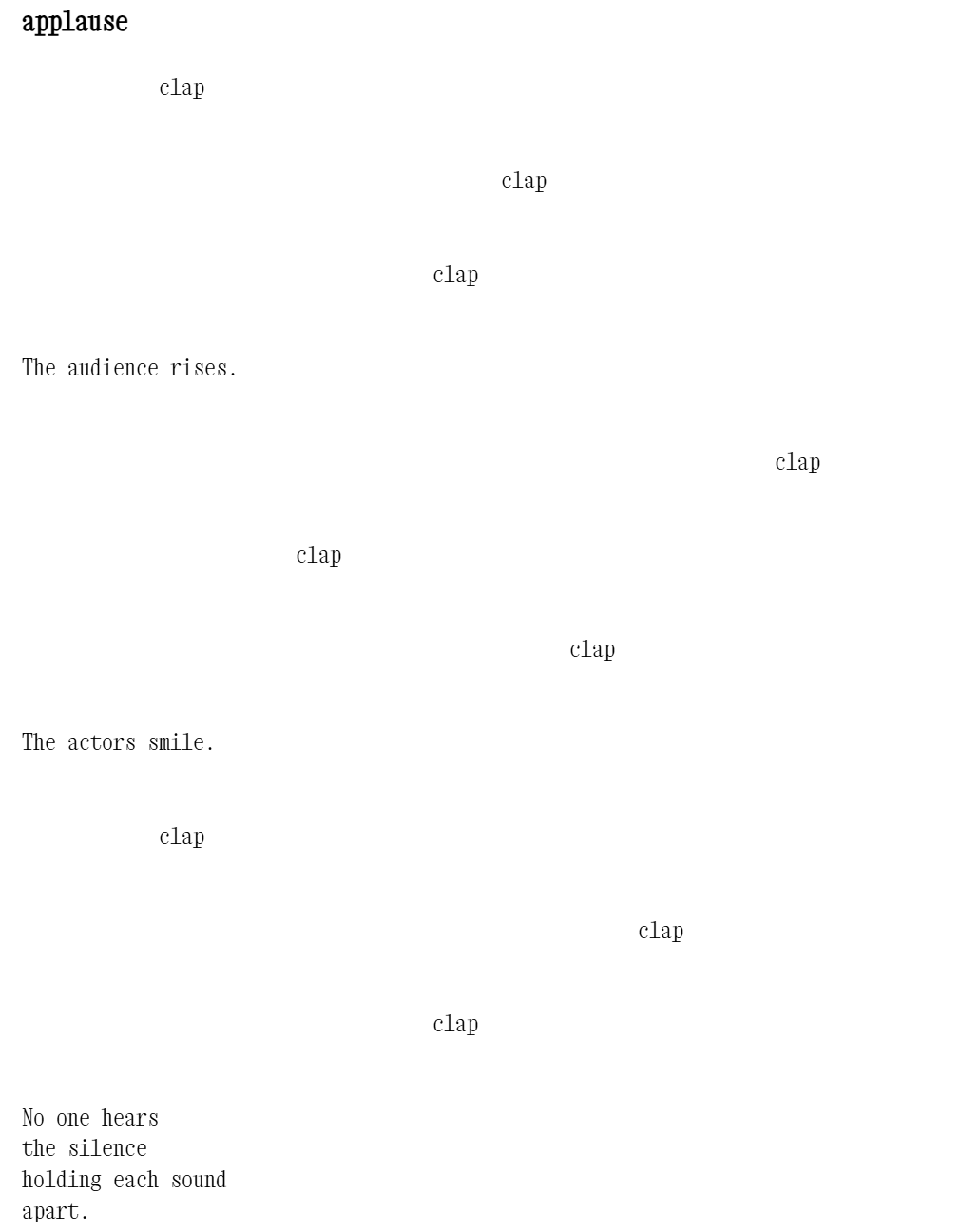
Last edited by TokoWrites (July 30, 2026 22:20:40)
- TokoWrites
-
Scratcher
500+ posts
✮ ~ Toko's Writing Thread ~ ✮
author's note
thank you so much to snowy, kiara, and vicky for critiquing, and to an irl friend for reading the first draft, encouraging me to keep going, and above all, for introducing me to the secret history and dead poets society! i am forever indebted to you <33
and to dead poets society, the secret history, and if we were villains - thank you for the classrooms, the theatres, the margins, the snow, and for proving that some stories don't end with the final page, closing scene, or curtain call. they simply become conversations someone else continues!
title inspired by shakespeare's “exit, pursued by a bear”
link to the piece!
thank you so much to snowy, kiara, and vicky for critiquing, and to an irl friend for reading the first draft, encouraging me to keep going, and above all, for introducing me to the secret history and dead poets society! i am forever indebted to you <33
and to dead poets society, the secret history, and if we were villains - thank you for the classrooms, the theatres, the margins, the snow, and for proving that some stories don't end with the final page, closing scene, or curtain call. they simply become conversations someone else continues!
title inspired by shakespeare's “exit, pursued by a bear”
link to the piece!
Last edited by TokoWrites (July 31, 2026 00:58:57)
- TokoWrites
-
Scratcher
500+ posts
✮ ~ Toko's Writing Thread ~ ✮
.
Last edited by TokoWrites (July 30, 2026 22:28:10)
- TokoWrites
-
Scratcher
500+ posts
✮ ~ Toko's Writing Thread ~ ✮
mabel app critique!
about me:
- i love how personality-filled this is!! the books, guitar, mangoes, dogs, ice cream, ikea, etc. make you feel like an actual person!
- i think you could potentially elaborate a tiny bit more on one or two interests instead of mentioning so many? for example, you could talk about why you love caraval/inheritance games or what you like about playing guitar. that could make the section feel more memorable rather than just being a list of things you enjoy?
- also, “musically infested” made me pause. not sure if that is on purpose or not but i do really like it!
- i really like the opening and ending, though. they both have personality without being too unserious!
experience:
- i think this is one of your strongest sections because you don't just list your experience - you actually explain what you've learned from it!
- i especially like the perfectionism paragraph. admitting that you struggled with something and explaining how you've changed because of it makes your reflection feel genuine!
- i think you could elaborate on this even more by giving one concrete example of how your leadership changed between july 2025 and march 2026. like, what specifically did you do differently that made the second cabin better? that would make the growth you're talking about much more tangible!
- similarly, the commitment paragraph is really good because you're taking accountability for a mistake. you could maybe explain briefly what you learned from that experience in practice and how you'd prevent it from happening again?
- your outside-of-scratch experience is also really interesting! maybe elaborate a little more on one specific charity event/social justice project you helped organize and what your role was? right now it tells us you have leadership experience outside of swc, but an example would show us what that actually looks like!
cabin preferences:
- both ideas sound really fun and very swc-y!! the riddles/puzzles/collaboration give both cabins a lot of potential!
- maybe mention whether campers need to know the books beforehand. since they're based on existing series, saying something like “no prior knowledge of the books would be required” might make one of these ideas more likely to be chosen?
- you could also explain why you chose each book beyond simply loving it. what about caraval makes it especially suited to an swc cabin? what about the grandest game makes it work well for a mystery/thriller cabin?
time dedication + management:
- i really like how specific you are here! giving actual estimates is much better than just saying you'll “be active.”
- i especially like that you acknowledge breaks and prioritizing life. that makes your dedication sound sustainable rather than like you're promising to be online 24/7.
- the calendar idea is GREAT. i'd definitely elaborate on this because it's one of your most concrete ideas. what exactly would go on the calendar? deadlines? activity dates? leader responsibilities? check-ins? who would maintain it? how would it help prevent things from getting lost?
- your monday/saturday/sunday availability is useful, but you could maybe explain why this matters to how your team should plan around you. it feels a little bit thrown in there?
- “The method that works best for me to keep me organized it” - the wording here is a bit confusing. i think you mean “is” instead of “it,” and overall the sentence feels a bit run-on-y to me.
communication + accountability:
- i really like the self-awareness here, especially admitting that you've struggled with communication and can sometimes be passive. it feels much more genuine than claiming you're an amazing communicator with no weaknesses!
- i think you could elaborate more on what you'd do if a co-leader wasn't communicating/responding?
- similarly, you talk about holding people accountable through check-ins, which is good, but what happens if someone repeatedly misses deadlines? would you talk to them privately? redistribute tasks? ask another co-leader for help? you don't have to make it super serious, but showing that you have a plan would strengthen this!
- the distinction between communication and accountability could also be clearer because they overlap a little right now.
- i LOVE the part about building friendships outside of cabin planning. i'd actually elaborate on this because it's a really good leadership philosophy. you could also explain how knowing your co-leaders personally can make it easier to communicate honestly, resolve disagreements, and understand each other's working styles!!
- also, there's an unfinished sentence at “when one.” definitely catch that before submitting!!
cabin atmosphere:
- i like the atmosphere description a lot!! it's concise but gives a clear idea of what you want the cabin to feel like.
- you could also elaborate on how you'd make the cabin inclusive for quieter campers. since you specifically talk about wanting campers to feel comfortable approaching you, it would be interesting to connect that here - e.g. how would you make sure participation doesn't only revolve around the loudest/more active campers?
- i also like the balance between competition and wellbeing. i'd emphasize that a little because it's a nice part of your cabin philosophy!
scenario a:
- i agree with the overall response completely, and your empathy comes through really well.
- however, maybe cut down the first paragraph about trying to prevent the situation? the question is specifically asking what you'd do if it happened, so you want to get into your response pretty quickly.
- i'd also make your response a little more concrete. after reassuring them that their wellbeing comes first, what would you actually offer? maybe taking a break, stepping away from the word goal, doing a smaller writing activity, or just letting them know they don't have to participate for a while.
- i think you could also elaborate on the boundaries point. what would you do if they don't want to talk about what's overwhelming them? what if they just say “i'm fine” but clearly aren't? showing that you wouldn't pressure them would make this answer even stronger.
- basically, you've got the emotional response down really well but maybe add a little more of the practical response?
swc impact:
- honestly, this is probably my favorite section!! it feels really personal, and i love that you connect your own experience as a camper to the kind of leader you want to be.
- the “kid's coding website” line is so cute <33
- the part about being afraid to approach leaders is especially strong. i'd definitely keep that and maybe elaborate on why you think campers feel intimidated and what specific things you'll do differently as a leader?
- i also really like the idea of answering qotds, being active in main cabin, and showing cabin spirit!
- the ending is sweet, but there are a few places where you repeat the idea of making a memorable/welcoming cabin. you could cut some repetition and use that space to explain what you hope a camper remembers about your cabin months/years later. i think that could make the ending really powerful!!
little things i'd fix before submitting:
overall, i genuinely really love your application!! it’s really well-written and you do a great job balancing professionalism with your personality, so it never feels like you’re forcing yourself to sound like a “perfect” leader. i think your strongest qualities really shine through, especially your self-awareness, empathy, experience, and how much you genuinely care about making swc a welcoming and memorable place for campers!! i also really like how reflective you are throughout the app - you’re not afraid to acknowledge things you’ve struggled with or mistakes you’ve made, but you always explain how you’ve grown from them, which makes your answers feel much more genuine. the main thing i’d focus on before submitting is elaborating on some of your strongest points with specific examples, while cutting down some repetition so your best ideas stand out even more! but genuinely, this is such a strong app and i had a lot of fun reading it!! good luck, although i honestly don't think you'll need it <33
about me:
- i love how personality-filled this is!! the books, guitar, mangoes, dogs, ice cream, ikea, etc. make you feel like an actual person!
- i think you could potentially elaborate a tiny bit more on one or two interests instead of mentioning so many? for example, you could talk about why you love caraval/inheritance games or what you like about playing guitar. that could make the section feel more memorable rather than just being a list of things you enjoy?
- also, “musically infested” made me pause. not sure if that is on purpose or not but i do really like it!
- i really like the opening and ending, though. they both have personality without being too unserious!
experience:
- i think this is one of your strongest sections because you don't just list your experience - you actually explain what you've learned from it!
- i especially like the perfectionism paragraph. admitting that you struggled with something and explaining how you've changed because of it makes your reflection feel genuine!
- i think you could elaborate on this even more by giving one concrete example of how your leadership changed between july 2025 and march 2026. like, what specifically did you do differently that made the second cabin better? that would make the growth you're talking about much more tangible!
- similarly, the commitment paragraph is really good because you're taking accountability for a mistake. you could maybe explain briefly what you learned from that experience in practice and how you'd prevent it from happening again?
- your outside-of-scratch experience is also really interesting! maybe elaborate a little more on one specific charity event/social justice project you helped organize and what your role was? right now it tells us you have leadership experience outside of swc, but an example would show us what that actually looks like!
cabin preferences:
- both ideas sound really fun and very swc-y!! the riddles/puzzles/collaboration give both cabins a lot of potential!
- maybe mention whether campers need to know the books beforehand. since they're based on existing series, saying something like “no prior knowledge of the books would be required” might make one of these ideas more likely to be chosen?
- you could also explain why you chose each book beyond simply loving it. what about caraval makes it especially suited to an swc cabin? what about the grandest game makes it work well for a mystery/thriller cabin?
time dedication + management:
- i really like how specific you are here! giving actual estimates is much better than just saying you'll “be active.”
- i especially like that you acknowledge breaks and prioritizing life. that makes your dedication sound sustainable rather than like you're promising to be online 24/7.
- the calendar idea is GREAT. i'd definitely elaborate on this because it's one of your most concrete ideas. what exactly would go on the calendar? deadlines? activity dates? leader responsibilities? check-ins? who would maintain it? how would it help prevent things from getting lost?
- your monday/saturday/sunday availability is useful, but you could maybe explain why this matters to how your team should plan around you. it feels a little bit thrown in there?
- “The method that works best for me to keep me organized it” - the wording here is a bit confusing. i think you mean “is” instead of “it,” and overall the sentence feels a bit run-on-y to me.
communication + accountability:
- i really like the self-awareness here, especially admitting that you've struggled with communication and can sometimes be passive. it feels much more genuine than claiming you're an amazing communicator with no weaknesses!
- i think you could elaborate more on what you'd do if a co-leader wasn't communicating/responding?
- similarly, you talk about holding people accountable through check-ins, which is good, but what happens if someone repeatedly misses deadlines? would you talk to them privately? redistribute tasks? ask another co-leader for help? you don't have to make it super serious, but showing that you have a plan would strengthen this!
- the distinction between communication and accountability could also be clearer because they overlap a little right now.
- i LOVE the part about building friendships outside of cabin planning. i'd actually elaborate on this because it's a really good leadership philosophy. you could also explain how knowing your co-leaders personally can make it easier to communicate honestly, resolve disagreements, and understand each other's working styles!!
- also, there's an unfinished sentence at “when one.” definitely catch that before submitting!!
cabin atmosphere:
- i like the atmosphere description a lot!! it's concise but gives a clear idea of what you want the cabin to feel like.
- you could also elaborate on how you'd make the cabin inclusive for quieter campers. since you specifically talk about wanting campers to feel comfortable approaching you, it would be interesting to connect that here - e.g. how would you make sure participation doesn't only revolve around the loudest/more active campers?
- i also like the balance between competition and wellbeing. i'd emphasize that a little because it's a nice part of your cabin philosophy!
scenario a:
- i agree with the overall response completely, and your empathy comes through really well.
- however, maybe cut down the first paragraph about trying to prevent the situation? the question is specifically asking what you'd do if it happened, so you want to get into your response pretty quickly.
- i'd also make your response a little more concrete. after reassuring them that their wellbeing comes first, what would you actually offer? maybe taking a break, stepping away from the word goal, doing a smaller writing activity, or just letting them know they don't have to participate for a while.
- i think you could also elaborate on the boundaries point. what would you do if they don't want to talk about what's overwhelming them? what if they just say “i'm fine” but clearly aren't? showing that you wouldn't pressure them would make this answer even stronger.
- basically, you've got the emotional response down really well but maybe add a little more of the practical response?
swc impact:
- honestly, this is probably my favorite section!! it feels really personal, and i love that you connect your own experience as a camper to the kind of leader you want to be.
- the “kid's coding website” line is so cute <33
- the part about being afraid to approach leaders is especially strong. i'd definitely keep that and maybe elaborate on why you think campers feel intimidated and what specific things you'll do differently as a leader?
- i also really like the idea of answering qotds, being active in main cabin, and showing cabin spirit!
- the ending is sweet, but there are a few places where you repeat the idea of making a memorable/welcoming cabin. you could cut some repetition and use that space to explain what you hope a camper remembers about your cabin months/years later. i think that could make the ending really powerful!!
little things i'd fix before submitting:
overall, i genuinely really love your application!! it’s really well-written and you do a great job balancing professionalism with your personality, so it never feels like you’re forcing yourself to sound like a “perfect” leader. i think your strongest qualities really shine through, especially your self-awareness, empathy, experience, and how much you genuinely care about making swc a welcoming and memorable place for campers!! i also really like how reflective you are throughout the app - you’re not afraid to acknowledge things you’ve struggled with or mistakes you’ve made, but you always explain how you’ve grown from them, which makes your answers feel much more genuine. the main thing i’d focus on before submitting is elaborating on some of your strongest points with specific examples, while cutting down some repetition so your best ideas stand out even more! but genuinely, this is such a strong app and i had a lot of fun reading it!! good luck, although i honestly don't think you'll need it <33
- TokoWrites
-
Scratcher
500+ posts
✮ ~ Toko's Writing Thread ~ ✮
Toko's SWC Leader App
About Me
Hi! I’m Toko, I use any pronouns, and I live in the wonderful PST/PDT timezone. I’m a writer, reader, baker, and general enthusiast of making small things that probably did not need to exist—but I’m very glad they do! I love baking (and more recently, experimenting with cooking), going on runs, journaling, and making tiny trinkets and gifts for people. There’s a decent chance that if I show up to school with a bag, it contains either baked goods or some extremely specific little craft I decided someone needed.
I’m also a very enthusiastic reader! I especially love poetry, historical fiction, and realistic fiction, although I’ll happily pick up almost anything if it catches my attention. Some of my favorite books I’ve read this year are I Who Have Never Known Men by Jacqueline Harpman, The Lilac People by Milo Todd, and On Earth We’re Briefly Gorgeous by Ocean Vuong. I love books that leave me thinking about them long after I’ve finished reading, whether because of a particularly strange idea, a beautiful sentence, or a character I have become far too emotionally invested in!
Music is another constant in my life. My taste is eclectic enough that I’ve mostly given up trying to name the genres I listen to, so you’ll almost always find me with something playing in the background. I make playlists for practically every occasion, including my writing projects and individual characters, because apparently fictional people need curated soundtracks too.
More than anything, I’d say I’m someone who pays attention to small details. I like noticing the tiny things that make a person, place, story, or moment feel real—the oddly specific object on someone’s desk, a line in a poem that makes you stop reading for a second, the song that becomes permanently attached to a memory. I think those little things are often where the most interesting stories hide, and I’m always happy to go looking for them.
Previous Participation
This will be my seventh session of SWC, after camping in in Script, Fan-Fi, Tragicomedy, and Lyric, as well as co-leading Magreal and Paranormal. Over the years, SWC has become a space where I’ve grown both as a writer and as a co-leader, and I’m really glad I’ve gotten to experience it from different perspectives.
I’m currently a host of WUC (Writing Universe Camp), where I’ve (co)led three cabins, and I’ve also led a cabin for JWC. Each of those experiences has taught me something different about leadership and community-building, from balancing structure with spontaneity and adapting to different group dynamics to making sure people feel comfortable enough to share their work, take creative risks, and have fun.
My writing experience is similarly wide-ranging. I love experimenting with different genres and forms, and I’m always interested in finding new ways to tell a story rather than settling into one particular style. I’ve also been fortunate enough to win a few writing awards and competitions, both on and off Scratch. While those have definitely helped boost my confidence, I think what I value most about them is that they’ve encouraged me to keep pushing myself and trying things outside my comfort zone. I want to keep approaching writing with curiosity rather than worrying too much about whether I’m doing it “right.”
Outside of Scratch, I’ve had the opportunity to take on leadership roles in several different communities. I’ve stage-managed and assistant-directed multiple shows in my school’s theatre department, where I’ve learned how to stay organized, communicate clearly, and keep a project moving even when approximately seventeen different things are happening at once. I also co-lead an affinity group and poetry club, work as a fellow at my school’s Writing Center, and serve on the advisory board for a creative writing program. These experiences have taught me how to listen closely, facilitate conversations, work with people who have different needs and perspectives, and support someone else’s ideas without trying to take over their creative process.
All of these experiences have shaped how I approach leadership. I’ve learned that good leadership isn’t necessarily about having the loudest voice or the perfect plan—it’s about paying attention, knowing when to step in and when to give people room, and helping create an environment where everyone feels like they belong. I try to balance organization with flexibility, enthusiasm with empathy, and structure with enough room for a little chaos. After six sessions of SWC, I’m still excited to come back because I love getting to help build the kind of community that made me want to stay in the first place.
Cabin Preferences
Since I’m applying only for co-leader, I’m pretty flexible when it comes to cabins! I think it would be fun to be dropped into a genre or concept I might not have chosen for myself and then figure out what I can do with it. That said, poetry and mythology especially catch my attention since those are two of my favorite genres. I’d also be happy with TCTWNW.
Ultimately, I care more about the community than the competition. I’d love to help create a space where people feel comfortable being silly, experimenting with their writing, and sharing half-formed ideas. I think a good cabin can be both genuinely supportive and genuinely fun, and I’d want to help make it a place people look forward to coming back to each day.
Time Management & Dedication
I expect to be able to dedicate at least an hour a day to SWC throughout September, October, and November, with more flexibility on weekends and the ability to check in throughout the day when needed.
There are a few periods where my availability will look a little different. November 6–8 will be my school play’s show days, so I’ll be significantly less available during those three days. I’ll still make time for SWC when I can (and I will, of course, always find time for Cabin Wars!), but I know I’ll need to prioritize theatre during the performances. From November 18–28, I’ll be on Thanksgiving break and should generally have more time for SWC, although I’ll be traveling on some of those days—likely November 18, 21 or 22, and 28—and I may be mostly offline. I’ll also be in the EST timezone during that stretch, which may make my usual activity hours look a little different.
Overall, I’m confident that I’ll be able to stay consistently involved. I’m used to balancing SWC with school, theatre, and other commitments, and I plan around busy periods rather than assuming I’ll somehow find extra time later. If anything unexpected comes up, I’ll communicate as early as possible so my co-leaders and hosts know what’s going on and we can make sure nothing gets dropped.
Time management is something I’ve learned largely through having a tendency to say “yes!” to approximately everything I find interesting. Between school, writing, theatre, leadership roles, and other commitments, I’ve had to become pretty intentional about managing both my time and my energy.
I rely heavily on lists and calendars to keep track of deadlines, responsibilities, and the small tasks that are easy to forget when there are a lot of moving pieces. For SWC specifically, I’d use those systems to keep track of cabin responsibilities, deadlines, planned activities, and anything I’ve told my team I’ll handle. I also like breaking larger projects into smaller steps, which makes it much easier to figure out what actually needs to happen today instead of staring at a giant task and hoping it becomes less intimidating on its own.
I’ve also learned how to prioritize. Not everything can be the most important thing at the same time, so when several responsibilities overlap, I decide what needs attention immediately, what can wait, and what can be delegated or simplified. I try to plan ahead for especially busy periods and leave myself some flexibility rather than scheduling every minute.
I can still be prone to overcommitting when I’m excited about something, so I’ve become much more conscious of pacing myself and being realistic about what I can take on. For me, good time management isn’t about filling every available minute—it’s about making sure that when I commit to something, I can actually show up for it. That’s something I want to bring to SWC as a co-leader: reliability, organization, and enough flexibility to handle the inevitable chaos!
Communication and Accountability
I would describe my communication style as clear, proactive, and collaborative. I like making sure everyone is on the same page, especially when a project has a lot of moving pieces, so I tend to communicate decisions, expectations, and changes rather than assuming everyone knows what is happening. I also try to be approachable when something isn’t working. I would much rather someone tell me early that they are confused, overwhelmed, or unsure about something than feel like they have to figure it out alone.
In practice, this means I’d rather overcommunicate than leave people guessing. At the beginning of a session, I’d want my (co)leaders and me to establish who is handling which responsibilities, what our general availability looks like, and how we want to communicate when something changes. If I’m planning an activity, I’d let my team know what I’m thinking before it becomes a finished plan rather than disappearing for three days and returning with a twenty-one-page document. If something changes, I’ll say so. If I don’t understand something, I’ll ask. And if I notice that we’ve stopped communicating as much as we were before, I’d rather check in than assume everything is fine.
When I’m working on a team, I think accountability starts with being accountable to the team myself. If I say I’ll do something, I make sure it gets done, and if something changes or I realize I won’t be able to meet an expectation, I’ll communicate that as early as possible. I also like having clear divisions of responsibility so that everyone knows what they are responsible for and can trust that other people will handle their parts. For me, accountability should feel less like keeping score and more like making sure everyone has what they need to do their job well.
When someone else isn’t following through, I’d try to address it directly but kindly. I don’t want to assume that someone is being careless when there might be a reason they’re struggling, so I’ll start by checking in and figuring out what’s going on. If they’re overwhelmed, I’d rather work out what can be redistributed or postponed than simply tell them to work harder. If the problem is unclear expectations, I’d make those expectations more concrete. And if something genuinely needs to be addressed, I won’t let it quietly become everyone else’s problem just because the conversation is uncomfortable.
One thing I’ve had to work on is becoming more comfortable with those difficult conversations. I sometimes hesitate to point out a small problem because I don’t want to create unnecessary tension, especially when I care about maintaining a positive group dynamic. Over time, though, I’ve learned that clear communication can actually prevent tension rather than cause it. I’m much more willing now to ask questions, clarify expectations, or respectfully say when something needs to change. I think that balance—being kind without being afraid to be direct—is especially important in a leadership team, where people need to feel both supported and able to rely on one another.
Scenario D
I would start by figuring out why we’ve fallen behind rather than immediately trying to make everyone work faster. If the team is stressed, there’s probably a reason for it, whether we’ve taken on too much, haven’t divided responsibilities clearly enough, or have simply had a particularly busy few days. I’d want to understand the problem before trying to solve it.
First, I’d have a quick conversation with the leadership team about what is currently unfinished and what is making it difficult to get done. I’d separate things that are genuinely time-sensitive from things that would be nice to have but could be simplified, postponed, or dropped entirely. I’d also ask each person what they realistically have the capacity to handle rather than dividing up the remaining work based only on what seems equal on paper.
From there, I’d turn the remaining work into a short, concrete plan. We could divide larger tasks into smaller pieces, assign clear responsibilities, and set realistic deadlines for the most important things. If someone has too much on their plate, I’d redistribute some of it to myself or another co-leader. I’d also make sure everyone knows that they can say if a deadline or assignment isn’t realistic instead of quietly struggling with it.
I’d want to check in again after we’ve had some time to work. Falling behind once is manageable; continuing to fall behind because nobody revisited the plan is much harder to fix. A short check-in would let us see what has actually gotten done, adjust responsibilities if necessary, and catch problems before they turn into another backlog.
Most importantly, I wouldn’t want the conversation to become about who is at fault. Falling behind is something the leadership team needs to solve together, and blaming individuals would probably make an already stressful situation worse. I’d focus on what we can change going forward and how we can support each other in getting back on track.
I’d also try to keep some of the fun in the process. SWC is supposed to be enjoyable, and I don’t think getting behind means the entire cabin experience has to become a productivity crisis. Sometimes a little humor, a reset, or one small achievable goal can do more for a stressed team than another giant list of things they need to accomplish. My goal would be for everyone to leave the conversation knowing exactly what needs to happen next—and feeling like we can handle it together.
SWC Impact
When I found SWC, I was feeling pretty lost. I wasn’t sure where I fit in with the people around me, and I was even less sure of how to understand myself. I discovered SWC in March 2024, but I didn’t become especially involved that session. Even so, something about knowing that this community was there stuck with me.
When I came back in March 2025, I was in a very different place. I needed somewhere that didn’t come with all of the assumptions attached to knowing me in real life. SWC gave me room to figure things out at my own pace. Through writing, conversations, and simply being around people who knew me only as the person I chose to be online, I was able to explore parts of my identity that I had been struggling to understand. I don’t think SWC magically gave me all the answers, but it gave me somewhere safe enough to ask the questions.
That has probably been the biggest impact SWC has had on me. It taught me that figuring yourself out doesn’t have to happen all at once. Sometimes it looks like trying on a new idea, writing something you wouldn’t normally write, talking to someone you met five minutes ago, or realizing that you feel more comfortable being yourself than you expected. Writing became part of that process for me. It gave me a way to put thoughts into words before I necessarily understood them, and sometimes I understood myself a little better because I had tried to write something down.
I think that experience is also what I most want to give back. I know what it feels like to arrive somewhere without really knowing where you belong yet, and I know that not everyone who needs a community is going to announce that they need one. Some people will be talkative immediately; others might spend most of the first week quietly reading cabin messages before they feel comfortable joining in. I want to make sure both kinds of campers have a place in my cabin.
As a co-leader, I’d make a point of paying attention to who is actually participating rather than assuming that the most visible campers are the only ones who need support. I’d regularly check cabin comments and respond when campers have questions, and I’d make an effort to start conversations that give quieter campers an easy way to join without putting them on the spot. If someone consistently seemed disconnected, I’d check in privately rather than calling attention to it in front of everyone. I’d also make sure that enthusiasm goes beyond word count: if someone shares a paragraph they’re proud of, a strange idea, or even something they think is terrible, I want them to get a response that makes them want to share something again.
I’d also like to be someone campers can actually approach. I remember how intimidating leaders could seem to me when I was newer to SWC, so I want to make that barrier as small as possible. That means being active in the cabin, answering questions without making people feel silly for asking them, joining in on cabin conversations myself, and letting campers see me as a person rather than just the person who tells them when the next activity is due.
More than anything, I want to give other people the kind of space SWC gave me: a place to create, meet people, try things out, and maybe discover something about themselves along the way. SWC has genuinely had a life-changing impact on me, and I don’t think I could ever fully repay a community for that. What I can do is help make sure that someone else who arrives feeling lost can leave feeling a little more like they belong.
Atmosphere
A relaxed and welcoming cabin where creativity comes first, friendships grow naturally, and campers feel encouraged to participate without pressure. (148 characters)
I’d want my cabin to feel relaxed and welcoming, with creativity and friendship at its center. I want campers to feel like they can participate without worrying about being the loudest person in the cabin or having the highest word count. I’d encourage conversation and cabin bonding through small, spontaneous activities rather than making everything feel like an obligation.
A lot of that atmosphere would come from how I interact with campers day to day. I’d be active in cabin comments, respond enthusiastically when people share their writing or ideas, and join in on conversations rather than expecting campers to create the community themselves. I’d also pay attention to the quieter campers and look for low-pressure ways to include them—asking about something they mentioned, responding to their work, or starting a conversation they can easily join.
I also don’t want “relaxed” to turn into “nobody knows what’s happening.” I’d keep important information easy to find, make sure campers know about activities and deadlines, and coordinate with my co-leaders so the cabin feels consistent rather than chaotic in an unpleasant way. At the same time, I’d leave plenty of room for spontaneous jokes, random conversations, and the occasional activity that exists mostly because we thought it would be funny.
If competition comes up, I’d want it to stay playful. I’d celebrate word-count milestones and Cabin Wars victories, but I wouldn’t want campers to feel like their value in the cabin depends on how much they write. If someone is having a quieter session, I want them to feel just as much a part of the cabin as someone who is constantly winning challenges.
Ultimately, I want the atmosphere to come from consistency: being present, responding to people, making room for different personalities, and keeping things fun without making participation feel mandatory. My goal is for campers to associate the cabin with people they enjoyed spending time with and a place where they felt comfortable being themselves.
(currently 3298 words)
About Me
Hi! I’m Toko, I use any pronouns, and I live in the wonderful PST/PDT timezone. I’m a writer, reader, baker, and general enthusiast of making small things that probably did not need to exist—but I’m very glad they do! I love baking (and more recently, experimenting with cooking), going on runs, journaling, and making tiny trinkets and gifts for people. There’s a decent chance that if I show up to school with a bag, it contains either baked goods or some extremely specific little craft I decided someone needed.
I’m also a very enthusiastic reader! I especially love poetry, historical fiction, and realistic fiction, although I’ll happily pick up almost anything if it catches my attention. Some of my favorite books I’ve read this year are I Who Have Never Known Men by Jacqueline Harpman, The Lilac People by Milo Todd, and On Earth We’re Briefly Gorgeous by Ocean Vuong. I love books that leave me thinking about them long after I’ve finished reading, whether because of a particularly strange idea, a beautiful sentence, or a character I have become far too emotionally invested in!
Music is another constant in my life. My taste is eclectic enough that I’ve mostly given up trying to name the genres I listen to, so you’ll almost always find me with something playing in the background. I make playlists for practically every occasion, including my writing projects and individual characters, because apparently fictional people need curated soundtracks too.
More than anything, I’d say I’m someone who pays attention to small details. I like noticing the tiny things that make a person, place, story, or moment feel real—the oddly specific object on someone’s desk, a line in a poem that makes you stop reading for a second, the song that becomes permanently attached to a memory. I think those little things are often where the most interesting stories hide, and I’m always happy to go looking for them.
Previous Participation
This will be my seventh session of SWC, after camping in in Script, Fan-Fi, Tragicomedy, and Lyric, as well as co-leading Magreal and Paranormal. Over the years, SWC has become a space where I’ve grown both as a writer and as a co-leader, and I’m really glad I’ve gotten to experience it from different perspectives.
I’m currently a host of WUC (Writing Universe Camp), where I’ve (co)led three cabins, and I’ve also led a cabin for JWC. Each of those experiences has taught me something different about leadership and community-building, from balancing structure with spontaneity and adapting to different group dynamics to making sure people feel comfortable enough to share their work, take creative risks, and have fun.
My writing experience is similarly wide-ranging. I love experimenting with different genres and forms, and I’m always interested in finding new ways to tell a story rather than settling into one particular style. I’ve also been fortunate enough to win a few writing awards and competitions, both on and off Scratch. While those have definitely helped boost my confidence, I think what I value most about them is that they’ve encouraged me to keep pushing myself and trying things outside my comfort zone. I want to keep approaching writing with curiosity rather than worrying too much about whether I’m doing it “right.”
Outside of Scratch, I’ve had the opportunity to take on leadership roles in several different communities. I’ve stage-managed and assistant-directed multiple shows in my school’s theatre department, where I’ve learned how to stay organized, communicate clearly, and keep a project moving even when approximately seventeen different things are happening at once. I also co-lead an affinity group and poetry club, work as a fellow at my school’s Writing Center, and serve on the advisory board for a creative writing program. These experiences have taught me how to listen closely, facilitate conversations, work with people who have different needs and perspectives, and support someone else’s ideas without trying to take over their creative process.
All of these experiences have shaped how I approach leadership. I’ve learned that good leadership isn’t necessarily about having the loudest voice or the perfect plan—it’s about paying attention, knowing when to step in and when to give people room, and helping create an environment where everyone feels like they belong. I try to balance organization with flexibility, enthusiasm with empathy, and structure with enough room for a little chaos. After six sessions of SWC, I’m still excited to come back because I love getting to help build the kind of community that made me want to stay in the first place.
Cabin Preferences
Since I’m applying only for co-leader, I’m pretty flexible when it comes to cabins! I think it would be fun to be dropped into a genre or concept I might not have chosen for myself and then figure out what I can do with it. That said, poetry and mythology especially catch my attention since those are two of my favorite genres. I’d also be happy with TCTWNW.
Ultimately, I care more about the community than the competition. I’d love to help create a space where people feel comfortable being silly, experimenting with their writing, and sharing half-formed ideas. I think a good cabin can be both genuinely supportive and genuinely fun, and I’d want to help make it a place people look forward to coming back to each day.
Time Management & Dedication
I expect to be able to dedicate at least an hour a day to SWC throughout September, October, and November, with more flexibility on weekends and the ability to check in throughout the day when needed.
There are a few periods where my availability will look a little different. November 6–8 will be my school play’s show days, so I’ll be significantly less available during those three days. I’ll still make time for SWC when I can (and I will, of course, always find time for Cabin Wars!), but I know I’ll need to prioritize theatre during the performances. From November 18–28, I’ll be on Thanksgiving break and should generally have more time for SWC, although I’ll be traveling on some of those days—likely November 18, 21 or 22, and 28—and I may be mostly offline. I’ll also be in the EST timezone during that stretch, which may make my usual activity hours look a little different.
Overall, I’m confident that I’ll be able to stay consistently involved. I’m used to balancing SWC with school, theatre, and other commitments, and I plan around busy periods rather than assuming I’ll somehow find extra time later. If anything unexpected comes up, I’ll communicate as early as possible so my co-leaders and hosts know what’s going on and we can make sure nothing gets dropped.
Time management is something I’ve learned largely through having a tendency to say “yes!” to approximately everything I find interesting. Between school, writing, theatre, leadership roles, and other commitments, I’ve had to become pretty intentional about managing both my time and my energy.
I rely heavily on lists and calendars to keep track of deadlines, responsibilities, and the small tasks that are easy to forget when there are a lot of moving pieces. For SWC specifically, I’d use those systems to keep track of cabin responsibilities, deadlines, planned activities, and anything I’ve told my team I’ll handle. I also like breaking larger projects into smaller steps, which makes it much easier to figure out what actually needs to happen today instead of staring at a giant task and hoping it becomes less intimidating on its own.
I’ve also learned how to prioritize. Not everything can be the most important thing at the same time, so when several responsibilities overlap, I decide what needs attention immediately, what can wait, and what can be delegated or simplified. I try to plan ahead for especially busy periods and leave myself some flexibility rather than scheduling every minute.
I can still be prone to overcommitting when I’m excited about something, so I’ve become much more conscious of pacing myself and being realistic about what I can take on. For me, good time management isn’t about filling every available minute—it’s about making sure that when I commit to something, I can actually show up for it. That’s something I want to bring to SWC as a co-leader: reliability, organization, and enough flexibility to handle the inevitable chaos!
Communication and Accountability
I would describe my communication style as clear, proactive, and collaborative. I like making sure everyone is on the same page, especially when a project has a lot of moving pieces, so I tend to communicate decisions, expectations, and changes rather than assuming everyone knows what is happening. I also try to be approachable when something isn’t working. I would much rather someone tell me early that they are confused, overwhelmed, or unsure about something than feel like they have to figure it out alone.
In practice, this means I’d rather overcommunicate than leave people guessing. At the beginning of a session, I’d want my (co)leaders and me to establish who is handling which responsibilities, what our general availability looks like, and how we want to communicate when something changes. If I’m planning an activity, I’d let my team know what I’m thinking before it becomes a finished plan rather than disappearing for three days and returning with a twenty-one-page document. If something changes, I’ll say so. If I don’t understand something, I’ll ask. And if I notice that we’ve stopped communicating as much as we were before, I’d rather check in than assume everything is fine.
When I’m working on a team, I think accountability starts with being accountable to the team myself. If I say I’ll do something, I make sure it gets done, and if something changes or I realize I won’t be able to meet an expectation, I’ll communicate that as early as possible. I also like having clear divisions of responsibility so that everyone knows what they are responsible for and can trust that other people will handle their parts. For me, accountability should feel less like keeping score and more like making sure everyone has what they need to do their job well.
When someone else isn’t following through, I’d try to address it directly but kindly. I don’t want to assume that someone is being careless when there might be a reason they’re struggling, so I’ll start by checking in and figuring out what’s going on. If they’re overwhelmed, I’d rather work out what can be redistributed or postponed than simply tell them to work harder. If the problem is unclear expectations, I’d make those expectations more concrete. And if something genuinely needs to be addressed, I won’t let it quietly become everyone else’s problem just because the conversation is uncomfortable.
One thing I’ve had to work on is becoming more comfortable with those difficult conversations. I sometimes hesitate to point out a small problem because I don’t want to create unnecessary tension, especially when I care about maintaining a positive group dynamic. Over time, though, I’ve learned that clear communication can actually prevent tension rather than cause it. I’m much more willing now to ask questions, clarify expectations, or respectfully say when something needs to change. I think that balance—being kind without being afraid to be direct—is especially important in a leadership team, where people need to feel both supported and able to rely on one another.
Scenario D
I would start by figuring out why we’ve fallen behind rather than immediately trying to make everyone work faster. If the team is stressed, there’s probably a reason for it, whether we’ve taken on too much, haven’t divided responsibilities clearly enough, or have simply had a particularly busy few days. I’d want to understand the problem before trying to solve it.
First, I’d have a quick conversation with the leadership team about what is currently unfinished and what is making it difficult to get done. I’d separate things that are genuinely time-sensitive from things that would be nice to have but could be simplified, postponed, or dropped entirely. I’d also ask each person what they realistically have the capacity to handle rather than dividing up the remaining work based only on what seems equal on paper.
From there, I’d turn the remaining work into a short, concrete plan. We could divide larger tasks into smaller pieces, assign clear responsibilities, and set realistic deadlines for the most important things. If someone has too much on their plate, I’d redistribute some of it to myself or another co-leader. I’d also make sure everyone knows that they can say if a deadline or assignment isn’t realistic instead of quietly struggling with it.
I’d want to check in again after we’ve had some time to work. Falling behind once is manageable; continuing to fall behind because nobody revisited the plan is much harder to fix. A short check-in would let us see what has actually gotten done, adjust responsibilities if necessary, and catch problems before they turn into another backlog.
Most importantly, I wouldn’t want the conversation to become about who is at fault. Falling behind is something the leadership team needs to solve together, and blaming individuals would probably make an already stressful situation worse. I’d focus on what we can change going forward and how we can support each other in getting back on track.
I’d also try to keep some of the fun in the process. SWC is supposed to be enjoyable, and I don’t think getting behind means the entire cabin experience has to become a productivity crisis. Sometimes a little humor, a reset, or one small achievable goal can do more for a stressed team than another giant list of things they need to accomplish. My goal would be for everyone to leave the conversation knowing exactly what needs to happen next—and feeling like we can handle it together.
SWC Impact
When I found SWC, I was feeling pretty lost. I wasn’t sure where I fit in with the people around me, and I was even less sure of how to understand myself. I discovered SWC in March 2024, but I didn’t become especially involved that session. Even so, something about knowing that this community was there stuck with me.
When I came back in March 2025, I was in a very different place. I needed somewhere that didn’t come with all of the assumptions attached to knowing me in real life. SWC gave me room to figure things out at my own pace. Through writing, conversations, and simply being around people who knew me only as the person I chose to be online, I was able to explore parts of my identity that I had been struggling to understand. I don’t think SWC magically gave me all the answers, but it gave me somewhere safe enough to ask the questions.
That has probably been the biggest impact SWC has had on me. It taught me that figuring yourself out doesn’t have to happen all at once. Sometimes it looks like trying on a new idea, writing something you wouldn’t normally write, talking to someone you met five minutes ago, or realizing that you feel more comfortable being yourself than you expected. Writing became part of that process for me. It gave me a way to put thoughts into words before I necessarily understood them, and sometimes I understood myself a little better because I had tried to write something down.
I think that experience is also what I most want to give back. I know what it feels like to arrive somewhere without really knowing where you belong yet, and I know that not everyone who needs a community is going to announce that they need one. Some people will be talkative immediately; others might spend most of the first week quietly reading cabin messages before they feel comfortable joining in. I want to make sure both kinds of campers have a place in my cabin.
As a co-leader, I’d make a point of paying attention to who is actually participating rather than assuming that the most visible campers are the only ones who need support. I’d regularly check cabin comments and respond when campers have questions, and I’d make an effort to start conversations that give quieter campers an easy way to join without putting them on the spot. If someone consistently seemed disconnected, I’d check in privately rather than calling attention to it in front of everyone. I’d also make sure that enthusiasm goes beyond word count: if someone shares a paragraph they’re proud of, a strange idea, or even something they think is terrible, I want them to get a response that makes them want to share something again.
I’d also like to be someone campers can actually approach. I remember how intimidating leaders could seem to me when I was newer to SWC, so I want to make that barrier as small as possible. That means being active in the cabin, answering questions without making people feel silly for asking them, joining in on cabin conversations myself, and letting campers see me as a person rather than just the person who tells them when the next activity is due.
More than anything, I want to give other people the kind of space SWC gave me: a place to create, meet people, try things out, and maybe discover something about themselves along the way. SWC has genuinely had a life-changing impact on me, and I don’t think I could ever fully repay a community for that. What I can do is help make sure that someone else who arrives feeling lost can leave feeling a little more like they belong.
Atmosphere
A relaxed and welcoming cabin where creativity comes first, friendships grow naturally, and campers feel encouraged to participate without pressure. (148 characters)
I’d want my cabin to feel relaxed and welcoming, with creativity and friendship at its center. I want campers to feel like they can participate without worrying about being the loudest person in the cabin or having the highest word count. I’d encourage conversation and cabin bonding through small, spontaneous activities rather than making everything feel like an obligation.
A lot of that atmosphere would come from how I interact with campers day to day. I’d be active in cabin comments, respond enthusiastically when people share their writing or ideas, and join in on conversations rather than expecting campers to create the community themselves. I’d also pay attention to the quieter campers and look for low-pressure ways to include them—asking about something they mentioned, responding to their work, or starting a conversation they can easily join.
I also don’t want “relaxed” to turn into “nobody knows what’s happening.” I’d keep important information easy to find, make sure campers know about activities and deadlines, and coordinate with my co-leaders so the cabin feels consistent rather than chaotic in an unpleasant way. At the same time, I’d leave plenty of room for spontaneous jokes, random conversations, and the occasional activity that exists mostly because we thought it would be funny.
If competition comes up, I’d want it to stay playful. I’d celebrate word-count milestones and Cabin Wars victories, but I wouldn’t want campers to feel like their value in the cabin depends on how much they write. If someone is having a quieter session, I want them to feel just as much a part of the cabin as someone who is constantly winning challenges.
Ultimately, I want the atmosphere to come from consistency: being present, responding to people, making room for different personalities, and keeping things fun without making participation feel mandatory. My goal is for campers to associate the cabin with people they enjoyed spending time with and a place where they felt comfortable being themselves.
(currently 3298 words)
- TokoWrites
-
Scratcher
500+ posts
✮ ~ Toko's Writing Thread ~ ✮
critique for eva!
about me
- i really like this section!! your personality comes through super strongly, and it feels very genuinely you. the humor is natural and memorable, especially the deserted island/coconut metaphor and the bit about fictional characters suffering while you ignore your own problems lmao
- i also like that you don't just list your hobbies - you explain why you love them, which makes the section much more personal!
- tiny grammar thing: “a such a sense of belonging” should probably be “such a sense of belonging”
- also feel free to ignore this, and i'm only pointing it out since i speak french but “bonjour, mon amies” should grammatically be “bonjour, mes amis” (amies is correct too, but that's the feminine version and if at least one person is male you would use amis) <33
previous participation
- i think this is one of your strongest sections because you show actual growth instead of just saying “i have leadership experience”!!
- i love that you mention not getting an offer in march! it makes the july experience feel like an actual progression and shows that you kept trying.
- the real-fi experience is obviously super valuable, but i think you could make it even stronger by adding one specific example of something you actually did as a co-leader. right now you explain what you learned from the experience really well, but one concrete “i did x, which taught me y” example would make your leadership experience feel more tangible!
- the little women experience is also a really good addition!! i like that you explain what being a lead taught you rather than just saying you had a lead role!
- your honesty about being shy, struggling to advocate for yourself, etc. is good because you always follow it with how you're working on it. that makes it feel self-aware rather than like you're undermining yourself!!
- the writing competition is also a good credibility boost! winning state three times is genuinely impressive, so i might make that achievement stand out just a tiny bit more.
cabin preferences
- these feel very consistent with your personality, which i think is a big strength. i can read this section and immediately understand what kind of cabin you'd thrive in!
- i really like that you explain why you prefer certain cabins instead of just listing genres!
- i also like that you say you'd still be willing to lead things outside your preferences, because it keeps you from sounding overly picky!
- gothic is listed twice by the way <3
- i might also phrase the “maybe not” section slightly more positively. instead of focusing too much on “i wouldn't do well in these,” you could emphasize what environments bring out your strengths and then briefly mention the types that aren't your first choice.
- your tctwnw note is good, especially because you've actually led it before. i like that you clarify you'd be a better fit if it isn't too inactive, because that gives useful information without making it sound like you refuse the cabin!
time management & dedication
- i love that you give actual availability instead of just saying “i'll have enough time.” the weekday/weekend estimates, fencing, possible dnd/study group, and vacation are all really helpful.
- i also really like your philosophy of prioritizing school, family, and your health over swc. that actually makes me trust your time management more, because you're showing that you understand your limits.
- the only thing i'd watch is how much you emphasize procrastination. the honesty is good, but there are several paragraphs about it, and you don't want the reader to leave thinking “eva procrastinates” instead of “eva has systems for dealing with procrastination.” or maybe you could also mention how your systems worked during real-fi, since you already have direct experience balancing co-lead responsibilities with everything else?
communication & accountability
- i think this is a really strong section! “kind yet straightforward” is exactly the kind of communication style i'd want in a leadership team.
- i love that you acknowledge being a peacekeeper and sometimes sacrificing your own opinions to avoid conflict. the fact that you're actively trying to improve that is a really good leadership-growth point.
- the part about bringing up ideas even when you think they're stupid is also great because it shows you understand that collaboration works best when people actually contribute.
- i especially like the part about noticing when someone's workload is too heavy and stepping in. that connects really nicely with your earlier discussion of burnout and boundaries!
scenario d
- i think your response fits your leadership style really well! you immediately go toward planning, prioritizing, and encouraging people rather than getting angry or panicking.
- the example message you give is good because it shows exactly how you'd communicate instead of just saying “i'd communicate positively.”
- i'd add one thing, though: what happens if there genuinely isn't enough time to finish everything? right now the solution is basically making a timeline and getting everything done, but sometimes leadership means deciding what matters most when you can't realistically complete everything. even just adding something about identifying the most important deadlines, communicating with the team, and cutting/deprioritizing less essential tasks would make the answer feel more realistic!
swc impact
- i love this section emotionally!! it doesn't feel like a generic “swc helped me become a better writer” answer - you actually explain how it changed your personality, perfectionism, creativity, and relationships with other people.
- the imperfection part is especially good because it's specific and shows actual personal growth.
- i think your strongest sentence/idea here is basically that you want to help other people grow the way swc helped you. that's a really strong reason for wanting to co-lead.
- the paragraph about what you want campers to leave with is also excellent because it gives a clear picture of what kind of leader you'd be.
- maybe connect it slightly more directly to co-leading by mentioning how your previous experience showed you that you can help create that kind of environment, but what's already there works really well!!
cabin atmosphere
- the competitive atmosphere especially has a really nice balance between wanting to do well and making sure people aren't miserable trying to win!
- the tctwnw description also makes the distinction between the two atmospheres very clear, which is good
- your explanations afterward are strong because you're giving actual examples of how you'd maintain the atmosphere - comments, conversations, activities, checking in, etc.
- i'd maybe make sure the “competitive” section doesn't accidentally sound like activity completion is the main priority. you already emphasize community and personal goals, so just make sure those stay prominent <3
bonus
- this is so cute!!!
- one tiny typo: “stain glass” should “stained glass.” <3
overall
- i think your biggest strength is how cohesive the entire application is. your personality, leadership philosophy, cabin preferences, communication style, and goals all line up!!!
- you come across as enthusiastic without seeming like you're trying too hard, experienced without relying entirely on experience, and self-aware without pretending you're perfect.
- overall i genuinely think this is a really strong app!! most of my feedback is “this is already good, here's how you could make it even stronger” rather than “this needs fixing.” you have a really clear idea of what kind of co-leader you want to be, and i think that comes through super well! best of luck though i don't think you'll need it <333
about me
- i really like this section!! your personality comes through super strongly, and it feels very genuinely you. the humor is natural and memorable, especially the deserted island/coconut metaphor and the bit about fictional characters suffering while you ignore your own problems lmao
- i also like that you don't just list your hobbies - you explain why you love them, which makes the section much more personal!
- tiny grammar thing: “a such a sense of belonging” should probably be “such a sense of belonging”
- also feel free to ignore this, and i'm only pointing it out since i speak french but “bonjour, mon amies” should grammatically be “bonjour, mes amis” (amies is correct too, but that's the feminine version and if at least one person is male you would use amis) <33
previous participation
- i think this is one of your strongest sections because you show actual growth instead of just saying “i have leadership experience”!!
- i love that you mention not getting an offer in march! it makes the july experience feel like an actual progression and shows that you kept trying.
- the real-fi experience is obviously super valuable, but i think you could make it even stronger by adding one specific example of something you actually did as a co-leader. right now you explain what you learned from the experience really well, but one concrete “i did x, which taught me y” example would make your leadership experience feel more tangible!
- the little women experience is also a really good addition!! i like that you explain what being a lead taught you rather than just saying you had a lead role!
- your honesty about being shy, struggling to advocate for yourself, etc. is good because you always follow it with how you're working on it. that makes it feel self-aware rather than like you're undermining yourself!!
- the writing competition is also a good credibility boost! winning state three times is genuinely impressive, so i might make that achievement stand out just a tiny bit more.
cabin preferences
- these feel very consistent with your personality, which i think is a big strength. i can read this section and immediately understand what kind of cabin you'd thrive in!
- i really like that you explain why you prefer certain cabins instead of just listing genres!
- i also like that you say you'd still be willing to lead things outside your preferences, because it keeps you from sounding overly picky!
- gothic is listed twice by the way <3
- i might also phrase the “maybe not” section slightly more positively. instead of focusing too much on “i wouldn't do well in these,” you could emphasize what environments bring out your strengths and then briefly mention the types that aren't your first choice.
- your tctwnw note is good, especially because you've actually led it before. i like that you clarify you'd be a better fit if it isn't too inactive, because that gives useful information without making it sound like you refuse the cabin!
time management & dedication
- i love that you give actual availability instead of just saying “i'll have enough time.” the weekday/weekend estimates, fencing, possible dnd/study group, and vacation are all really helpful.
- i also really like your philosophy of prioritizing school, family, and your health over swc. that actually makes me trust your time management more, because you're showing that you understand your limits.
- the only thing i'd watch is how much you emphasize procrastination. the honesty is good, but there are several paragraphs about it, and you don't want the reader to leave thinking “eva procrastinates” instead of “eva has systems for dealing with procrastination.” or maybe you could also mention how your systems worked during real-fi, since you already have direct experience balancing co-lead responsibilities with everything else?
communication & accountability
- i think this is a really strong section! “kind yet straightforward” is exactly the kind of communication style i'd want in a leadership team.
- i love that you acknowledge being a peacekeeper and sometimes sacrificing your own opinions to avoid conflict. the fact that you're actively trying to improve that is a really good leadership-growth point.
- the part about bringing up ideas even when you think they're stupid is also great because it shows you understand that collaboration works best when people actually contribute.
- i especially like the part about noticing when someone's workload is too heavy and stepping in. that connects really nicely with your earlier discussion of burnout and boundaries!
scenario d
- i think your response fits your leadership style really well! you immediately go toward planning, prioritizing, and encouraging people rather than getting angry or panicking.
- the example message you give is good because it shows exactly how you'd communicate instead of just saying “i'd communicate positively.”
- i'd add one thing, though: what happens if there genuinely isn't enough time to finish everything? right now the solution is basically making a timeline and getting everything done, but sometimes leadership means deciding what matters most when you can't realistically complete everything. even just adding something about identifying the most important deadlines, communicating with the team, and cutting/deprioritizing less essential tasks would make the answer feel more realistic!
swc impact
- i love this section emotionally!! it doesn't feel like a generic “swc helped me become a better writer” answer - you actually explain how it changed your personality, perfectionism, creativity, and relationships with other people.
- the imperfection part is especially good because it's specific and shows actual personal growth.
- i think your strongest sentence/idea here is basically that you want to help other people grow the way swc helped you. that's a really strong reason for wanting to co-lead.
- the paragraph about what you want campers to leave with is also excellent because it gives a clear picture of what kind of leader you'd be.
- maybe connect it slightly more directly to co-leading by mentioning how your previous experience showed you that you can help create that kind of environment, but what's already there works really well!!
cabin atmosphere
- the competitive atmosphere especially has a really nice balance between wanting to do well and making sure people aren't miserable trying to win!
- the tctwnw description also makes the distinction between the two atmospheres very clear, which is good
- your explanations afterward are strong because you're giving actual examples of how you'd maintain the atmosphere - comments, conversations, activities, checking in, etc.
- i'd maybe make sure the “competitive” section doesn't accidentally sound like activity completion is the main priority. you already emphasize community and personal goals, so just make sure those stay prominent <3
bonus
- this is so cute!!!
- one tiny typo: “stain glass” should “stained glass.” <3
overall
- i think your biggest strength is how cohesive the entire application is. your personality, leadership philosophy, cabin preferences, communication style, and goals all line up!!!
- you come across as enthusiastic without seeming like you're trying too hard, experienced without relying entirely on experience, and self-aware without pretending you're perfect.
- overall i genuinely think this is a really strong app!! most of my feedback is “this is already good, here's how you could make it even stronger” rather than “this needs fixing.” you have a really clear idea of what kind of co-leader you want to be, and i think that comes through super well! best of luck though i don't think you'll need it <333
- TokoWrites
-
Scratcher
500+ posts
✮ ~ Toko's Writing Thread ~ ✮
critique for snowy
hi snowy!! upon reading this i'm once again reminded of how similar we are LOL
about me
- i really like this section!! it feels very you and gives a strong sense of your personality beyond just “i like writing”
- the parentheticals line is SUCH a good opening because it immediately gives the app personality lol (don't worry me too)
- the reading/writing/music stuff is all interesting, but i wonder if you could trim a little bit of the specific names/details to make room for more about you as a leader. since the rest of the app covers your experience, though, this isn't a huge issue
- i especially like the last paragraph because it gives a much broader picture of you and makes you feel like an actual person rather than just an applicant!
- one tiny thing: there are a lot of “i love…”/“i like…” constructions throughout this section, so varying the phrasing could make it flow a little more naturally
- overall though, i wouldn’t make this significantly more formal. the personality is one of the strongest parts i think!
experience
- i like that you don't just list leadership positions, but actually explain what you learned from them, especially the point about leadership being collaboration!
- “leading is about being a good collaborator” is a really good takeaway and probably worth emphasizing even more because it connects directly to being a co-leader!
cabin preferences
- all three concepts are really creative and feel distinct, which is great!!
- i particularly like the watch shop one because the premise is immediately understandable and has a clear direction for a storyline
- for each idea, you could maybe add one sentence about how campers would interact with the plot. right now they’re strong premises, but i’d love to know what the actual camper experience would look like
- the “i’m basically the only SWC person…” line is funny and very you, so i’d keep it lol
- the TCTWNW preference is straightforward and useful; no issues there
- omg i would love to see the what if one! i love that book
time management + dedication
- i think this section does a good job of acknowledging that junior year will be busy without making it sound like you’re going to be unavailable
- the concrete schedule is especially helpful because it shows you’ve actually thought through potential conflicts
- i like the to-do list explanation because it demonstrates an actual system rather than just saying “i’m good at time management”
- the only thing i’d reconsider is “i won’t let myself fall behind.” it’s confident, but could potentially come across as a little absolute. something like “i make a point of addressing tasks before they become urgent” might communicate the same thing while sounding more realistic
communication + accountability
- honestly one of the strongest sections in the application
- the confrontation/people-pleasing paragraph is really honest, and i think it actually makes the later examples more convincing because you show how you’ve worked on it
- the concrete examples are VERY helpful. the anthology example especially demonstrates how you disagree without shutting someone down
i love the point about sometimes needing to make an executive decision. that feels like a genuinely useful leadership skill rather than generic “i value communication” stuff
- the 2–3 day recap idea is also really good and concrete. it shows exactly what you’d do, rather than just saying you communicate frequently
- one thing you could maybe add is how you’d handle a situation where a co-leader repeatedly isn’t responding or completing tasks. you mention checking in, but a little more detail on escalation/accountability could strengthen this section
- overall, though, this section makes you sound like someone people would really want to work with!!
scenario a
- i really like that the first thing you focus on is the camper’s wellbeing rather than immediately trying to solve their word count problem
- the response is empathetic and reassuring without being dismissive
- one thing i’d change is making the response a little shorter. there are several repetitions of “take care of yourself”/“life comes first,” so you could say it once really clearly and then move into practical options?
- i’d also maybe add something about asking what specifically is overwhelming them before suggesting solutions. e.g. is it the word goal, activities, school, personal stuff, not knowing where to start, etc. that would make the response feel more individualized (and maybe they also wouldn't want solutions)
- the point about explaining activities individually is really good because it recognizes that “overwhelmed” can come from not knowing where to begin
swc impact
- this is really heartfelt and probably one of the sections that makes your motivation for applying clearest
- “bucket full of writing and, more importantly, friendships” is a lovely line
- the section also connects nicely to what you want to do as a leader: reaching out, welcoming people, celebrating successes, listening, etc.
- you could maybe include one very specific example of a time a leader reached out to you and made a difference, if you have one. that would make the impact feel even more personal!
cabin atmosphere
- i LOVE the emphasis on getting campers together early. that’s a very practical way to build the kind of long-term community you describe
the specific activity ideas (question of the day, three-word stories, abecedarian poetry) are great because they show what “fun” actually means to you
- i also like that you’re thinking about campers who struggle to ask for help and how proactive check-ins can make that easier
- the self-care section is especially thoughtful, although i’d be careful about making “checking in twice” feel like a rigid requirement. you could frame it more as a minimum guideline while emphasizing that you’ll adjust based on what campers need?
overall
- this is a REALLY strong application! your biggest strength is that you consistently give actual examples of how you lead instead of just listing positive traits
- you also have a really nice balance between confidence and self-awareness. admitting that confrontation is difficult for you, then showing how you’ve improved, is much more convincing than pretending you’re perfect
- overall, you come across as someone who is experienced, organized, genuinely cares about campers, and, most importantly,actually wants to make SWC a good experience for people. i think that comes through really well!! i'd wish you luck but i don't think you'll need it <33
hi snowy!! upon reading this i'm once again reminded of how similar we are LOL
about me
- i really like this section!! it feels very you and gives a strong sense of your personality beyond just “i like writing”
- the parentheticals line is SUCH a good opening because it immediately gives the app personality lol (don't worry me too)
- the reading/writing/music stuff is all interesting, but i wonder if you could trim a little bit of the specific names/details to make room for more about you as a leader. since the rest of the app covers your experience, though, this isn't a huge issue
- i especially like the last paragraph because it gives a much broader picture of you and makes you feel like an actual person rather than just an applicant!
- one tiny thing: there are a lot of “i love…”/“i like…” constructions throughout this section, so varying the phrasing could make it flow a little more naturally
- overall though, i wouldn’t make this significantly more formal. the personality is one of the strongest parts i think!
experience
- i like that you don't just list leadership positions, but actually explain what you learned from them, especially the point about leadership being collaboration!
- “leading is about being a good collaborator” is a really good takeaway and probably worth emphasizing even more because it connects directly to being a co-leader!
cabin preferences
- all three concepts are really creative and feel distinct, which is great!!
- i particularly like the watch shop one because the premise is immediately understandable and has a clear direction for a storyline
- for each idea, you could maybe add one sentence about how campers would interact with the plot. right now they’re strong premises, but i’d love to know what the actual camper experience would look like
- the “i’m basically the only SWC person…” line is funny and very you, so i’d keep it lol
- the TCTWNW preference is straightforward and useful; no issues there
- omg i would love to see the what if one! i love that book

time management + dedication
- i think this section does a good job of acknowledging that junior year will be busy without making it sound like you’re going to be unavailable
- the concrete schedule is especially helpful because it shows you’ve actually thought through potential conflicts
- i like the to-do list explanation because it demonstrates an actual system rather than just saying “i’m good at time management”
- the only thing i’d reconsider is “i won’t let myself fall behind.” it’s confident, but could potentially come across as a little absolute. something like “i make a point of addressing tasks before they become urgent” might communicate the same thing while sounding more realistic
communication + accountability
- honestly one of the strongest sections in the application
- the confrontation/people-pleasing paragraph is really honest, and i think it actually makes the later examples more convincing because you show how you’ve worked on it
- the concrete examples are VERY helpful. the anthology example especially demonstrates how you disagree without shutting someone down
i love the point about sometimes needing to make an executive decision. that feels like a genuinely useful leadership skill rather than generic “i value communication” stuff
- the 2–3 day recap idea is also really good and concrete. it shows exactly what you’d do, rather than just saying you communicate frequently
- one thing you could maybe add is how you’d handle a situation where a co-leader repeatedly isn’t responding or completing tasks. you mention checking in, but a little more detail on escalation/accountability could strengthen this section
- overall, though, this section makes you sound like someone people would really want to work with!!
scenario a
- i really like that the first thing you focus on is the camper’s wellbeing rather than immediately trying to solve their word count problem
- the response is empathetic and reassuring without being dismissive
- one thing i’d change is making the response a little shorter. there are several repetitions of “take care of yourself”/“life comes first,” so you could say it once really clearly and then move into practical options?
- i’d also maybe add something about asking what specifically is overwhelming them before suggesting solutions. e.g. is it the word goal, activities, school, personal stuff, not knowing where to start, etc. that would make the response feel more individualized (and maybe they also wouldn't want solutions)
- the point about explaining activities individually is really good because it recognizes that “overwhelmed” can come from not knowing where to begin
swc impact
- this is really heartfelt and probably one of the sections that makes your motivation for applying clearest
- “bucket full of writing and, more importantly, friendships” is a lovely line
- the section also connects nicely to what you want to do as a leader: reaching out, welcoming people, celebrating successes, listening, etc.
- you could maybe include one very specific example of a time a leader reached out to you and made a difference, if you have one. that would make the impact feel even more personal!
cabin atmosphere
- i LOVE the emphasis on getting campers together early. that’s a very practical way to build the kind of long-term community you describe
the specific activity ideas (question of the day, three-word stories, abecedarian poetry) are great because they show what “fun” actually means to you
- i also like that you’re thinking about campers who struggle to ask for help and how proactive check-ins can make that easier
- the self-care section is especially thoughtful, although i’d be careful about making “checking in twice” feel like a rigid requirement. you could frame it more as a minimum guideline while emphasizing that you’ll adjust based on what campers need?
overall
- this is a REALLY strong application! your biggest strength is that you consistently give actual examples of how you lead instead of just listing positive traits
- you also have a really nice balance between confidence and self-awareness. admitting that confrontation is difficult for you, then showing how you’ve improved, is much more convincing than pretending you’re perfect
- overall, you come across as someone who is experienced, organized, genuinely cares about campers, and, most importantly,actually wants to make SWC a good experience for people. i think that comes through really well!! i'd wish you luck but i don't think you'll need it <33
- Discussion Forums
- » Things I'm Making and Creating
-
» ✮ ~ Toko's Writing Thread ~ ✮