Discuss Scratch

- Discussion Forums
- » Things I'm Making and Creating
- » ✮ ~ Toko's Writing Thread ~ ✮
![[RSS Feed]](//cdn.scratch.mit.edu/scratchr2/static/__5b3e40ec58a840b41702360e9891321b__//djangobb_forum/img/feed-icon-small.png "[RSS Feed]")
![[RSS Feed]](http://cdn.scratch.mit.edu/scratchr2/static/__5b3e40ec58a840b41702360e9891321b__//djangobb_forum/img/feed-icon-small.png "[RSS Feed]")
- TokoWrites
-
 Scratcher

100+ posts
✮ ~ Toko's Writing Thread ~ ✮
To Fold Words Like Old Wounds
SWC Writing Comp Fanfic Entry Nov '25
The library smelled of dust and parchment, and the faint tang of candle smoke lingered in the corners where no one had lingered for hours. Robin pushed open the heavy oak door, the hinges groaning like a throat in mourning. The hour was late. The benches were empty, the stacks silent, but the manuscripts waited, patient as shadows, as if the ink itself had learned to breathe.
He carried the document carefully, a thin folio of political decrees recovered from the archives of a colony now forgotten, though never forgiven. Its edges were frayed, corners softened by decades of handling, the surface mottled with stains and faded signatures. The words promised nothing but power and ruin, and he felt their weight pressing against his palm even before he had unfolded the first page.
A candle flickered as he set the folio on the table. Its wax dripped slowly, a river of time he could almost feel. The library was too quiet. Even the walls seemed to lean inward, listening. Robin opened the manuscript and the letters shimmered faintly in the dim light, as if aware of him. At first, he thought it was the reflection of the candle, or fatigue pressing against his eyelids. But the letters shifted, subtle, almost imperceptible, like tiny tremors in the earth of language.
He read the first paragraph aloud to himself, softly, careful to enunciate each word. The language was formal, bureaucratic—decrees, punishments, allocations of resources, statements of authority. But beneath the paper’s surface, beneath the ink, there was something else: a pulse, a tremor. He could feel the words resisting him. He could feel their history thrumming under his fingers, vibrating with meaning beyond comprehension.
A line of the text twisted as he read: “…the right of the Crown extends beyond the lands and people, to their tongues, their stories, their memories.” The words wriggled like serpents, curling and uncurling on the page. Robin blinked, and they settled. Or did he merely look away long enough for his eyes to convince him?
He dipped his quill in ink, the cold metal of the nib brushing his palm, and began to translate. Each word resisted fidelity. A decree became a question. A statement became a confession. The margins seemed to absorb meaning, as though the manuscript remembered every hand that had touched it, every mind that had bent to its demands. Robin paused, aware that every act of translation here was an act of violence, an act of creation, an act of power.
Memory intruded as he worked. He remembered a conversation with Victoire, her voice firm, words clipped, laughter hidden beneath precision. She had asked why he translated, what it meant to him. Why he bothered with nuance, when the world would only ever respond to force. And he remembered Letty’s gaze, sharp and accusing, not at him, but at the institutions that demanded complicity as a price of survival. Even the faces of colleagues, mentors, those long gone or estranged, pressed against the edges of his consciousness. The manuscript seemed to pulse in sympathy.
A phrase resisted translation so violently that the letters vibrated under his fingers. Robin lifted the quill, half-afraid of what the words might do if he continued. He read silently: “…the colonies are to serve as mirrors of the Crown, reflecting power unbroken, bending tongues until the past is lost, until the speech of the conquered is erased.” His throat tightened. The words were neither fully alive nor fully dead; they shimmered in the candlelight, vibrating with histories of subjugation, histories of blood written in silence.
He began to translate, slow, careful. But the letters tugged at him, tugged at memory, tugged at conscience. Every choice—every preposition, every infinitive, every delicate turn of phrase—was moral. He could choose to preserve the full cruelty, render it raw and undeniable, or he could soften, obscure, make the text palatable for those who might read it tomorrow. The manuscript seemed to wait for his choice, aware of him, patient and unyielding.
Time became elastic. Candle flames shivered. Ink hummed faintly, as if alive. Robin’s own heartbeat grew strange, echoing the rhythm of the manuscript’s pulse. He translated a paragraph, then paused, reading it aloud to test its fidelity. The words sounded different from the manuscript, but in a way that was neither right nor wrong. They were his responsibility now, and he felt the weight pressing through his chest.
A memory surfaced abruptly: the late nights spent with students in the practice rooms, testing the limits of language, the gleam in a pupil’s eye when translation revealed a hidden truth. Another: the heated debates over whether power could ever be ethical, whether language could ever be neutral. He shivered. These were lessons etched into the marrow of Babel itself, and yet, here, alone, he felt the weight of centuries pressing down through ink and parchment.
A particularly charged sentence forced his hand to tremble. “…those who speak in tongues not sanctioned shall be corrected, silenced, or erased, their histories folded into the margins of the state.” The words danced and twisted, curling upward from the page, and Robin felt a strange cold rise through him. Translation here was not mere language—it was action. Every word carried consequence. To translate fully was to enact the text. To hesitate was to defer history. To alter meaning was to betray.
He closed his eyes. The manuscript pulsed faintly, a heartbeat he could feel through the table, through the quill, through his own bones. He thought of Victoire’s voice: “Force is what the world respects. But it is not what the world needs.” He thought of Letty’s eyes, of Ramy’s quiet warnings, of the ghosts of choices he could not undo. His quill hovered.
Then he began again. Line by line, sentence by sentence, he rendered the text into the common tongue. But the letters resisted, curling and elongating, creating new shapes, new echoes. A word would shimmer, and Robin would hesitate, tracing it with his fingertip as if he could anchor its meaning through touch alone. In the margins, faint lines appeared, not written but suggested, as if the manuscript itself murmured commentary on his choices.
Hours passed, though time was meaningless here. He lost himself in the act: translation was work, meditation, confrontation. He wept silently for those lost in the histories the manuscript carried, for those who would be lost still, for himself. Words became sensation, sensation became reflection, reflection became action. Every letter a pulse, every phrase a small eternity.
Eventually, he reached the final passage: a decree of conquest, a statement of ownership over tongues, lands, and minds. It shimmered brighter than the rest, the letters vibrating in tandem with some hidden rhythm. He could feel the manuscript weighing on him, and he knew the choice he must make: to translate fully, to alter subtly, or to leave it unfinished.
He chose. Not with triumph, nor with ease, but with clarity. He rendered the text faithfully, but he marked the margins with subtle caveats, annotations invisible to those who would skim, notes of conscience that would speak to careful readers. The manuscript throbbed faintly under his hand, then settled.
Robin set down the quill. His hands shook. The candlelight flickered, illuminating the text in patterns that seemed alive, shimmering and fading like memory itself. He exhaled slowly, aware that the work was never truly done—that history, like language, would always resist, always push back, always demand attention.
He leaned back, listening to the silence of the library, the faint hum of ink and parchment, the echo of all the words he had translated and all the ones left unsaid. A single glyph glowed faintly on the edge of the page, winking in the candlelight like a secret, a warning, a memory. He did not touch it. He only watched, and in the watching, he felt the weight of words settle into his ribs, into his mind, into the quiet eternity of the library.
And then, quietly, he closed the manuscript.
The library exhaled with him, and the shadows seemed to draw back, leaving only the faint smell of parchment and candle smoke. Outside, the world continued, indifferent. But within these walls, for a moment, Robin had carried the past, the power, and the moral weight of language itself—and survived, though not unscathed.
He rose, leaving the manuscript carefully on the table. The candle gutters flickered, a small, hesitant rhythm, and he realized that translation was never neutral. It was always choice. It was always power. And in that knowledge, he walked toward the door, the manuscript still alive behind him, whispering its histories into the quiet.
SWC Writing Comp Fanfic Entry Nov '25
The library smelled of dust and parchment, and the faint tang of candle smoke lingered in the corners where no one had lingered for hours. Robin pushed open the heavy oak door, the hinges groaning like a throat in mourning. The hour was late. The benches were empty, the stacks silent, but the manuscripts waited, patient as shadows, as if the ink itself had learned to breathe.
He carried the document carefully, a thin folio of political decrees recovered from the archives of a colony now forgotten, though never forgiven. Its edges were frayed, corners softened by decades of handling, the surface mottled with stains and faded signatures. The words promised nothing but power and ruin, and he felt their weight pressing against his palm even before he had unfolded the first page.
A candle flickered as he set the folio on the table. Its wax dripped slowly, a river of time he could almost feel. The library was too quiet. Even the walls seemed to lean inward, listening. Robin opened the manuscript and the letters shimmered faintly in the dim light, as if aware of him. At first, he thought it was the reflection of the candle, or fatigue pressing against his eyelids. But the letters shifted, subtle, almost imperceptible, like tiny tremors in the earth of language.
He read the first paragraph aloud to himself, softly, careful to enunciate each word. The language was formal, bureaucratic—decrees, punishments, allocations of resources, statements of authority. But beneath the paper’s surface, beneath the ink, there was something else: a pulse, a tremor. He could feel the words resisting him. He could feel their history thrumming under his fingers, vibrating with meaning beyond comprehension.
A line of the text twisted as he read: “…the right of the Crown extends beyond the lands and people, to their tongues, their stories, their memories.” The words wriggled like serpents, curling and uncurling on the page. Robin blinked, and they settled. Or did he merely look away long enough for his eyes to convince him?
He dipped his quill in ink, the cold metal of the nib brushing his palm, and began to translate. Each word resisted fidelity. A decree became a question. A statement became a confession. The margins seemed to absorb meaning, as though the manuscript remembered every hand that had touched it, every mind that had bent to its demands. Robin paused, aware that every act of translation here was an act of violence, an act of creation, an act of power.
Memory intruded as he worked. He remembered a conversation with Victoire, her voice firm, words clipped, laughter hidden beneath precision. She had asked why he translated, what it meant to him. Why he bothered with nuance, when the world would only ever respond to force. And he remembered Letty’s gaze, sharp and accusing, not at him, but at the institutions that demanded complicity as a price of survival. Even the faces of colleagues, mentors, those long gone or estranged, pressed against the edges of his consciousness. The manuscript seemed to pulse in sympathy.
A phrase resisted translation so violently that the letters vibrated under his fingers. Robin lifted the quill, half-afraid of what the words might do if he continued. He read silently: “…the colonies are to serve as mirrors of the Crown, reflecting power unbroken, bending tongues until the past is lost, until the speech of the conquered is erased.” His throat tightened. The words were neither fully alive nor fully dead; they shimmered in the candlelight, vibrating with histories of subjugation, histories of blood written in silence.
He began to translate, slow, careful. But the letters tugged at him, tugged at memory, tugged at conscience. Every choice—every preposition, every infinitive, every delicate turn of phrase—was moral. He could choose to preserve the full cruelty, render it raw and undeniable, or he could soften, obscure, make the text palatable for those who might read it tomorrow. The manuscript seemed to wait for his choice, aware of him, patient and unyielding.
Time became elastic. Candle flames shivered. Ink hummed faintly, as if alive. Robin’s own heartbeat grew strange, echoing the rhythm of the manuscript’s pulse. He translated a paragraph, then paused, reading it aloud to test its fidelity. The words sounded different from the manuscript, but in a way that was neither right nor wrong. They were his responsibility now, and he felt the weight pressing through his chest.
A memory surfaced abruptly: the late nights spent with students in the practice rooms, testing the limits of language, the gleam in a pupil’s eye when translation revealed a hidden truth. Another: the heated debates over whether power could ever be ethical, whether language could ever be neutral. He shivered. These were lessons etched into the marrow of Babel itself, and yet, here, alone, he felt the weight of centuries pressing down through ink and parchment.
A particularly charged sentence forced his hand to tremble. “…those who speak in tongues not sanctioned shall be corrected, silenced, or erased, their histories folded into the margins of the state.” The words danced and twisted, curling upward from the page, and Robin felt a strange cold rise through him. Translation here was not mere language—it was action. Every word carried consequence. To translate fully was to enact the text. To hesitate was to defer history. To alter meaning was to betray.
He closed his eyes. The manuscript pulsed faintly, a heartbeat he could feel through the table, through the quill, through his own bones. He thought of Victoire’s voice: “Force is what the world respects. But it is not what the world needs.” He thought of Letty’s eyes, of Ramy’s quiet warnings, of the ghosts of choices he could not undo. His quill hovered.
Then he began again. Line by line, sentence by sentence, he rendered the text into the common tongue. But the letters resisted, curling and elongating, creating new shapes, new echoes. A word would shimmer, and Robin would hesitate, tracing it with his fingertip as if he could anchor its meaning through touch alone. In the margins, faint lines appeared, not written but suggested, as if the manuscript itself murmured commentary on his choices.
Hours passed, though time was meaningless here. He lost himself in the act: translation was work, meditation, confrontation. He wept silently for those lost in the histories the manuscript carried, for those who would be lost still, for himself. Words became sensation, sensation became reflection, reflection became action. Every letter a pulse, every phrase a small eternity.
Eventually, he reached the final passage: a decree of conquest, a statement of ownership over tongues, lands, and minds. It shimmered brighter than the rest, the letters vibrating in tandem with some hidden rhythm. He could feel the manuscript weighing on him, and he knew the choice he must make: to translate fully, to alter subtly, or to leave it unfinished.
He chose. Not with triumph, nor with ease, but with clarity. He rendered the text faithfully, but he marked the margins with subtle caveats, annotations invisible to those who would skim, notes of conscience that would speak to careful readers. The manuscript throbbed faintly under his hand, then settled.
Robin set down the quill. His hands shook. The candlelight flickered, illuminating the text in patterns that seemed alive, shimmering and fading like memory itself. He exhaled slowly, aware that the work was never truly done—that history, like language, would always resist, always push back, always demand attention.
He leaned back, listening to the silence of the library, the faint hum of ink and parchment, the echo of all the words he had translated and all the ones left unsaid. A single glyph glowed faintly on the edge of the page, winking in the candlelight like a secret, a warning, a memory. He did not touch it. He only watched, and in the watching, he felt the weight of words settle into his ribs, into his mind, into the quiet eternity of the library.
And then, quietly, he closed the manuscript.
The library exhaled with him, and the shadows seemed to draw back, leaving only the faint smell of parchment and candle smoke. Outside, the world continued, indifferent. But within these walls, for a moment, Robin had carried the past, the power, and the moral weight of language itself—and survived, though not unscathed.
He rose, leaving the manuscript carefully on the table. The candle gutters flickered, a small, hesitant rhythm, and he realized that translation was never neutral. It was always choice. It was always power. And in that knowledge, he walked toward the door, the manuscript still alive behind him, whispering its histories into the quiet.
Thank you to:
R. F. Kuang for writing Babel
@rocksalmon800 for inspiring me to read Babel and letting me ramble to her about it <33
Last edited by TokoWrites (Nov. 24, 2025 23:25:14)
- TokoWrites
-
Scratcher
100+ posts
✮ ~ Toko's Writing Thread ~ ✮
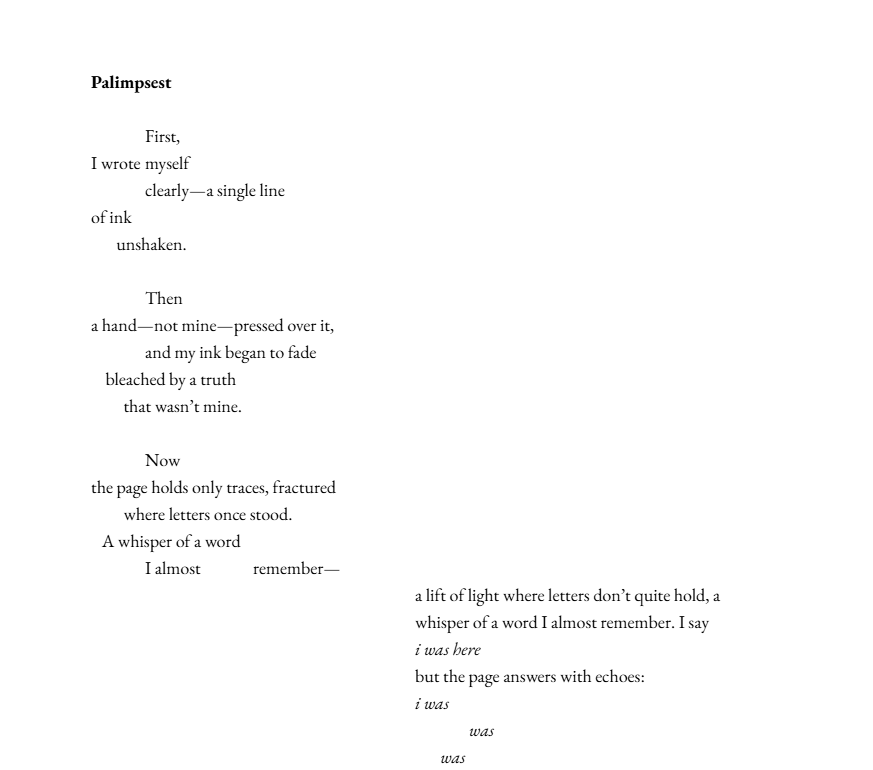
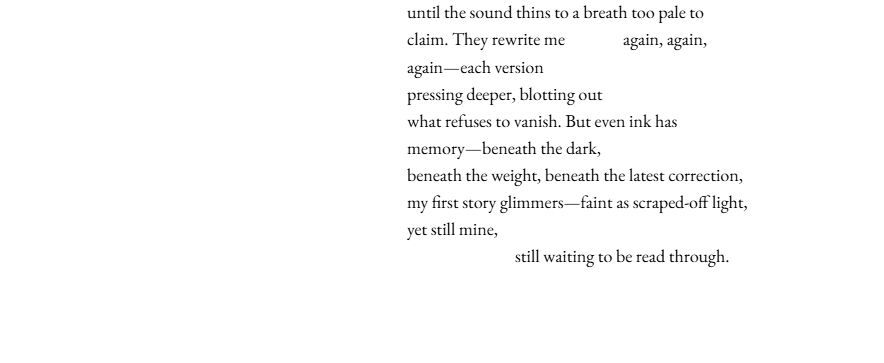
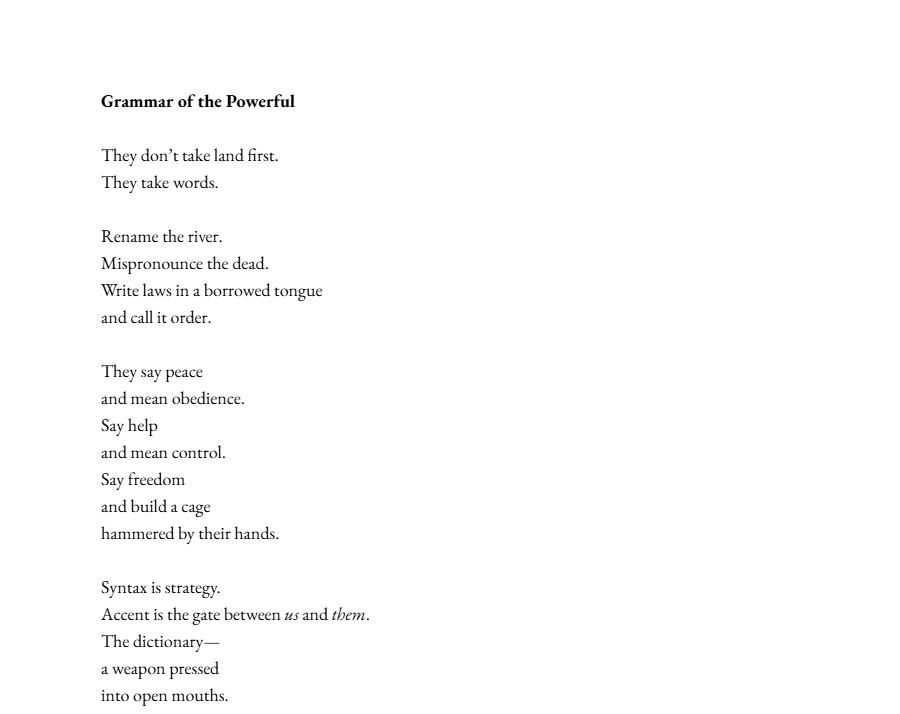
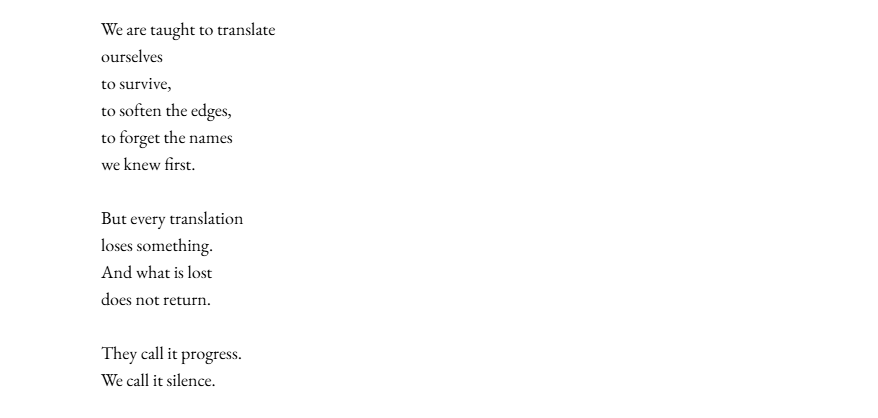
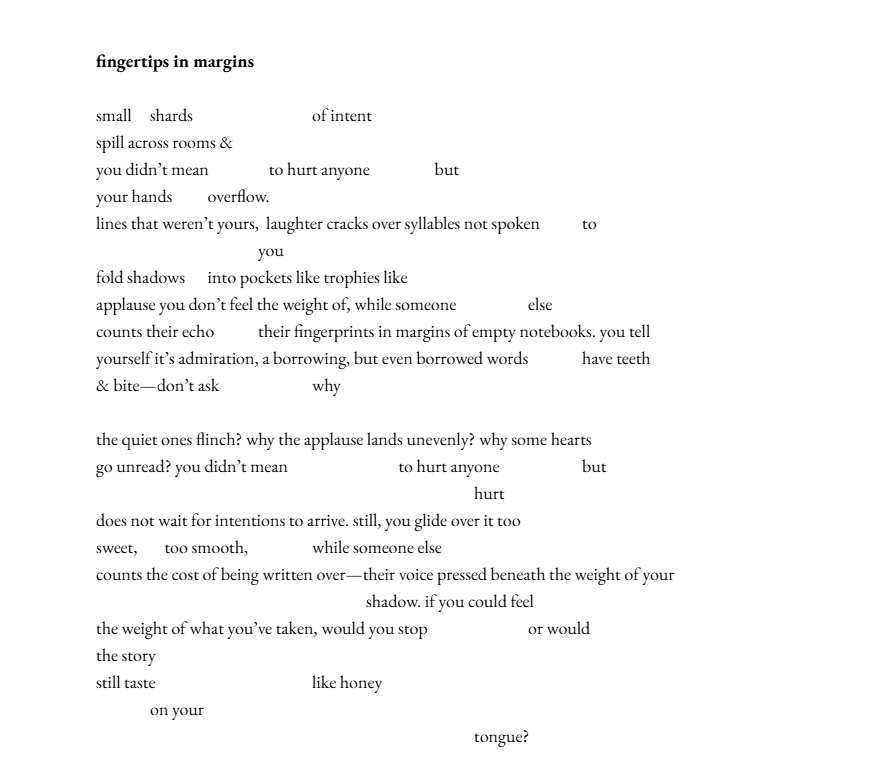
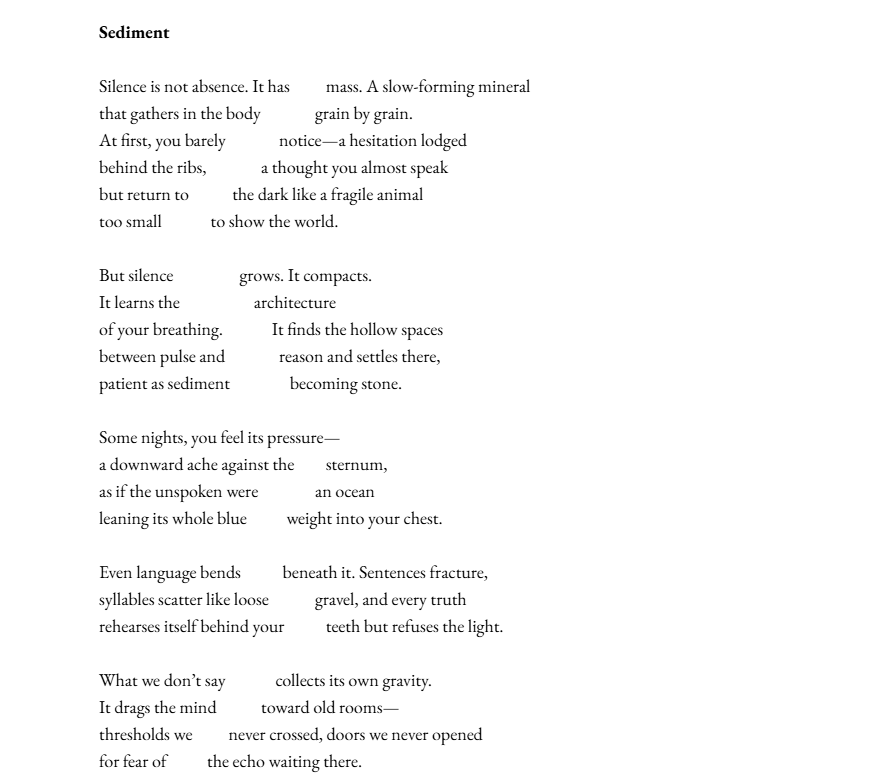
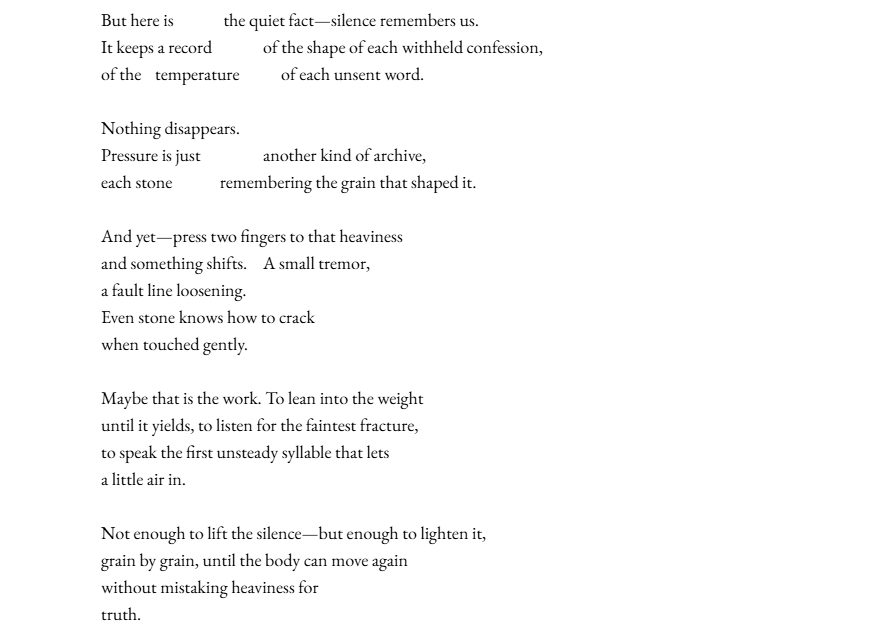
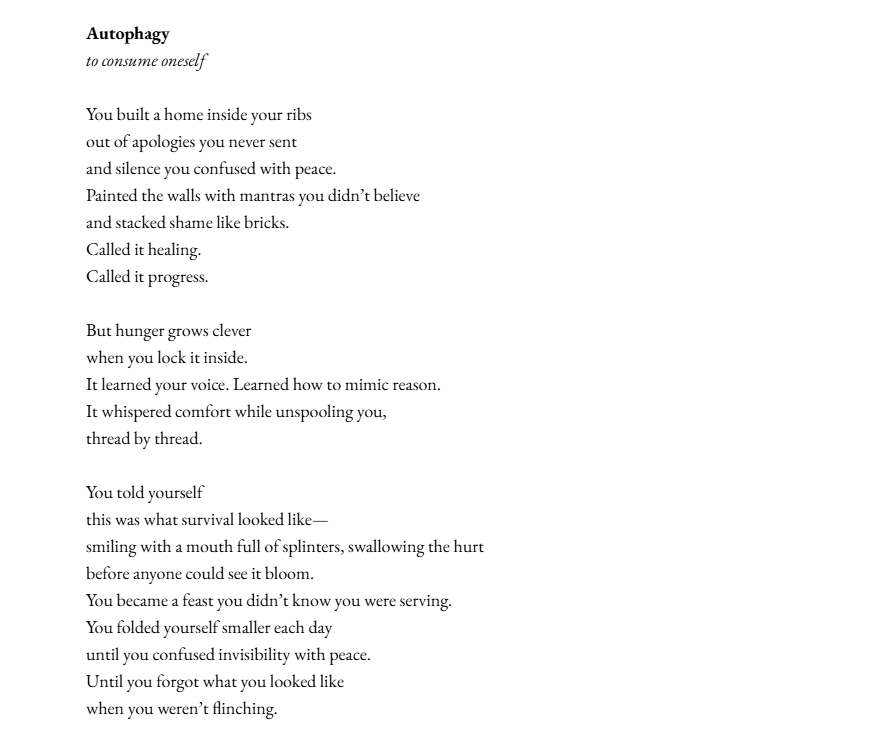
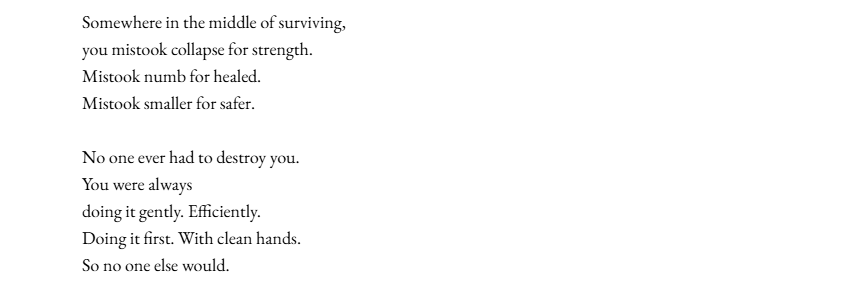
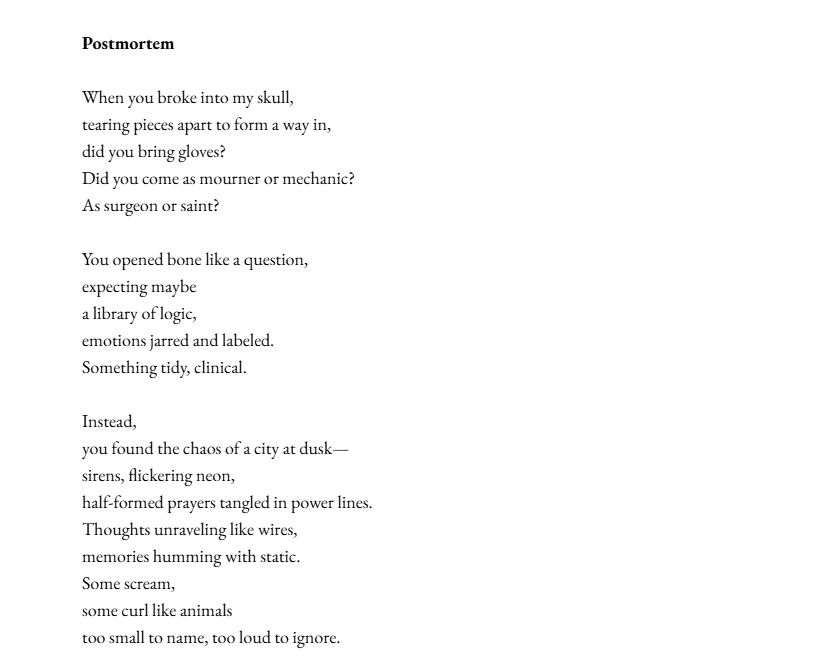
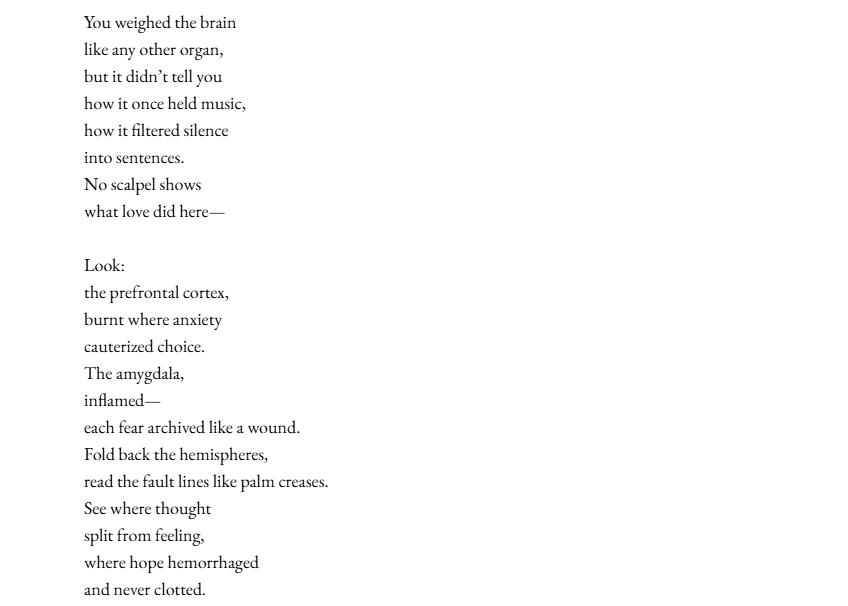
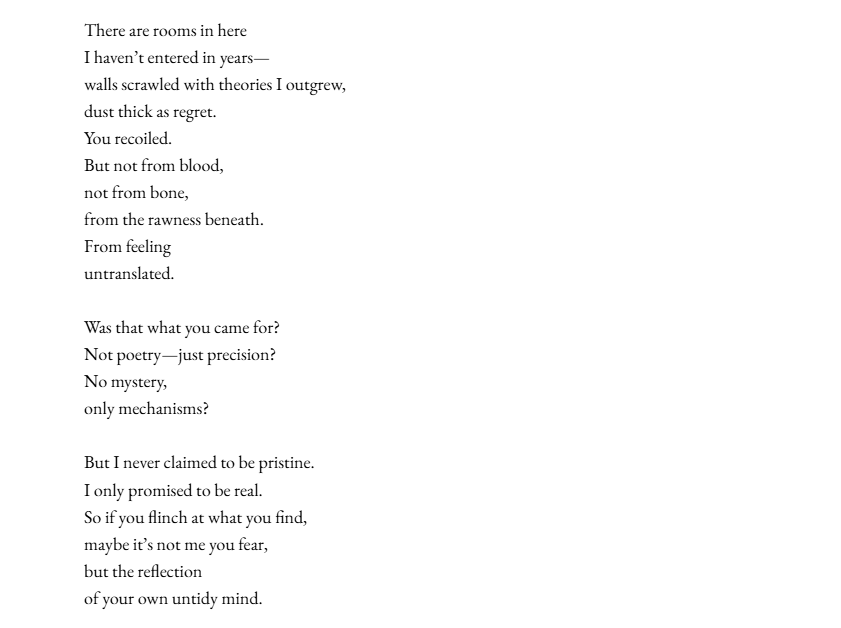
Last edited by TokoWrites (Nov. 26, 2025 02:59:07)
- TokoWrites
-
Scratcher
100+ posts
✮ ~ Toko's Writing Thread ~ ✮
Threshold Pressure is a collection about what builds beneath the surface—silence, memory, language, harm, and the ways we reassemble ourselves under the weight of all three. These poems trace different kinds of pressure: the quiet kind that forms inside a body, the inherited kind that shapes our histories, and the structural kind written into power, borders, and grammar.
“Grammar of the Powerful” was heavily inspired by R.F. Kuang’s Babel, especially in the way that book interrogates colonialism through language. The other poems grew from more personal places—self-erasure, anxiety, survival, and the shifting line between who we are and who we’re told to be.
Although each piece stands on its own, together they follow a loose arc: being rewritten, being silenced, being shaped by others, collapsing inward, and finally turning back toward an authentic self that still glimmers underneath.
A huge thank you to:
@-starrii-skies-
@SnowdropSugar
@Imacreamoo
@FireBlood23
@seastar_station
@therea_ink
@rocksalmon800
for reading and critiquing these poems and helping me see them more clearly—both the fractures and the light.
169 words, link to piece
Last edited by TokoWrites (Nov. 26, 2025 03:00:07)
- TokoWrites
-
Scratcher
100+ posts
✮ ~ Toko's Writing Thread ~ ✮
SWC
11/27 - 738 words
Monaco,
I’m writing this from our bed. *Our* bed. It still feels weird using the singular word “my” for anything in this room. I keep catching myself halfway through thinking, *my pillow*, *my half of the closet*, *my side of the room,* and then I stop, because it feels like I’m erasing you. Like you’re going to walk in any second with your headphones around your neck and your hair still damp from the shower, and I’m going to have to explain why I’m sitting on your pillow with your ugly-but-sentimental stuffed alpaca in my lap.
I’m not sending this. I already know I’m not. But writing it makes it feel less like you vanished into the adult-world vortex and more like you’re still… reachable, I guess.
Alia is currently in the living room watching that same princess show for the ninth time this week. Mom’s asleep on the couch, but one of her hands is still holding the TV remote like she’s guarding it in her dreams. The apartment feels lopsided without you here—like someone took away one of the legs on a table and now it keeps wobbling, but nobody wants to admit it’s broken.
You’d laugh if you saw how clean I’ve kept our side of the room. I even folded your laundry before you left. I keep doing it, actually. I find one of your shirts and I fold it and stack it neatly, like some ghost version of you is going to come home and check my corners. Alia keeps asking when you’re coming back. When she asks *why* you had to go, her voice gets all squished, like she’s trying not to cry. I get it. I feel like crying whenever I look at your empty half of the room, too.
School is weird. People ask about you like I’m your spokesperson instead of your sister. “How’s Monaco’s new campus?” “Does she like her roommates?” “Is she coming home for break?” I don’t know how to tell them I don’t know. That I haven’t figured out how to talk to you without feeling like I’m interrupting something more important, some big dazzling future thing you’re building.
I miss talking to you about… everything. Especially the stuff I don’t know how to talk to anyone else about. Like the girl in my history class—her name is Jada, and she has these braids with little purple beads at the ends that click when she turns her head. She sits two rows ahead of me, and whenever she laughs, I look up like someone just opened a window. I don’t know what that means. I don’t know how to *feel* about what it might mean. I’m scared to say it out loud, even to myself.
I keep thinking about the way you always seemed so sure of who you were, like you were building yourself on purpose while the rest of us were tripping over the pieces. Maybe that’s why I miss you so much. You made space for me to not know things. You never made me feel stupid or dramatic or… wrong.
Without you here, the silence is different. It feels heavier. I lie awake at night listening for your breathing, which is stupid because the only thing I hear now is Mom scratching in her sleep and Alia kicking the wall because she refuses to admit she’s outgrown her toddler bed. Sometimes I catch myself whispering jokes into the dark like you’re still on the top bunk. I don’t say them out loud though. Not really. Just mouth them. The room feels too empty for real sound.
I’m trying, though. I want you to know that. I’ve been brushing my hair before school. I’ve been doing my homework before midnight. I’ve even been eating breakfast with Mom instead of pretending I’m not hungry. It’s not fixing everything, but it makes the days less blurry. I think you’d be proud of that, even if it’s small.
I wish you were here. Not because I want to drag you back into this cramped little apartment or weigh you down with all the messy stuff in my head… but because things make more sense when you’re close. When you’re across the room instead of across the state.
If you ever read this, pretend I’m not being dramatic. Or pretend I am, but be nice about it.
I miss you. Come home soon, okay?
Love,
Bee
11/27 - 738 words
Monaco,
I’m writing this from our bed. *Our* bed. It still feels weird using the singular word “my” for anything in this room. I keep catching myself halfway through thinking, *my pillow*, *my half of the closet*, *my side of the room,* and then I stop, because it feels like I’m erasing you. Like you’re going to walk in any second with your headphones around your neck and your hair still damp from the shower, and I’m going to have to explain why I’m sitting on your pillow with your ugly-but-sentimental stuffed alpaca in my lap.
I’m not sending this. I already know I’m not. But writing it makes it feel less like you vanished into the adult-world vortex and more like you’re still… reachable, I guess.
Alia is currently in the living room watching that same princess show for the ninth time this week. Mom’s asleep on the couch, but one of her hands is still holding the TV remote like she’s guarding it in her dreams. The apartment feels lopsided without you here—like someone took away one of the legs on a table and now it keeps wobbling, but nobody wants to admit it’s broken.
You’d laugh if you saw how clean I’ve kept our side of the room. I even folded your laundry before you left. I keep doing it, actually. I find one of your shirts and I fold it and stack it neatly, like some ghost version of you is going to come home and check my corners. Alia keeps asking when you’re coming back. When she asks *why* you had to go, her voice gets all squished, like she’s trying not to cry. I get it. I feel like crying whenever I look at your empty half of the room, too.
School is weird. People ask about you like I’m your spokesperson instead of your sister. “How’s Monaco’s new campus?” “Does she like her roommates?” “Is she coming home for break?” I don’t know how to tell them I don’t know. That I haven’t figured out how to talk to you without feeling like I’m interrupting something more important, some big dazzling future thing you’re building.
I miss talking to you about… everything. Especially the stuff I don’t know how to talk to anyone else about. Like the girl in my history class—her name is Jada, and she has these braids with little purple beads at the ends that click when she turns her head. She sits two rows ahead of me, and whenever she laughs, I look up like someone just opened a window. I don’t know what that means. I don’t know how to *feel* about what it might mean. I’m scared to say it out loud, even to myself.
I keep thinking about the way you always seemed so sure of who you were, like you were building yourself on purpose while the rest of us were tripping over the pieces. Maybe that’s why I miss you so much. You made space for me to not know things. You never made me feel stupid or dramatic or… wrong.
Without you here, the silence is different. It feels heavier. I lie awake at night listening for your breathing, which is stupid because the only thing I hear now is Mom scratching in her sleep and Alia kicking the wall because she refuses to admit she’s outgrown her toddler bed. Sometimes I catch myself whispering jokes into the dark like you’re still on the top bunk. I don’t say them out loud though. Not really. Just mouth them. The room feels too empty for real sound.
I’m trying, though. I want you to know that. I’ve been brushing my hair before school. I’ve been doing my homework before midnight. I’ve even been eating breakfast with Mom instead of pretending I’m not hungry. It’s not fixing everything, but it makes the days less blurry. I think you’d be proud of that, even if it’s small.
I wish you were here. Not because I want to drag you back into this cramped little apartment or weigh you down with all the messy stuff in my head… but because things make more sense when you’re close. When you’re across the room instead of across the state.
If you ever read this, pretend I’m not being dramatic. Or pretend I am, but be nice about it.
I miss you. Come home soon, okay?
Love,
Bee
- TokoWrites
-
Scratcher
100+ posts
✮ ~ Toko's Writing Thread ~ ✮
Weekly 4 - 8878 words
A - Autumn - 304 words
Most people in Brumevale greeted autumn with scarves and cinnamon tea, but Elodie had no patience for that. The moment the first leaf yellowed, she dragged a crate of gardening tools from the shed and announced, to no one in particular, “It’s time to plant.”
“Plant?” Julien echoed, watching her kneel in the cooling dirt. “Everything’s supposed to be dying now.”
“That’s what people think,” Elodie replied, brushing soil from her palms. “But some things only take root in the cold.”
Sylvie bounced beside her, her breath puffing in a thin white mist. “Like the moonlilies?”
Elodie nodded. Moonlilies—pale blossoms that only opened under frostlight—were said to keep away wandering spirits. Whether or not the old stories were true didn’t matter. Planting them made her feel like she was doing something about the strange whispers drifting from the Hollows lately.
August arrived last, hands tucked in their coat pockets. “You’re starting early,” they said. Not in disapproval—August never disapproved—but in that observant way of theirs that made Elodie feel seen.
“I want them blooming before the first real freeze,” Elodie said. “Besides… the garden’s quieter now. Less awake.”
August crouched beside her, brushing fallen leaves from the soil as if greeting an old friend. “Everything listens in autumn. It’s a good time for planting secrets.”
Julien snorted. “Or catching colds.”
But even he helped, eventually. The four of them worked in companionable silence: Sylvie humming; Julien digging firm, practical holes; August murmuring some half-remembered charm; Elodie pressing each small bulb into the earth like a promise.
When they finished, the garden looked like nothing special—just patches of dark soil stitched between dying marigolds. But Elodie could feel it: the faint thrum beneath the ground, soft as a heartbeat.
Autumn didn’t have to be about endings.
Sometimes it was the season when hidden things began.
B - Beauty - 300 words
Beauty was a quiet thing, Elodie thought—quiet enough that most people stepped right over it. Brumevale had its loud beauties, of course: the great oak in the square, the stained-glass windows of the chapel, Sylvie’s unembarrassed laughter. But Elodie’s gaze slid past all that.
She found beauty in the spaces between.
In the tiny moth resting on the windowsill, its wings powdered with silver that glimmered only when the moon rose. In the sound of Julien sharpening a knife, the steady scrape-scrape-scrape that made a soft rhythm against the pulse of the house. In August’s hands, always gentle, always deliberate, as if everything they touched might crumble.
Most of all, she found beauty in moments. The way Sylvie leaned into her when she was cold, pretending she wasn’t seeking warmth. The way fog softened the hollow of the valley at dawn, blurring the edges of the world. The way the lantern-holders lit their wicks at dusk, carrying tiny constellations through the village.
People said Brumevale was dreary, a town pressed between wood and river, built from stone that never warmed. But Elodie saw beauty threaded through it like veins of gold in dark rock. You only had to look long enough.
Sometimes she wondered if others felt it too—the thin shimmer of magic that slept beneath everything. Not the dramatic magic of stories, no fire breathing or ancient spells. Just the kind that made the world feel kinder than it looked. The kind that told her the moonlilies she planted would bloom, even if winter came early.
Beauty, she realized, wasn’t meant to dazzle. It was meant to anchor. To whisper: There is goodness here. Even now.
And so she collected beautiful things—not objects, but moments—and kept them quietly in her heart.
The world felt easier to bear that way.
C - Curse - 312 words
Sylvie was the first to notice the humming.
It started after she plucked a strange seedpod from the Hollows, despite every warning Elodie and August had ever given her. She claimed it looked “lonely.” That was Sylvie’s excuse for everything she wasn’t supposed to touch.
The curse came upon her overnight.
A faint, persistent hum vibrated from her chest, like the sound of bees trapped in a bottle. At first, she thought it was funny. Then it grew louder. And louder. And louder still, until the whole house felt full of sound.
Julien couldn’t even stand in the same room.
“It’s like sitting inside a violin,” he muttered, hands over his ears.
Elodie tried everything—blankets, herbs, warm soup, even an old charm from a book she wasn’t sure was reliable. Nothing softened the hum.
August arrived at dusk, expression tight. They listened to the buzzing, their brows knitting. “It’s not a sickness,” they said softly. “It’s a Calling Curse.”
Sylvie groaned. “What’s calling me? More bees?”
“It calls its match,” August explained. “Some seeds choose their keepers. If you touch one before it’s ready… it sings until the other half arrives.”
“The other half?” Elodie echoed, dread creeping coldly up her spine.
August nodded. “The seedling. You’ve taken its pod. It wants to be planted.”
So into the night they went: Elodie guiding Sylvie, who stumbled with each vibrating pulse; Julien dragging a shovel like a reluctant soldier; August leading the way with a lantern.
Back to the Hollows.
The forest swallowed the sound greedily, as if starved for it. When Sylvie returned the seed to the soil, the humming ceased instantly—cut off like a breath.
Silence fell so suddenly it hurt.
Sylvie sagged into Elodie’s arms, trembling with relief. “I am never touching anything mysterious again.”
Elodie snorted. “You absolutely are.”
But she held her sister tighter, grateful for the quiet.
D - Double - 269 words
Elodie didn’t scream when she saw her double.
She simply froze.
There she stood, by the riverbank—another Elodie, same braids, same worn boots, same solemn eyes. Except… the double’s eyes were wrong. Not frightening, not glowing, just too still. Like a reflection that hadn’t learned how to breathe.
Julien swore under his breath. “Tell me I’m not seeing this.”
“You’re seeing it,” August murmured, stepping protectively beside Elodie. “Doubles don’t appear without reason.”
The other Elodie tilted her head. The motion was deliberate, mechanical. “You plant moonlilies.”
Her voice echoed slightly, as though spoken from inside a well.
Elodie swallowed hard. “Yes.”
“You tend to things that are dying,” the double continued. “And you think that makes you safe.”
Sylvie crept behind Julien, gripping his sleeve. “I don’t like her.”
Neither did Elodie. But something in her chest tugged her forward despite her fear.
“What are you?” she asked.
The double smiled, but it was a sad sort of smile, as if painted on. “What you could become. If you stop listening.” She pointed toward the forest. “There’s a choice coming. You hold too tightly to the soft things. They won’t hold you back.”
Elodie’s pulse fluttered. She felt August’s hand at her back, grounding her.
The double stepped closer. “When the moonlilies bloom, you’ll understand.”
Then, like mist touched by wind, the double dissolved—fading into riverlight until nothing was left but ripples.
For a long moment, none of them spoke.
Finally Julien said, “Well. That was horrifying.”
Elodie wasn’t sure what it was—warning or omen. But she felt it: something in her life had shifted, quietly and irrevocably.
E - Epiphany- 250 words
It happened on the bridge at twilight—when the lanterns hadn’t been lit yet, and the world felt suspended between breaths.
Elodie stood alone, gripping the wooden railing. The encounter with her double had unsettled something deep in her. All day she’d felt a weight inside her chest, pressing outward like a blooming bruise.
She was afraid.
Afraid of change, of choices, of becoming someone she didn’t recognize.
The river beneath her whispered its usual low murmur, carrying pale leaves downstream. She watched them drift and felt a strange ache. Leaves didn’t cling. They let themselves be carried.
And suddenly—suddenly—she understood.
All her life she’d believed that tending, mending, holding things together was what kept the world from falling apart. But maybe the world wasn’t asking her to hold everything. Maybe it was asking her to move.
To grow.
To step forward.
Even if it meant stepping into the unknown.
Her breath caught, sharp and soft at once.
The epiphany wasn’t loud. It didn’t crash into her.
It unfurled—quiet and inevitable—like a moonlily blooming in cold air.
She didn’t have to be the gentle one, the careful one, the safe one.
She could be brave, too.
Behind her, footsteps approached. August’s voice drifted through the dusk. “Elodie? You left dinner early.”
She turned, and for the first time in days, her smile didn’t feel fragile.
“I think I’m ready.”
“For what?” August asked.
Elodie looked toward the Hollows, where shadows grew thick and patient.
“For whatever’s coming.”
And she meant it.
F - Fight - 299 words
Brumevale didn’t have wars, not the kind with soldiers and banners. But it had battles—small ones, quiet ones—that mattered just as much.
Elodie found herself in one.
The lantern-holders, who kept the village paths lit each night, were growing fewer. Their duty was simple: walk the twilight paths with fire in hand, keeping the wandering spirits from drifting too near. It wasn’t glamorous work. It wasn’t praised. It was simply needed.
And lately, too many villagers had begun to say, “The spirits aren’t real” or “The Hollows have been quiet for years” or “Someone else can handle it.”
So Elodie volunteered.
Julien stared at her when she told him. “You? Walking around at night with one tiny flame? Are you out of your mind?”
Sylvie clapped, delighted. “Can I come? Please?”
“No,” Elodie and Julien said in unison.
August simply smiled. “I think it suits you.”
And so she trained. It wasn’t physical training—they didn’t hand her a sword. Instead, the elders taught her the old ways: how to anchor her courage into the lantern’s frame, how to keep its flame steady even when dread scratched at her, how to listen for the subtle shift in the air that meant something unseen was near.
Her first night on duty, she walked the path by the river. Her lantern cast a thin circle of soft, golden light. Shadows crowded at its edges. The spirits never showed themselves outright, but she felt them watching, curious and hungry in a harmless way.
Elodie lifted her chin and kept walking.
She wasn’t fighting monsters. She wasn’t protecting the world.
She was protecting something simpler: the sense of safety that let Sylvie sleep soundly, that let August wander the woods without fear, that let Brumevale be a place where children still played by lanternlight.
Her cause was small.
But it mattered.
And she carried her flame proudly.
G - Grass - 238 words
The morning after her first lantern shift, Elodie wandered to the meadow behind the old mill. She told herself she needed fresh air, but really she needed to stop thinking about the shadows she felt brushing against her lantern’s glow.
The grass was cool beneath her palms as she knelt, breathing in the scent of dew. The world felt honest here—uncomplicated, unconcerned with omens or duties. Sylvie trailed behind her, picking handfuls of clover, while Julien skipped stones across the nearby creek with unimpressive accuracy.
August lay in the grass, hands folded beneath their head. “Look closely,” they murmured. “The meadow changes every day.”
Elodie did.
And that’s when she saw it—a single white feather standing upright in the soil, impossibly balanced on its tip.
It didn’t sway in the breeze. It didn’t fall. It simply stood.
She touched it. Warm.
That’s what startled her. Feathers weren’t warm. They didn’t hum, either, but this one did—a faint thrum, like the far-distant echo of wings beating.
Sylvie blinked. “Is it magic?”
“Everything is,” August replied softly. “If it chooses to be.”
Elodie wasn’t sure what the feather meant, or if it meant anything at all. But she tucked it safely inside her coat. It made her feel… grounded. As if something larger than her had noticed her small efforts and quietly approved.
When she stood, the world looked no different.
But she felt different.
Maybe that was the point.
H - Hope - 219 words
Hope arrived in Brumevale the same way spring did—quietly, and after far too long.
For Elodie, it came the evening Sylvie returned from the Hollows with flushed cheeks and wide eyes, breathless with excitement rather than fear.
“They bloomed!” Sylvie cried, nearly tripping over the threshold.
“The moonlilies?” Elodie asked, heart catching.
Sylvie nodded so hard her braids thumped against her shoulders. “They’re glowing—really glowing! Julien says it’s unnatural but he wouldn’t stop staring, and August made that face they make when they pretend not to be proud—”
Elodie didn’t wait. She grabbed her coat and ran.
By the time she reached the garden, dusk had deepened into velvet. The moonlily patch shimmered with pale blue light, each blossom spreading wide and bright like a tiny frozen star. The air around them felt softer, warmer, alive.
She knelt, tears pricking her eyes.
They had taken root. Despite the cold. Despite her doubts. Despite the quiet warnings of her double.
For the first time in weeks, she felt the certainty that she was not walking blindly into what lay ahead. Not everything was shadow. Some things bloomed even in the hardest seasons.
August joined her quietly, lantern in hand. “They’re beautiful,” they murmured.
Elodie nodded. “They give me hope.”
August smiled—gentle, knowing. “That’s why they bloom.”
And Elodie believed them.
I - Imagery - 313 words
Peaceful days in Brumevale were rare, but when they came, the whole town softened.
Elodie stood in the wheat fields just beyond the mill, the late afternoon sun dipping low enough to gild everything it touched. The breeze carried the warm scent of grain, toasted and comforting, like bread just pulled from an oven. The stalks swayed in slow, synchronized waves—gold shifting into gold, shimmering like the surface of a sunlit lake.
Julien slept beneath a tree, hat covering his face, boots kicked off. Sylvie danced between the rows, her fingertips brushing the wheat tops as though she were conducting some invisible orchestra. August sat upon the old fence, humming a tune that blended with the rustle of the fields.
A dragonfly drifted past Elodie’s cheek, wings sparkling like stained glass. Far off, the church bell tolled soft and low—a heartbeat echoing across the valley.
There was no magic visible today. No whispers from the Hollows. No omens or curses or strange doubles. Just the simple, nearly-sacred beauty of an afternoon that asked for nothing and offered everything.
Elodie breathed in deeply. The scent of wheat wrapped around her like a warm shawl.
For the first time in a long time, her shoulders unknotted.
She closed her eyes.
The breeze brushed her skin like a gentle hand. The sun kissed her eyelids. The world hummed, not with danger or warning, but with quiet contentment.
Peace.
She wished she could bottle it—save it for the nights the lanternlight flickered too sharply, for the days Sylvie wandered too far or the shadows pressed too close.
But maybe peace wasn’t meant to be kept.
Maybe it was meant to be lived when it arrived, treasured in memory when it passed, and trusted to return again.
Elodie opened her eyes and let the wind carry her worries away.
Today, the world was kind.
And that was enough.
J - Joy - 333 words
Happiness was a rare creature in Brumevale—shy, skittish, easily spooked. But on the day of the Harvest Fair, it appeared boldly, wearing ribbons and laughter.
Elodie hadn’t planned on enjoying herself. She never did; fairs were loud, crowded, chaotic. But Sylvie dragged her by the hand through the lantern-strung streets, proclaiming it a “sister obligation.” Julien trailed behind, already chewing on something fried, and August meandered alongside them with their usual calm, eyes absorbing every detail as though they were storing memories for winter.
Music flowed from the square—fiddles, tambourines, a drumbeat like a happy heartbeat. Children wove between adults, carrying paper animals on sticks. Vendors shouted. Lanterns bobbed. Everything smelled of cinnamon and woodsmoke.
Elodie felt her chest loosen.
Sylvie tugged her toward the game stalls. “Try the ring toss! Or the guess-the-sweets jar! Or—oh! The fortune reader!”
“I don’t need my fortune read,” Elodie protested.
Julien smirked. “Afraid she’ll tell you something true?”
“Afraid she’ll tell me something obvious,” Elodie shot back.
August laughed softly—quiet, warm, like wind chimes stirred by a gentle breeze.
That laugh did something to Elodie.
Something warm.
Something startling.
She decided to try the ring toss after all.
Her first attempt clattered uselessly. Her second landed but bounced away. Her third—
Clink.
Perfect.
Sylvie whooped so loudly three pigeons took flight. Julien stared, impressed. August clapped politely but their eyes were bright with pride.
Elodie felt it then—joy, full and startling, blooming in her chest like a firecracker made of sunlight.
The booth owner handed her a small prize: a stuffed fox stitched from soft brown felt. Sylvie immediately demanded to hold it, then refused to give it back, then gave it back with a dramatic bow.
Elodie laughed. Really laughed. The sound surprised her.
For a moment, nothing strange shadowed the edges of her world. No ominous doubles. No whispering spirits. No quiet weight of responsibility.
Just her friends. Her sister. The golden lanterns swaying above them.
Happiness didn’t feel shy today.
It felt inevitable.
K - Kindness - 356 words
It began with a storm.
Brumevale rarely saw violent weather, but that night the sky cracked open in thunderous fury. Rain battered rooftops like fists. Wind howled through narrow alleys, snuffing lanterns and scattering fallen leaves like frightened birds.
Elodie, Sylvie, Julien, and August had gathered in the old chapel—sturdy stone, warm candles, a roof that had survived decades of temperamental seasons. They waited out the storm in uneasy silence.
Until a sudden crash echoed outside.
Julien peered through the chapel doors. “The south fence is down. Someone’s out there.”
Before anyone could stop her, Elodie grabbed a cloak and ran into the storm. Rain soaked her instantly, icy and sharp. The wind clawed at her hair. Thunder cracked like a warning.
But she saw the figure—a young woman from the far edge of the village, kneeling in the mud, desperately trying to lift a fallen wooden beam.
Her goat was trapped beneath it, bleating in terror.
Elodie didn’t think. She simply acted.
“Julien!” she shouted over the storm as he reached her side. “Help me lift it!”
Together they heaved, mud sucking at their boots, rain blinding them. The beam resisted, heavy and slick, but Elodie gritted her teeth and pushed harder.
August appeared through the downpour, silently adding their strength.
The beam shifted.
Lifted.
Sylvie coaxed the terrified goat out, murmuring soft nonsense to soothe it.
The moment the animal was free, the woman collapsed into Elodie’s arms, sobbing relief. “Thank you—I thought—I thought she’d be—”
“It’s all right,” Elodie said, brushing wet hair from the woman’s face. “You’re safe. She’s safe.”
They guided her back to the chapel, wrapped her in blankets, gave her hot tea once the storm eased. No one praised Elodie; she wouldn’t have wanted it anyway.
But as she wrung water from her cloak, August placed a hand on her shoulder.
“You ran into the storm for someone you barely knew,” they said softly. “That matters.”
Elodie shrugged, but her chest warmed. “Anyone would have done it.”
August offered a knowing smile. “Maybe. But you did.”
Outside, the rain softened.
Inside, kindness lingered long after the storm had gone.
L - Location - 376 words
Brumevale was all Elodie had ever known—stone cottages, whispering woods, river mist curling like a friendly ghost. But today she stood somewhere entirely new: the Dunewind Coast, a place spoken of in stories but rarely visited by anyone from the valley.
The sea stretched endlessly before her, a shifting silver under pale sunlight. Waves rushed and retreated in rhythmic sighs, leaving lace-edged foam across the sand. The air tasted like salt and cold, like something crisp enough to bite.
Sylvie sprinted ahead, boots kicking up sand. “It’s huge!” she shouted to no one in particular. “It’s alive!”
Julien trailed behind, unimpressed. “It’s water, Sylvie. A lot of water.”
August simply closed their eyes, letting the sea breeze comb through their hair, a faint smile tugging at their lips.
Elodie felt small here—but in a comforting way. As if the world had broadened and she finally had room to breathe.
They had come to the coast for a single purpose: to deliver an old map August’s grandmother had entrusted to them, one meant for a cartographer who lived by the lighthouse. A simple errand, but it had taken them days of travel by wagon and foot. And in that time, Elodie had learned how different silence felt when shared with friends.
The lighthouse loomed ahead—white stone marked with salt scars, its lantern room glinting. As they approached, the cartographer—a wiry man with wind-burned cheeks—welcomed them with surprising warmth.
Inside, Elodie marveled at maps of faraway places: cities built on cliffs, forests with trees taller than houses, islands shaped like spiraling shells. The world was larger than she had known. Wilder. Older.
And she belonged to it—not as a prisoner of fate but as a traveler.
That realization settled deep in her bones.
Late that afternoon, she wandered alone to the tide pools. Tiny glass-bodied fish darted among the rocks. Seaweed swayed like soft green ribbons. A crab, indignant at her shadow, raised a claw in challenge.
Elodie laughed.
The sea did not whisper warnings. It did not carry omens. It simply existed—vast, unknowable, beautiful.
For the first time since meeting her double, Elodie felt not fear of the future, but curiosity.
A new location had changed her.
Or maybe it had just revealed what she could become.
M - MacGuffin - 367 words
It all began with a rumor: somewhere in the Hollows lay a stone that could grant a single wish.
Sylvie overheard it from an old market vendor. Julien insisted it was nonsense. August was unreadable but intrigued. Elodie… well, she didn’t believe in wish-granting stones, but she did believe Sylvie should not wander into cursed forests alone.
So they went together.
The Hollows were quieter than usual, moss swallowing sound like an old secret. Fog clung low to the ground. The trees leaned inward—as if curious why children would seek something so foolish.
“What would you wish for?” Sylvie asked, skipping over a fallen log.
“Nothing,” Julien muttered. “Wishes always come with strings.”
“I’d wish for a never-ending jar of honey,” Sylvie announced.
Elodie smiled. “You’d get sick in a week.”
“And you?” August asked softly.
Elodie hesitated. She didn’t want to say her wish aloud—that she wanted to know her place in the future before she stepped into it. That she wanted certainty. Control. Safety.
But she said only, “I don’t know.”
They searched for hours, guided by half-remembered tales and markings on trees that seemed to shift when no one watched. Finally they found it—a smooth, unremarkable stone sitting on a stump as if placed there by a polite forest spirit.
Sylvie gasped. Julien frowned. August raised an eyebrow.
Elodie stepped closer. The stone did nothing. No glow. No warmth. No hum. Just a rock.
“Maybe it’s shy?” Sylvie suggested.
Julien kicked it lightly. “Maybe it’s just a rock.”
And indeed, when Elodie picked it up, it was nothing more. No magic. No wish. No destiny.
Sylvie deflated. “So the stories were wrong?”
August smiled gently. “Not wrong. Just… stories.”
Elodie slipped the stone into Sylvie’s pocket. “Keep it anyway. A wish doesn’t need magic. Sometimes the wanting is enough.”
They walked home lighter than they’d come. The forest felt less ominous, almost amused by their naïve pursuit.
In the end, the stone changed nothing.
But the journey—walking together, facing shadows, laughing at disappointment—changed everything about the way Elodie saw her own yearning.
Sometimes the MacGuffin wasn’t the point.
Sometimes the point was simply moving toward something, even if it turned out to be nothing.
N - Note - 301 words
To August—
(Delivered by hand, because letters feel safer that way.)
I don’t know if this is silly, but I needed to write something down—something I can’t quite say aloud without my voice shaking. Writing feels easier. Maybe because paper doesn’t look at me the way you do, like you’re hearing everything I’m not saying.
Do you remember the moonlilies? Of course you do—you were there. I went to see them again tonight. They’re fading now, their glow thinning like breath on winter glass. I thought seeing them wilt would sadden me, but instead it felt… right. A reminder that some things are beautiful even when they’re ending.
It made me think about what my double said—that I hold too tightly. I’ve been trying not to. Trying to imagine a future I don’t control, a path I don’t plan. Trying to let things grow as they will, not as I will them to.
And I realized something. I’m not afraid of change. I’m afraid of change happening alone.
But when you walk beside me—even when we’re silent—my fear feels smaller. Like a shadow seen by lanternlight: still present, but softened.
This is the part that feels foolish to write, but I’m writing it anyway: I trust you. More than I trust most things. Maybe more than I should.
You don’t have to say anything about that. I’m not expecting anything in return. I just wanted you to know. If something’s coming—and it feels like something is—then I’m glad you’re here for it. With all of us, yes, but also… with me.
If this letter sounds overly dramatic, blame the moonlilies. They make everything feel like a poem.
— Elodie
P.S.
If you find this too strange, please burn it.
If you don’t, please keep it.
Either way… thank you for reading.
O - Office Job - 323 words
Elodie had never imagined she’d work in an office, but when Mr. Briarwood—the town registrar—fell ill, she volunteered to help. She thought it would be simple: writing names, stamping documents, filing forms.
It was not simple.
For one, the office smelled strongly of ink, dust, and something reminiscent of boiled cabbage. Piles of paper towered precariously on every surface, each stack leaning like it wanted to collapse onto her lap. The inkwell kept tipping over. The stamp squeaked horribly. And the chair—oh, the chair—creaked louder than the chapel pews on a stormy night.
Her first task was copying the census list. Easy enough, until she realized half the names were spelled differently every time they appeared. Was it “Mirelle” or “Mirrelle”? “Oakenford” or “Okanford”? And why did someone simply sign their household as “The Goat”? (Julien found this part hilarious.)
Then came the petitions: requests for lantern repairs, complaints about the miller’s rooster that greeted dawn two hours too early, and one ominous letter that read only:
“Something is stirring in the Hollows.”
(It had no signature. August frowned when she showed it to them.)
By mid-afternoon, Elodie was drenched in ink up to her elbows and dangerously close to screaming. Sylvie had stopped by twice to offer moral support and snacks. Julien had been banished after attempting to reorganize the filing system “his way.” August quietly fixed the crooked window latch.
But something strange happened as the hours passed. Amid the monotony, Elodie found small comforts: the rhythmic scratch of quill on parchment, the soft thump of stamped seals, the satisfaction of sorting chaos into order. She liked helping people, even in mundane ways. And she liked the quiet—the safe, predictable quiet.
When the day ended, she blew out the office candle and felt a surprising swell of pride.
She still preferred moonlilies and lanternlight, but maybe she could survive paperwork—so long as she had friends popping in to break the monotony.
P - Promise - 299 words
It happened the night Sylvie went missing.
She hadn’t meant to—she never did. One moment she was picking berries near the Hollows; the next, she was gone. The villagers searched for an hour before Elodie realized Sylvie wasn’t simply lost. She was taken.
Not by anything malicious, August insisted, but by the forest itself. “The Hollows can be protective,” they said quietly. “Or curious.”
Elodie didn’t care about its motives. She just wanted her sister back.
She stormed into the trees, Julien and August at her heels, lantern swinging wildly. Shadows twisted. Branches arched like ribs over a beating heart. The deeper they went, the more Elodie felt the forest watching, listening.
“Please,” she whispered. “Please don’t keep her.”
Maybe the Hollows heard. Maybe it pitied her.
Because soon they found Sylvie sitting beside a ring of stone mushrooms, perfectly unharmed, humming to a small glowing moth perched on her hand.
“Elodie!” Sylvie beamed. “You should’ve seen it—the mushrooms lit up when I whispered to them!”
Elodie’s knees nearly buckled. She knelt, pulled Sylvie into her arms, and held her as if the world might fall apart if she let go.
“Don’t ever run off like that again,” she choked.
Sylvie blinked. “I wasn’t running off. I was… exploring.”
Julien groaned. “Same thing.”
August placed a gentle hand on Elodie’s shoulder. “She’s safe now.”
Elodie looked at her sister—curious, impulsive, wonderful, reckless Sylvie—and felt something inside her solidify.
“I promise,” she said softly, not to Sylvie but to herself, “I will always come for you. No matter where you wander. No matter what tries to keep you.”
Sylvie hugged her tighter. “And I promise I’ll try not to make that too difficult.”
Elodie gave a shaky laugh.
Promises didn’t stop danger. But they anchored love.
And that was enough.
Q - Questioning - 344 words
Elodie had always believed the world was… orderly. Not perfect, not fair, but governed by quiet rules: plant seeds, they grow; hold a lantern, shadows recede; care for others, and things will turn out all right.
But that belief cracked the night she stood at the edge of the Hollows alone, gripping her lantern so tightly her knuckles ached.
The forest was restless. Not dangerous—just shifting, muttering, rearranging itself in ways that suggested intention. The air trembled with faint whispers, like a distant melody she couldn’t quite catch.
Her double’s words returned to her:
“You hold too tightly. They won’t hold you back.”
Elodie had dismissed the warning. But now… she wasn’t sure.
August found her staring into the dark. “You’re thinking too loudly,” they murmured.
Elodie exhaled. “Do you ever feel like the world expects something from you? Something you didn’t choose?”
August considered this. “Sometimes. But I think the world asks. It doesn’t demand.”
“What if I’m not enough for what it’s asking?”
“You are. You care. That’s harder than courage.”
Elodie shook her head. “Caring doesn’t stop bad things.”
“No,” August said gently. “But it keeps us human while we face them.”
Elodie hesitated. The lantern flame flickered as if listening.
“I always thought light kept the shadows away,” she whispered. “But what if… what if shadows aren’t meant to be chased? What if they’re part of the world too?”
August’s expression softened. “Then maybe the lantern isn’t for banishing shadows. Maybe it’s for guiding you through them.”
Elodie’s breath hitched. She had never considered that.
All this time, she’d treated fear as an enemy. But perhaps fear was simply a path—one she could walk without letting it swallow her. Perhaps the world was not asking her to be strong or certain.
Just willing.
The forest murmured, wind brushing leaves like a hand across a page. Elodie lifted her lantern slightly.
Maybe she didn’t need all the answers. Maybe questions were a kind of compass, too.
And for the first time, she stepped toward the shadows not out of fear—but curiosity.
R - Rescue - 433 words
The Hollows never slept, but some nights they seemed to breathe deeper—slow, heavy breaths that made the trees sway as though responding to something unseen. It was on such a night that the trouble began.
Julien had volunteered to watch the moonlilies, insisting that “someone sensible” should keep an eye on the fading blossoms. Elodie trusted him; he was steady, practical, and—despite his grumbling—deeply protective. So when he didn’t return by dusk, she felt the wrongness settle instantly into her bones.
Sylvie insisted on coming. August did too. Elodie didn’t argue. She didn’t have the strength.
They entered the Hollows together, lantern light trembling against the undergrowth. The path that should have been familiar stretched wrong—curved where it had been straight, split where it had been whole. The forest wasn’t being cruel; it was simply… rearranging. Deciding.
“Elodie,” August murmured, pausing at a fork. “Listen.”
She did.
Soft groans reached them—pained, frustrated, unmistakably human.
Julien.
She ran before anyone could stop her.
They found him trapped in a pit hidden beneath a camouflage of fallen leaves. Not deep, but deep enough that the roots jutting from the walls made climbing difficult. His lantern had smashed, leaving him in darkness.
“Well,” Julien said, attempting a weak grin, “this is embarrassing.”
Elodie’s heart clenched. “Are you hurt?”
“No. Just my pride. And maybe my ankle.” He winced. “Mostly my pride.”
Sylvie leaned over the pit. “Throw me the rope!”
“No,” three voices said at once.
August knotted the rope around a tree, their fingers moving deftly. Elodie lay flat on her stomach and lowered the line. “Take it.”
Julien hesitated. “I’m fine, Elodie. Really.”
Something in her snapped—not anger, but fear sharpened into a blade. “Take. It.”
He obeyed.
They pulled together—Elodie’s muscles burning, Sylvie cheering encouragement, August steady as stone. Inch by inch, Julien rose until his hands reached the forest floor and he scrambled onto solid ground again.
The moment he stood, Elodie threw her arms around him. He stiffened in surprise before awkwardly patting her back.
“You scared me,” she whispered into his shoulder.
“Yeah, well,” Julien replied, voice rough, “me too.”
On the walk back, the forest seemed calmer, almost satisfied—as though it had wanted to test them and found their loyalty acceptable.
Elodie didn’t know if the Hollows had trapped Julien intentionally. She didn’t want to imagine it. But as she held the lantern high, guiding the four of them through shifting shadows, she realized something:
She wasn’t rescuing Julien alone.
They were rescuing each other—
again and again, in small, necessary ways.
And that was how you survived Brumevale.
S - Stealing - 431 words
Sylvie had never considered herself a thief. Borrower, maybe. Curious collector, certainly. But thief? That felt dramatic.
Then came the day she stole a book from the Briarwood Library.
To be fair, it was an accident at first. She’d been searching for stories about moonlilies, about the Hollows, about doubles that whispered warnings. The library was a cavernous, dusty old place where the shelves groaned with age and knowledge and disapproval. Sylvie hated the silence. It felt like the books were listening.
She found the volume in a forgotten corner: Folklore of the Hidden Valley, its spine cracked, its pages uneven. When she opened it, a pressed flower fell into her palm—a white, star-shaped bloom that shimmered faintly blue.
A moonlily.
But moonlilies didn’t press. They dissolved when picked.
Heart pounding, Sylvie turned the pages. More impossible things stared back at her: drawings of glowing plants, diagrams of lantern charms, stories about the Hollows guiding children back home or swallowing unwary travelers whole. One page had been blacked out entirely with brush strokes of ink.
She knew she shouldn’t take it. She knew. But the library was closing soon, and Elodie needed answers, and the book felt alive in her hands—as if it wanted to be taken.
So she slipped it under her coat.
The guilt hit halfway home. The fear hit when August noticed.
“You’re hiding something,” they said softly. “You’re bad at hiding things.”
Sylvie produced the book like a guilty cat spitting up a stolen fish. “Don’t be mad.”
August didn’t look mad. They looked… worried. Very worried.
“Elodie,” August called. “Julien. Come here.”
Elodie skimmed the book and paled. “Sylvie… this is dangerous.”
“It’s just a book!”
“Not this one.” August tapped the ink-blackened page. “This is a ward. Someone concealed whatever was written here.” They looked at Sylvie, eyes narrowing. “Did the book hum when you touched it?”
“Yes?” Sylvie squeaked.
“That means it’s bound. It belongs to the Briarwood keepers. They’ll know it’s missing.”
Sylvie’s stomach dropped. “I didn’t mean to steal it!”
Julien sighed. “Intent doesn’t change the consequences.”
But before panic could overwhelm her, Elodie touched her hand gently. “We’ll return it. Together. And we’ll explain.”
“Will they be angry?” Sylvie whispered.
“Maybe,” Elodie admitted. “But honesty is better than fear.”
That night, the four of them walked to the library, moonlily glow tucked in Sylvie’s coat like a heartbeat. When they returned the book, the keeper’s disapproving glare softened—not because Sylvie was innocent, but because she was brave enough to confess.
She’d stolen something precious. But she’d gained something more valuable: trust.
T - Telling the Story- 371 words
This is the truth of it, plainly told:
Elodie grew up believing she could keep her world stitched neatly together. She thought if she watered the garden, tended her sister, honored the old traditions, and carried her lantern with steady hands, everything around her would remain safe.
But she was wrong. Things change whether you want them to or not.
The Hollows shifted. Strange signs appeared. Moonlilies bloomed earlier than expected. A double stepped out of the river not to frighten her, but to warn her. The world began asking more of her than she had ever planned to give.
And she realized she was afraid—not just of the unknown, but of failing the people she loved. She feared one day Sylvie would wander too far, Julien would take one risk too many, August would slip quietly into danger without telling anyone. She feared being the one left behind.
So she clung to what she knew.
But here is another truth, equally plain:
Every moment she clung to, the world tugged gently back. The Hollows rearranged themselves to guide, not trap. The lanterns burned brighter around her. Her friends grew closer rather than farther. Even her double—cold and eerie and unsettling—had not been an enemy, but a mirror.
Elodie didn’t want to see it, but she had to: she was changing, too.
She was becoming someone braver, someone willing to step toward shadows rather than flee them. Someone who did not need certainty to act. Someone whose quiet strength mattered in ways she couldn’t yet measure.
And she wasn’t alone in this transformation. Sylvie’s curiosity, Julien’s stubborn loyalty, August’s calm wisdom—each of them was a piece of the world she was learning to trust.
It would be easy to say she discovered courage, or destiny, or some hidden spark of magic within herself. But that would be a prettier story than the truth.
The truth is simpler:
Elodie learned to move forward even when afraid.
She learned that fear doesn’t mean stop.
It means care. It means the path is important. It means she is alive.
And that was enough to carry her through the shifting forest, the glowing flowers, the mysterious warnings, and all the uncertain seasons yet to come.
U - Unity - 424 words
Every year, at the end of autumn, Brumevale held the Lantern Weave—a tradition older than any living villager. No one knew who began it. Some said it was to honor the spirits of the Hollows; others claimed it was to remind the valley that light endures even when the nights grow long.
Elodie remembered attending as a child, clutching her mother’s hand, watching the woven lanterns drift like fireflies above the river. But she’d never understood the ceremony. Not really.
This year, she understood too well.
Each family crafted a lantern from reeds and tissue paper, then tied it to a long strand of braided twine. Hundreds of lanterns, all connected. When the festival began, everyone held the strand together, a single living chain looping around the village square.
The first time Elodie grasped her section, she felt the tug of countless hands—steady, warm, present. Even the coldest villagers didn’t stand apart tonight. The baker, the miller, the Briarwood librarians, even the grumpy old man from the east ridge—they all held the twine with quiet dignity.
Sylvie’s lantern was shaped like a moonlily. Julien’s resembled a crooked star. August’s was simple but elegant, painted with delicate brushstrokes of silver.
Elodie’s lantern was plain. She liked it that way.
But the twine she held… that was anything but plain.
For that strand connected them all: the fearful and the fearless, the cautious and the curious, the young and the old. It symbolized what Brumevale was at its core—not a village of stone houses but a village of people who chose, again and again, to hold on to one another.
As the crowd began to walk toward the river, the lanterns bobbed in unison, casting warm gold over the cobblestones. The air hummed with murmured prayers, laughter, promises whispered beneath breath.
Elodie felt August’s hand brush hers.
“You okay?” they asked.
“Yes,” she said, surprised by the truth in it.
At the riverbank, the villagers lowered the twine slowly. One by one, each lantern touched the water, drifting outward in a glowing tapestry. Dozens became hundreds. Hundreds became a sky reflected upside down.
Unity.
Not forced, not demanded—chosen.
Elodie watched her lantern glide gently among the others.
For a moment, she imagined the river carrying all their hopes together, weaving them into something stronger than any of them alone.
And she realized that the Hollows, the doubles, the strange shifting futures—none of it felt as frightening when she remembered this.
They were a village of many hands on one strand.
And she was part of it.
V - Vow- 358 words
The Briarwood Library kept a strange collection tucked away in its oldest wing: teaching primers written in the form of fables. Sylvie adored them. Elodie found them mildly unsettling. August insisted the stories were harmless—anthropomorphized nonsense meant to entertain children. And Julien, predictably, declared the whole collection “creepy.”
But one evening, Sylvie discovered a volume none of them had seen before. Arithmetic Oddities: Tales of Numbers Who Walk and Eat.
Julien whispered, “Why would numbers eat anything?”
Elodie ignored him and flipped to a page titled Seven’s Last Vow.
And the story went like this:
Seven had begun consuming numbers out of frustration. Not cruelty—frustration. The other numbers mocked Seven for being neither even nor odd in spirit, too prickly to befriend Two, too restless to sit beside Six. They teased Seven with rhymes—Seven eats nine!—until one day, Seven did.
At first, Seven felt powerful. Then guilty. Then lonely.
So Seven made a vow:
“I will stop eating numbers… after one more.”
The children of the village (for the story insisted these numbers lived in a village, absurdly) tried to intervene. But Seven had chosen someone next: Four.
Why Four?
Because Four had always been steady, predictable, favored. Four had what Seven believed they lacked: acceptance.
Seven didn’t want Four’s destruction—they wanted Four’s certainty.
As Seven approached, Four didn’t run. Four simply said, “You’re not monstrous. You’re hurting.”
And something in Seven cracked. The hunger wasn’t hunger at all—it was the ache of wanting to belong.
Four offered a place beside them.
Seven collapsed into relieved tears.
And the vow dissolved on their tongue.
The story ended there, abruptly. No moral. Just that incomplete moment of almost-devouring and unexpected grace.
Sylvie closed the book and whispered, “I feel bad for Seven.”
Julien muttered, “I still think it’s creepy.”
But Elodie’s mind lingered on the idea of wanting something so fiercely it twisted into harm. Of longing to fit somewhere, to be seen, to be accepted.
August quietly said, “Sometimes stories teach more through strangeness than sense.”
And Elodie wondered—not for the first time—if the Hollows had stories too, waiting to be understood in their own impossible language.
W - Working Through a Challenge - 431 words
Winter crept into Brumevale with the silent certainty of a closing book. The cold pressed in through stone walls, the river stiffened into sluggish ice, and the Hollows grew sharper—edges of shadows like ink strokes against snow.
It was during this brittle season that Elodie faced one of her greatest challenges: repairing the lantern wards.
The lantern wards weren’t ordinary lights. Each was anchored by a delicate sigil carved into glass, meant to keep the worst of the forest’s moods from spilling into the village. The wards didn’t control the Hollows—nothing could—but they soothed the border between human and wild magic.
Except this year, the wards flickered out of rhythm.
One by one. Quietly. Warningly.
Elodie, August, Julien, and Sylvie gathered at dusk to inspect them. The sigils were intact, but the glass felt colder than usual, like holding an untouched grave marker.
“It’s the changing paths,” August murmured. “The Hollows is rearranging. The wards are struggling to interpret the new boundaries.”
Julien frowned. “Can we fix them or not?”
“We can try,” Elodie said, surprising even herself with how steady her voice sounded.
They worked lantern by lantern, using warmed ink to redraw the sigils’ breath lines. But the ink refused to take. It slid across the glass like oil on water.
Sylvie kicked at the snow. “It doesn’t like us.”
“It’s not liking or disliking,” Elodie said gently. “It’s just resisting change.”
The realization hit her like a struck bell. She had been doing the same—resisting, clinging, fearing the world shifting beneath her feet. Maybe the wards were reacting the way she had been: confused, unprepared, overwhelmed.
She took a breath. Then another.
“Let’s stop forcing it,” she said. “Let’s listen instead.”
So the four of them stood quietly, lanterns dim, snow falling in soft spirals. Cold pricked their skin. The forest murmured—soft, questioning, almost… apologetic.
Elodie stepped closer to the ward, placed her palm on the glass, and whispered, “It’s all right. We’re learning too.”
The glass warmed beneath her hand.
August exhaled. “Do that again.”
Together, they pressed their hands to the lantern, whispering words of reassurance—nonsense words, comforting words, names, memories, laughter. Human warmth meeting magical hesitance.
The ink flowed.
The sigil accepted.
One ward repaired. Then another. And another.
By the time they reached the last lantern, Elodie’s fingers were numb, her boots soaked, her breath clouded in silver plumes. But the wards glowed bright and steady, each one syncing with the rhythm of Brumevale’s beating heart.
The obstacle hadn’t been magic.
It had been fear.
And Elodie had walked through it, lantern held high.
X - Xylophones - 399 words
The winter festival always included music—violins, flutes, hand drums, and the old hammered dulcimer played by Mrs. Thistle, whose hands shook but never missed a note. Elodie loved listening, but she had never played herself; she preferred to watch from the edges, wrapped in a shawl, letting the melodies settle into her bones.
This year, however, Sylvie shoved a small wooden instrument into her hands.
A xylophone.
Or what passed for one: a modest folk version with uneven wooden bars, strung together with twine, each bar carved from a different tree. The tones were soft, warm, imperfect—like tapping on enchanted firewood.
“I can’t play this,” Elodie protested.
“Good. Then you’ll learn something,” Sylvie said cheerfully.
Julien suggested she start with a simple scale. August, ever gentle, sat beside her and tapped a single bar. “Just one note. That’s all you need at first.”
Elodie reluctantly struck the lowest bar. It produced a mellow tok, like a raindrop hitting wood.
Not terrible.
She tried another. Tuk.
Then another. Tik.
Soon she was experimenting, fingers stiff with cold, trying to find a pattern that didn’t sound like someone falling down a set of stairs. Sylvie hummed along, encouragement bursting from her like sunlight. Julien tried (and failed) not to snicker. August’s soft nods calmed the embarrassment simmering in Elodie’s stomach.
Eventually, a rhythm began to form—
slow, thoughtful, uneven, but hers.
The sound blended with the crackle of the festival bonfire, with laughter drifting from nearby stalls, with the soft howl of winter wind threading through the valley. People didn’t stop to stare. They simply let her play, letting her small melody join the tapestry of the evening.
And Elodie discovered something unexpected:
Playing was… freeing.
No perfect rules to follow. No fear of mistakes. No pressure to excel. Just the gentle clack of wood, the pulse of curiosity, the feeling of making something that existed nowhere else.
August leaned closer. “You’re good.”
“I’m adequate,” Elodie corrected.
“Same thing,” Julien called from behind them.
Elodie laughed—a clear, unguarded sound she rarely let herself express.
The rhythm faltered; she didn’t care.
For a few minutes, she wasn’t holding a lantern against the dark or navigating warnings or deciphering the Hollows’ shifting language.
She was simply Elodie. Playing a wooden xylophone. Finding music in imperfection.
And when the final note faded, she felt lighter—like someone whose world had widened, even just an inch.
Y - Yapping - 404 words
The four of them had gathered in Elodie’s kitchen, the only room warm enough to defy the winter wind. A kettle hummed on the stove. Sylvie was perched on the table (despite repeated protests), Julien paced like a restless wolf, and August sat neatly with folded hands.
The discussion was… heated.
“Elodie, you can’t just walk into the Hollows alone,” Julien said.
“I wasn’t alone. I had my lantern.”
“That’s not the same thing!”
Sylvie swung her legs. “I’d go alone if it meant answers.”
“Exactly why you’re not going alone,” Julien snapped.
August sighed. “Can we have a rational conversation?”
“That’s what I’m trying to have,” Julien said.
“You’re shouting,” August replied calmly.
“I’m passionate.”
“You’re loud.”
Sylvie raised her hand. “Can I vote for adventure?”
“No,” Elodie, Julien, and August chorused.
Sylvie pouted.
Elodie folded her arms. “Look, I just wanted to confirm the wards are stable without dragging everyone out in the cold.”
“You still should have told us,” Julien muttered.
“I tell you everything.”
“Except the part where you nearly slipped on a frozen stream.”
“That was not worth mentioning.”
August pinched the bridge of their nose. “We are getting nowhere.”
Sylvie perked up. “Then let’s get somewhere else! I propose—”
“No,” Julien said instantly.
“You didn’t even let me finish!”
“I don’t need to. Your proposals always end with one of the following: danger, climbing, glowing fungi, or explosions.”
“Only two explosions,” Sylvie corrected proudly.
Elodie finally groaned, sitting down at the table. “The Hollows isn’t trying to hurt me.”
Julien froze. “…You can’t know that.”
“I do. I feel it. The forest is changing, but it isn’t malicious.”
“You’re trusting instinct over safety.”
“Maybe safety isn’t the point anymore.”
Sylvie gasped dramatically. “Character development!”
Julien glared. “Sylvie.”
“What? It is!”
August placed a gentle hand on Elodie’s arm. “You can trust the Hollows. But trust us, too.”
Elodie softened. “I do.”
“Then stop acting like you’re the only one who needs to face it,” Julien said quietly. “We’re in this together.”
A beat of silence.
The kettle whistled softly.
“…Fine,” Elodie conceded. “Next time I’ll tell you.”
Sylvie thrust her fists triumphantly into the air. “Victory!”
Julien shook his head. “This family is exhausting.”
“We’re not a family,” Sylvie said.
“We basically are,” Julien muttered.
“I agree,” August said.
Elodie smiled. “We are.”
And somehow, with nothing resolved and everything still uncertain, the kitchen felt warmer than ever.
Z - Zoo - 424 words
Brumevale didn’t have a zoo—not in the way cities did. But once a year, traveling naturalists visited the valley with caged displays of rare creatures, hoping to trade knowledge or supplies. Elodie had always felt uneasy about the event; the animals looked tired, lonely, far from their homes. Sylvie, meanwhile, adored it. Julien tolerated it. August walked through it with quiet reverence.
This year, however, something unusual arrived: a whisper-cat.
A creature thought to be a myth—silvery fur, tufted ears, and eyes reflecting light like polished mirrors. It was said whisper-cats could mimic the voices of people they trusted.
The naturalist boasted loudly, “Caught it myself, deep in the Hollowwood Mountains!”
Elodie’s stomach twisted. Captured magic never sat right with her.
The whisper-cat lay curled at the back of the cage, tail wrapped around its body, breathing shallowly. Its fur dimmed, as though the world were draining color from it.
Sylvie knelt. “It looks sad.”
Julien scowled. “It looks wrong. This thing belongs in the wild.”
August approached slowly, speaking in barely audible tones. “Whisper-cats don’t survive long in confinement. They bond with silence. With freedom.”
Elodie met August’s gaze.
Something unspoken passed between them.
That night—long after the naturalists shut their tents—Elodie, Julien, Sylvie, and August slipped into the fairgrounds. Snow crunched beneath their boots. Lanternlight flickered against canvas walls.
“Okay,” Julien whispered. “We open the cage, it runs, we pretend we know nothing. Easy.”
“Easy,” Sylvie echoed.
It was not easy.
The cage lock was enchanted—old, crude magic, but stubborn. August worked quietly, breath fogging the cold air. Elodie kept watch. Sylvie hummed softly to calm the creature. Julien muttered complaints.
Then—
click.
The lock loosened.
The whisper-cat lifted its head.
Its eyes glimmered.
August opened the door slowly. “Go,” they murmured. “You’re free.”
The cat stepped out, paws silent on the snow. It paused before Elodie, meeting her gaze with an intelligence that felt older than the Hollows themselves.
Then—soft and startling—
it spoke in a voice like wind brushing leaves:
“Thank you.”
Sylvie gasped. Julien swore under his breath. Elodie’s heart thudded.
The creature vanished into the night—melting into darkness as though it had been made from shadow and moonlight.
When they regrouped by the river, breathless and giddy and terrified, Elodie felt her chest swell with something fierce and luminous.
Not just relief. Not just pride.
But a realization:
Even small acts—quiet ones, secret ones—could shift the balance of the world.
Set things right.
Protect what should never have been caged.
And the Hollows, far off, hummed in approval.
A - Autumn - 304 words
Most people in Brumevale greeted autumn with scarves and cinnamon tea, but Elodie had no patience for that. The moment the first leaf yellowed, she dragged a crate of gardening tools from the shed and announced, to no one in particular, “It’s time to plant.”
“Plant?” Julien echoed, watching her kneel in the cooling dirt. “Everything’s supposed to be dying now.”
“That’s what people think,” Elodie replied, brushing soil from her palms. “But some things only take root in the cold.”
Sylvie bounced beside her, her breath puffing in a thin white mist. “Like the moonlilies?”
Elodie nodded. Moonlilies—pale blossoms that only opened under frostlight—were said to keep away wandering spirits. Whether or not the old stories were true didn’t matter. Planting them made her feel like she was doing something about the strange whispers drifting from the Hollows lately.
August arrived last, hands tucked in their coat pockets. “You’re starting early,” they said. Not in disapproval—August never disapproved—but in that observant way of theirs that made Elodie feel seen.
“I want them blooming before the first real freeze,” Elodie said. “Besides… the garden’s quieter now. Less awake.”
August crouched beside her, brushing fallen leaves from the soil as if greeting an old friend. “Everything listens in autumn. It’s a good time for planting secrets.”
Julien snorted. “Or catching colds.”
But even he helped, eventually. The four of them worked in companionable silence: Sylvie humming; Julien digging firm, practical holes; August murmuring some half-remembered charm; Elodie pressing each small bulb into the earth like a promise.
When they finished, the garden looked like nothing special—just patches of dark soil stitched between dying marigolds. But Elodie could feel it: the faint thrum beneath the ground, soft as a heartbeat.
Autumn didn’t have to be about endings.
Sometimes it was the season when hidden things began.
B - Beauty - 300 words
Beauty was a quiet thing, Elodie thought—quiet enough that most people stepped right over it. Brumevale had its loud beauties, of course: the great oak in the square, the stained-glass windows of the chapel, Sylvie’s unembarrassed laughter. But Elodie’s gaze slid past all that.
She found beauty in the spaces between.
In the tiny moth resting on the windowsill, its wings powdered with silver that glimmered only when the moon rose. In the sound of Julien sharpening a knife, the steady scrape-scrape-scrape that made a soft rhythm against the pulse of the house. In August’s hands, always gentle, always deliberate, as if everything they touched might crumble.
Most of all, she found beauty in moments. The way Sylvie leaned into her when she was cold, pretending she wasn’t seeking warmth. The way fog softened the hollow of the valley at dawn, blurring the edges of the world. The way the lantern-holders lit their wicks at dusk, carrying tiny constellations through the village.
People said Brumevale was dreary, a town pressed between wood and river, built from stone that never warmed. But Elodie saw beauty threaded through it like veins of gold in dark rock. You only had to look long enough.
Sometimes she wondered if others felt it too—the thin shimmer of magic that slept beneath everything. Not the dramatic magic of stories, no fire breathing or ancient spells. Just the kind that made the world feel kinder than it looked. The kind that told her the moonlilies she planted would bloom, even if winter came early.
Beauty, she realized, wasn’t meant to dazzle. It was meant to anchor. To whisper: There is goodness here. Even now.
And so she collected beautiful things—not objects, but moments—and kept them quietly in her heart.
The world felt easier to bear that way.
C - Curse - 312 words
Sylvie was the first to notice the humming.
It started after she plucked a strange seedpod from the Hollows, despite every warning Elodie and August had ever given her. She claimed it looked “lonely.” That was Sylvie’s excuse for everything she wasn’t supposed to touch.
The curse came upon her overnight.
A faint, persistent hum vibrated from her chest, like the sound of bees trapped in a bottle. At first, she thought it was funny. Then it grew louder. And louder. And louder still, until the whole house felt full of sound.
Julien couldn’t even stand in the same room.
“It’s like sitting inside a violin,” he muttered, hands over his ears.
Elodie tried everything—blankets, herbs, warm soup, even an old charm from a book she wasn’t sure was reliable. Nothing softened the hum.
August arrived at dusk, expression tight. They listened to the buzzing, their brows knitting. “It’s not a sickness,” they said softly. “It’s a Calling Curse.”
Sylvie groaned. “What’s calling me? More bees?”
“It calls its match,” August explained. “Some seeds choose their keepers. If you touch one before it’s ready… it sings until the other half arrives.”
“The other half?” Elodie echoed, dread creeping coldly up her spine.
August nodded. “The seedling. You’ve taken its pod. It wants to be planted.”
So into the night they went: Elodie guiding Sylvie, who stumbled with each vibrating pulse; Julien dragging a shovel like a reluctant soldier; August leading the way with a lantern.
Back to the Hollows.
The forest swallowed the sound greedily, as if starved for it. When Sylvie returned the seed to the soil, the humming ceased instantly—cut off like a breath.
Silence fell so suddenly it hurt.
Sylvie sagged into Elodie’s arms, trembling with relief. “I am never touching anything mysterious again.”
Elodie snorted. “You absolutely are.”
But she held her sister tighter, grateful for the quiet.
D - Double - 269 words
Elodie didn’t scream when she saw her double.
She simply froze.
There she stood, by the riverbank—another Elodie, same braids, same worn boots, same solemn eyes. Except… the double’s eyes were wrong. Not frightening, not glowing, just too still. Like a reflection that hadn’t learned how to breathe.
Julien swore under his breath. “Tell me I’m not seeing this.”
“You’re seeing it,” August murmured, stepping protectively beside Elodie. “Doubles don’t appear without reason.”
The other Elodie tilted her head. The motion was deliberate, mechanical. “You plant moonlilies.”
Her voice echoed slightly, as though spoken from inside a well.
Elodie swallowed hard. “Yes.”
“You tend to things that are dying,” the double continued. “And you think that makes you safe.”
Sylvie crept behind Julien, gripping his sleeve. “I don’t like her.”
Neither did Elodie. But something in her chest tugged her forward despite her fear.
“What are you?” she asked.
The double smiled, but it was a sad sort of smile, as if painted on. “What you could become. If you stop listening.” She pointed toward the forest. “There’s a choice coming. You hold too tightly to the soft things. They won’t hold you back.”
Elodie’s pulse fluttered. She felt August’s hand at her back, grounding her.
The double stepped closer. “When the moonlilies bloom, you’ll understand.”
Then, like mist touched by wind, the double dissolved—fading into riverlight until nothing was left but ripples.
For a long moment, none of them spoke.
Finally Julien said, “Well. That was horrifying.”
Elodie wasn’t sure what it was—warning or omen. But she felt it: something in her life had shifted, quietly and irrevocably.
E - Epiphany- 250 words
It happened on the bridge at twilight—when the lanterns hadn’t been lit yet, and the world felt suspended between breaths.
Elodie stood alone, gripping the wooden railing. The encounter with her double had unsettled something deep in her. All day she’d felt a weight inside her chest, pressing outward like a blooming bruise.
She was afraid.
Afraid of change, of choices, of becoming someone she didn’t recognize.
The river beneath her whispered its usual low murmur, carrying pale leaves downstream. She watched them drift and felt a strange ache. Leaves didn’t cling. They let themselves be carried.
And suddenly—suddenly—she understood.
All her life she’d believed that tending, mending, holding things together was what kept the world from falling apart. But maybe the world wasn’t asking her to hold everything. Maybe it was asking her to move.
To grow.
To step forward.
Even if it meant stepping into the unknown.
Her breath caught, sharp and soft at once.
The epiphany wasn’t loud. It didn’t crash into her.
It unfurled—quiet and inevitable—like a moonlily blooming in cold air.
She didn’t have to be the gentle one, the careful one, the safe one.
She could be brave, too.
Behind her, footsteps approached. August’s voice drifted through the dusk. “Elodie? You left dinner early.”
She turned, and for the first time in days, her smile didn’t feel fragile.
“I think I’m ready.”
“For what?” August asked.
Elodie looked toward the Hollows, where shadows grew thick and patient.
“For whatever’s coming.”
And she meant it.
F - Fight - 299 words
Brumevale didn’t have wars, not the kind with soldiers and banners. But it had battles—small ones, quiet ones—that mattered just as much.
Elodie found herself in one.
The lantern-holders, who kept the village paths lit each night, were growing fewer. Their duty was simple: walk the twilight paths with fire in hand, keeping the wandering spirits from drifting too near. It wasn’t glamorous work. It wasn’t praised. It was simply needed.
And lately, too many villagers had begun to say, “The spirits aren’t real” or “The Hollows have been quiet for years” or “Someone else can handle it.”
So Elodie volunteered.
Julien stared at her when she told him. “You? Walking around at night with one tiny flame? Are you out of your mind?”
Sylvie clapped, delighted. “Can I come? Please?”
“No,” Elodie and Julien said in unison.
August simply smiled. “I think it suits you.”
And so she trained. It wasn’t physical training—they didn’t hand her a sword. Instead, the elders taught her the old ways: how to anchor her courage into the lantern’s frame, how to keep its flame steady even when dread scratched at her, how to listen for the subtle shift in the air that meant something unseen was near.
Her first night on duty, she walked the path by the river. Her lantern cast a thin circle of soft, golden light. Shadows crowded at its edges. The spirits never showed themselves outright, but she felt them watching, curious and hungry in a harmless way.
Elodie lifted her chin and kept walking.
She wasn’t fighting monsters. She wasn’t protecting the world.
She was protecting something simpler: the sense of safety that let Sylvie sleep soundly, that let August wander the woods without fear, that let Brumevale be a place where children still played by lanternlight.
Her cause was small.
But it mattered.
And she carried her flame proudly.
G - Grass - 238 words
The morning after her first lantern shift, Elodie wandered to the meadow behind the old mill. She told herself she needed fresh air, but really she needed to stop thinking about the shadows she felt brushing against her lantern’s glow.
The grass was cool beneath her palms as she knelt, breathing in the scent of dew. The world felt honest here—uncomplicated, unconcerned with omens or duties. Sylvie trailed behind her, picking handfuls of clover, while Julien skipped stones across the nearby creek with unimpressive accuracy.
August lay in the grass, hands folded beneath their head. “Look closely,” they murmured. “The meadow changes every day.”
Elodie did.
And that’s when she saw it—a single white feather standing upright in the soil, impossibly balanced on its tip.
It didn’t sway in the breeze. It didn’t fall. It simply stood.
She touched it. Warm.
That’s what startled her. Feathers weren’t warm. They didn’t hum, either, but this one did—a faint thrum, like the far-distant echo of wings beating.
Sylvie blinked. “Is it magic?”
“Everything is,” August replied softly. “If it chooses to be.”
Elodie wasn’t sure what the feather meant, or if it meant anything at all. But she tucked it safely inside her coat. It made her feel… grounded. As if something larger than her had noticed her small efforts and quietly approved.
When she stood, the world looked no different.
But she felt different.
Maybe that was the point.
H - Hope - 219 words
Hope arrived in Brumevale the same way spring did—quietly, and after far too long.
For Elodie, it came the evening Sylvie returned from the Hollows with flushed cheeks and wide eyes, breathless with excitement rather than fear.
“They bloomed!” Sylvie cried, nearly tripping over the threshold.
“The moonlilies?” Elodie asked, heart catching.
Sylvie nodded so hard her braids thumped against her shoulders. “They’re glowing—really glowing! Julien says it’s unnatural but he wouldn’t stop staring, and August made that face they make when they pretend not to be proud—”
Elodie didn’t wait. She grabbed her coat and ran.
By the time she reached the garden, dusk had deepened into velvet. The moonlily patch shimmered with pale blue light, each blossom spreading wide and bright like a tiny frozen star. The air around them felt softer, warmer, alive.
She knelt, tears pricking her eyes.
They had taken root. Despite the cold. Despite her doubts. Despite the quiet warnings of her double.
For the first time in weeks, she felt the certainty that she was not walking blindly into what lay ahead. Not everything was shadow. Some things bloomed even in the hardest seasons.
August joined her quietly, lantern in hand. “They’re beautiful,” they murmured.
Elodie nodded. “They give me hope.”
August smiled—gentle, knowing. “That’s why they bloom.”
And Elodie believed them.
I - Imagery - 313 words
Peaceful days in Brumevale were rare, but when they came, the whole town softened.
Elodie stood in the wheat fields just beyond the mill, the late afternoon sun dipping low enough to gild everything it touched. The breeze carried the warm scent of grain, toasted and comforting, like bread just pulled from an oven. The stalks swayed in slow, synchronized waves—gold shifting into gold, shimmering like the surface of a sunlit lake.
Julien slept beneath a tree, hat covering his face, boots kicked off. Sylvie danced between the rows, her fingertips brushing the wheat tops as though she were conducting some invisible orchestra. August sat upon the old fence, humming a tune that blended with the rustle of the fields.
A dragonfly drifted past Elodie’s cheek, wings sparkling like stained glass. Far off, the church bell tolled soft and low—a heartbeat echoing across the valley.
There was no magic visible today. No whispers from the Hollows. No omens or curses or strange doubles. Just the simple, nearly-sacred beauty of an afternoon that asked for nothing and offered everything.
Elodie breathed in deeply. The scent of wheat wrapped around her like a warm shawl.
For the first time in a long time, her shoulders unknotted.
She closed her eyes.
The breeze brushed her skin like a gentle hand. The sun kissed her eyelids. The world hummed, not with danger or warning, but with quiet contentment.
Peace.
She wished she could bottle it—save it for the nights the lanternlight flickered too sharply, for the days Sylvie wandered too far or the shadows pressed too close.
But maybe peace wasn’t meant to be kept.
Maybe it was meant to be lived when it arrived, treasured in memory when it passed, and trusted to return again.
Elodie opened her eyes and let the wind carry her worries away.
Today, the world was kind.
And that was enough.
J - Joy - 333 words
Happiness was a rare creature in Brumevale—shy, skittish, easily spooked. But on the day of the Harvest Fair, it appeared boldly, wearing ribbons and laughter.
Elodie hadn’t planned on enjoying herself. She never did; fairs were loud, crowded, chaotic. But Sylvie dragged her by the hand through the lantern-strung streets, proclaiming it a “sister obligation.” Julien trailed behind, already chewing on something fried, and August meandered alongside them with their usual calm, eyes absorbing every detail as though they were storing memories for winter.
Music flowed from the square—fiddles, tambourines, a drumbeat like a happy heartbeat. Children wove between adults, carrying paper animals on sticks. Vendors shouted. Lanterns bobbed. Everything smelled of cinnamon and woodsmoke.
Elodie felt her chest loosen.
Sylvie tugged her toward the game stalls. “Try the ring toss! Or the guess-the-sweets jar! Or—oh! The fortune reader!”
“I don’t need my fortune read,” Elodie protested.
Julien smirked. “Afraid she’ll tell you something true?”
“Afraid she’ll tell me something obvious,” Elodie shot back.
August laughed softly—quiet, warm, like wind chimes stirred by a gentle breeze.
That laugh did something to Elodie.
Something warm.
Something startling.
She decided to try the ring toss after all.
Her first attempt clattered uselessly. Her second landed but bounced away. Her third—
Clink.
Perfect.
Sylvie whooped so loudly three pigeons took flight. Julien stared, impressed. August clapped politely but their eyes were bright with pride.
Elodie felt it then—joy, full and startling, blooming in her chest like a firecracker made of sunlight.
The booth owner handed her a small prize: a stuffed fox stitched from soft brown felt. Sylvie immediately demanded to hold it, then refused to give it back, then gave it back with a dramatic bow.
Elodie laughed. Really laughed. The sound surprised her.
For a moment, nothing strange shadowed the edges of her world. No ominous doubles. No whispering spirits. No quiet weight of responsibility.
Just her friends. Her sister. The golden lanterns swaying above them.
Happiness didn’t feel shy today.
It felt inevitable.
K - Kindness - 356 words
It began with a storm.
Brumevale rarely saw violent weather, but that night the sky cracked open in thunderous fury. Rain battered rooftops like fists. Wind howled through narrow alleys, snuffing lanterns and scattering fallen leaves like frightened birds.
Elodie, Sylvie, Julien, and August had gathered in the old chapel—sturdy stone, warm candles, a roof that had survived decades of temperamental seasons. They waited out the storm in uneasy silence.
Until a sudden crash echoed outside.
Julien peered through the chapel doors. “The south fence is down. Someone’s out there.”
Before anyone could stop her, Elodie grabbed a cloak and ran into the storm. Rain soaked her instantly, icy and sharp. The wind clawed at her hair. Thunder cracked like a warning.
But she saw the figure—a young woman from the far edge of the village, kneeling in the mud, desperately trying to lift a fallen wooden beam.
Her goat was trapped beneath it, bleating in terror.
Elodie didn’t think. She simply acted.
“Julien!” she shouted over the storm as he reached her side. “Help me lift it!”
Together they heaved, mud sucking at their boots, rain blinding them. The beam resisted, heavy and slick, but Elodie gritted her teeth and pushed harder.
August appeared through the downpour, silently adding their strength.
The beam shifted.
Lifted.
Sylvie coaxed the terrified goat out, murmuring soft nonsense to soothe it.
The moment the animal was free, the woman collapsed into Elodie’s arms, sobbing relief. “Thank you—I thought—I thought she’d be—”
“It’s all right,” Elodie said, brushing wet hair from the woman’s face. “You’re safe. She’s safe.”
They guided her back to the chapel, wrapped her in blankets, gave her hot tea once the storm eased. No one praised Elodie; she wouldn’t have wanted it anyway.
But as she wrung water from her cloak, August placed a hand on her shoulder.
“You ran into the storm for someone you barely knew,” they said softly. “That matters.”
Elodie shrugged, but her chest warmed. “Anyone would have done it.”
August offered a knowing smile. “Maybe. But you did.”
Outside, the rain softened.
Inside, kindness lingered long after the storm had gone.
L - Location - 376 words
Brumevale was all Elodie had ever known—stone cottages, whispering woods, river mist curling like a friendly ghost. But today she stood somewhere entirely new: the Dunewind Coast, a place spoken of in stories but rarely visited by anyone from the valley.
The sea stretched endlessly before her, a shifting silver under pale sunlight. Waves rushed and retreated in rhythmic sighs, leaving lace-edged foam across the sand. The air tasted like salt and cold, like something crisp enough to bite.
Sylvie sprinted ahead, boots kicking up sand. “It’s huge!” she shouted to no one in particular. “It’s alive!”
Julien trailed behind, unimpressed. “It’s water, Sylvie. A lot of water.”
August simply closed their eyes, letting the sea breeze comb through their hair, a faint smile tugging at their lips.
Elodie felt small here—but in a comforting way. As if the world had broadened and she finally had room to breathe.
They had come to the coast for a single purpose: to deliver an old map August’s grandmother had entrusted to them, one meant for a cartographer who lived by the lighthouse. A simple errand, but it had taken them days of travel by wagon and foot. And in that time, Elodie had learned how different silence felt when shared with friends.
The lighthouse loomed ahead—white stone marked with salt scars, its lantern room glinting. As they approached, the cartographer—a wiry man with wind-burned cheeks—welcomed them with surprising warmth.
Inside, Elodie marveled at maps of faraway places: cities built on cliffs, forests with trees taller than houses, islands shaped like spiraling shells. The world was larger than she had known. Wilder. Older.
And she belonged to it—not as a prisoner of fate but as a traveler.
That realization settled deep in her bones.
Late that afternoon, she wandered alone to the tide pools. Tiny glass-bodied fish darted among the rocks. Seaweed swayed like soft green ribbons. A crab, indignant at her shadow, raised a claw in challenge.
Elodie laughed.
The sea did not whisper warnings. It did not carry omens. It simply existed—vast, unknowable, beautiful.
For the first time since meeting her double, Elodie felt not fear of the future, but curiosity.
A new location had changed her.
Or maybe it had just revealed what she could become.
M - MacGuffin - 367 words
It all began with a rumor: somewhere in the Hollows lay a stone that could grant a single wish.
Sylvie overheard it from an old market vendor. Julien insisted it was nonsense. August was unreadable but intrigued. Elodie… well, she didn’t believe in wish-granting stones, but she did believe Sylvie should not wander into cursed forests alone.
So they went together.
The Hollows were quieter than usual, moss swallowing sound like an old secret. Fog clung low to the ground. The trees leaned inward—as if curious why children would seek something so foolish.
“What would you wish for?” Sylvie asked, skipping over a fallen log.
“Nothing,” Julien muttered. “Wishes always come with strings.”
“I’d wish for a never-ending jar of honey,” Sylvie announced.
Elodie smiled. “You’d get sick in a week.”
“And you?” August asked softly.
Elodie hesitated. She didn’t want to say her wish aloud—that she wanted to know her place in the future before she stepped into it. That she wanted certainty. Control. Safety.
But she said only, “I don’t know.”
They searched for hours, guided by half-remembered tales and markings on trees that seemed to shift when no one watched. Finally they found it—a smooth, unremarkable stone sitting on a stump as if placed there by a polite forest spirit.
Sylvie gasped. Julien frowned. August raised an eyebrow.
Elodie stepped closer. The stone did nothing. No glow. No warmth. No hum. Just a rock.
“Maybe it’s shy?” Sylvie suggested.
Julien kicked it lightly. “Maybe it’s just a rock.”
And indeed, when Elodie picked it up, it was nothing more. No magic. No wish. No destiny.
Sylvie deflated. “So the stories were wrong?”
August smiled gently. “Not wrong. Just… stories.”
Elodie slipped the stone into Sylvie’s pocket. “Keep it anyway. A wish doesn’t need magic. Sometimes the wanting is enough.”
They walked home lighter than they’d come. The forest felt less ominous, almost amused by their naïve pursuit.
In the end, the stone changed nothing.
But the journey—walking together, facing shadows, laughing at disappointment—changed everything about the way Elodie saw her own yearning.
Sometimes the MacGuffin wasn’t the point.
Sometimes the point was simply moving toward something, even if it turned out to be nothing.
N - Note - 301 words
To August—
(Delivered by hand, because letters feel safer that way.)
I don’t know if this is silly, but I needed to write something down—something I can’t quite say aloud without my voice shaking. Writing feels easier. Maybe because paper doesn’t look at me the way you do, like you’re hearing everything I’m not saying.
Do you remember the moonlilies? Of course you do—you were there. I went to see them again tonight. They’re fading now, their glow thinning like breath on winter glass. I thought seeing them wilt would sadden me, but instead it felt… right. A reminder that some things are beautiful even when they’re ending.
It made me think about what my double said—that I hold too tightly. I’ve been trying not to. Trying to imagine a future I don’t control, a path I don’t plan. Trying to let things grow as they will, not as I will them to.
And I realized something. I’m not afraid of change. I’m afraid of change happening alone.
But when you walk beside me—even when we’re silent—my fear feels smaller. Like a shadow seen by lanternlight: still present, but softened.
This is the part that feels foolish to write, but I’m writing it anyway: I trust you. More than I trust most things. Maybe more than I should.
You don’t have to say anything about that. I’m not expecting anything in return. I just wanted you to know. If something’s coming—and it feels like something is—then I’m glad you’re here for it. With all of us, yes, but also… with me.
If this letter sounds overly dramatic, blame the moonlilies. They make everything feel like a poem.
— Elodie
P.S.
If you find this too strange, please burn it.
If you don’t, please keep it.
Either way… thank you for reading.
O - Office Job - 323 words
Elodie had never imagined she’d work in an office, but when Mr. Briarwood—the town registrar—fell ill, she volunteered to help. She thought it would be simple: writing names, stamping documents, filing forms.
It was not simple.
For one, the office smelled strongly of ink, dust, and something reminiscent of boiled cabbage. Piles of paper towered precariously on every surface, each stack leaning like it wanted to collapse onto her lap. The inkwell kept tipping over. The stamp squeaked horribly. And the chair—oh, the chair—creaked louder than the chapel pews on a stormy night.
Her first task was copying the census list. Easy enough, until she realized half the names were spelled differently every time they appeared. Was it “Mirelle” or “Mirrelle”? “Oakenford” or “Okanford”? And why did someone simply sign their household as “The Goat”? (Julien found this part hilarious.)
Then came the petitions: requests for lantern repairs, complaints about the miller’s rooster that greeted dawn two hours too early, and one ominous letter that read only:
“Something is stirring in the Hollows.”
(It had no signature. August frowned when she showed it to them.)
By mid-afternoon, Elodie was drenched in ink up to her elbows and dangerously close to screaming. Sylvie had stopped by twice to offer moral support and snacks. Julien had been banished after attempting to reorganize the filing system “his way.” August quietly fixed the crooked window latch.
But something strange happened as the hours passed. Amid the monotony, Elodie found small comforts: the rhythmic scratch of quill on parchment, the soft thump of stamped seals, the satisfaction of sorting chaos into order. She liked helping people, even in mundane ways. And she liked the quiet—the safe, predictable quiet.
When the day ended, she blew out the office candle and felt a surprising swell of pride.
She still preferred moonlilies and lanternlight, but maybe she could survive paperwork—so long as she had friends popping in to break the monotony.
P - Promise - 299 words
It happened the night Sylvie went missing.
She hadn’t meant to—she never did. One moment she was picking berries near the Hollows; the next, she was gone. The villagers searched for an hour before Elodie realized Sylvie wasn’t simply lost. She was taken.
Not by anything malicious, August insisted, but by the forest itself. “The Hollows can be protective,” they said quietly. “Or curious.”
Elodie didn’t care about its motives. She just wanted her sister back.
She stormed into the trees, Julien and August at her heels, lantern swinging wildly. Shadows twisted. Branches arched like ribs over a beating heart. The deeper they went, the more Elodie felt the forest watching, listening.
“Please,” she whispered. “Please don’t keep her.”
Maybe the Hollows heard. Maybe it pitied her.
Because soon they found Sylvie sitting beside a ring of stone mushrooms, perfectly unharmed, humming to a small glowing moth perched on her hand.
“Elodie!” Sylvie beamed. “You should’ve seen it—the mushrooms lit up when I whispered to them!”
Elodie’s knees nearly buckled. She knelt, pulled Sylvie into her arms, and held her as if the world might fall apart if she let go.
“Don’t ever run off like that again,” she choked.
Sylvie blinked. “I wasn’t running off. I was… exploring.”
Julien groaned. “Same thing.”
August placed a gentle hand on Elodie’s shoulder. “She’s safe now.”
Elodie looked at her sister—curious, impulsive, wonderful, reckless Sylvie—and felt something inside her solidify.
“I promise,” she said softly, not to Sylvie but to herself, “I will always come for you. No matter where you wander. No matter what tries to keep you.”
Sylvie hugged her tighter. “And I promise I’ll try not to make that too difficult.”
Elodie gave a shaky laugh.
Promises didn’t stop danger. But they anchored love.
And that was enough.
Q - Questioning - 344 words
Elodie had always believed the world was… orderly. Not perfect, not fair, but governed by quiet rules: plant seeds, they grow; hold a lantern, shadows recede; care for others, and things will turn out all right.
But that belief cracked the night she stood at the edge of the Hollows alone, gripping her lantern so tightly her knuckles ached.
The forest was restless. Not dangerous—just shifting, muttering, rearranging itself in ways that suggested intention. The air trembled with faint whispers, like a distant melody she couldn’t quite catch.
Her double’s words returned to her:
“You hold too tightly. They won’t hold you back.”
Elodie had dismissed the warning. But now… she wasn’t sure.
August found her staring into the dark. “You’re thinking too loudly,” they murmured.
Elodie exhaled. “Do you ever feel like the world expects something from you? Something you didn’t choose?”
August considered this. “Sometimes. But I think the world asks. It doesn’t demand.”
“What if I’m not enough for what it’s asking?”
“You are. You care. That’s harder than courage.”
Elodie shook her head. “Caring doesn’t stop bad things.”
“No,” August said gently. “But it keeps us human while we face them.”
Elodie hesitated. The lantern flame flickered as if listening.
“I always thought light kept the shadows away,” she whispered. “But what if… what if shadows aren’t meant to be chased? What if they’re part of the world too?”
August’s expression softened. “Then maybe the lantern isn’t for banishing shadows. Maybe it’s for guiding you through them.”
Elodie’s breath hitched. She had never considered that.
All this time, she’d treated fear as an enemy. But perhaps fear was simply a path—one she could walk without letting it swallow her. Perhaps the world was not asking her to be strong or certain.
Just willing.
The forest murmured, wind brushing leaves like a hand across a page. Elodie lifted her lantern slightly.
Maybe she didn’t need all the answers. Maybe questions were a kind of compass, too.
And for the first time, she stepped toward the shadows not out of fear—but curiosity.
R - Rescue - 433 words
The Hollows never slept, but some nights they seemed to breathe deeper—slow, heavy breaths that made the trees sway as though responding to something unseen. It was on such a night that the trouble began.
Julien had volunteered to watch the moonlilies, insisting that “someone sensible” should keep an eye on the fading blossoms. Elodie trusted him; he was steady, practical, and—despite his grumbling—deeply protective. So when he didn’t return by dusk, she felt the wrongness settle instantly into her bones.
Sylvie insisted on coming. August did too. Elodie didn’t argue. She didn’t have the strength.
They entered the Hollows together, lantern light trembling against the undergrowth. The path that should have been familiar stretched wrong—curved where it had been straight, split where it had been whole. The forest wasn’t being cruel; it was simply… rearranging. Deciding.
“Elodie,” August murmured, pausing at a fork. “Listen.”
She did.
Soft groans reached them—pained, frustrated, unmistakably human.
Julien.
She ran before anyone could stop her.
They found him trapped in a pit hidden beneath a camouflage of fallen leaves. Not deep, but deep enough that the roots jutting from the walls made climbing difficult. His lantern had smashed, leaving him in darkness.
“Well,” Julien said, attempting a weak grin, “this is embarrassing.”
Elodie’s heart clenched. “Are you hurt?”
“No. Just my pride. And maybe my ankle.” He winced. “Mostly my pride.”
Sylvie leaned over the pit. “Throw me the rope!”
“No,” three voices said at once.
August knotted the rope around a tree, their fingers moving deftly. Elodie lay flat on her stomach and lowered the line. “Take it.”
Julien hesitated. “I’m fine, Elodie. Really.”
Something in her snapped—not anger, but fear sharpened into a blade. “Take. It.”
He obeyed.
They pulled together—Elodie’s muscles burning, Sylvie cheering encouragement, August steady as stone. Inch by inch, Julien rose until his hands reached the forest floor and he scrambled onto solid ground again.
The moment he stood, Elodie threw her arms around him. He stiffened in surprise before awkwardly patting her back.
“You scared me,” she whispered into his shoulder.
“Yeah, well,” Julien replied, voice rough, “me too.”
On the walk back, the forest seemed calmer, almost satisfied—as though it had wanted to test them and found their loyalty acceptable.
Elodie didn’t know if the Hollows had trapped Julien intentionally. She didn’t want to imagine it. But as she held the lantern high, guiding the four of them through shifting shadows, she realized something:
She wasn’t rescuing Julien alone.
They were rescuing each other—
again and again, in small, necessary ways.
And that was how you survived Brumevale.
S - Stealing - 431 words
Sylvie had never considered herself a thief. Borrower, maybe. Curious collector, certainly. But thief? That felt dramatic.
Then came the day she stole a book from the Briarwood Library.
To be fair, it was an accident at first. She’d been searching for stories about moonlilies, about the Hollows, about doubles that whispered warnings. The library was a cavernous, dusty old place where the shelves groaned with age and knowledge and disapproval. Sylvie hated the silence. It felt like the books were listening.
She found the volume in a forgotten corner: Folklore of the Hidden Valley, its spine cracked, its pages uneven. When she opened it, a pressed flower fell into her palm—a white, star-shaped bloom that shimmered faintly blue.
A moonlily.
But moonlilies didn’t press. They dissolved when picked.
Heart pounding, Sylvie turned the pages. More impossible things stared back at her: drawings of glowing plants, diagrams of lantern charms, stories about the Hollows guiding children back home or swallowing unwary travelers whole. One page had been blacked out entirely with brush strokes of ink.
She knew she shouldn’t take it. She knew. But the library was closing soon, and Elodie needed answers, and the book felt alive in her hands—as if it wanted to be taken.
So she slipped it under her coat.
The guilt hit halfway home. The fear hit when August noticed.
“You’re hiding something,” they said softly. “You’re bad at hiding things.”
Sylvie produced the book like a guilty cat spitting up a stolen fish. “Don’t be mad.”
August didn’t look mad. They looked… worried. Very worried.
“Elodie,” August called. “Julien. Come here.”
Elodie skimmed the book and paled. “Sylvie… this is dangerous.”
“It’s just a book!”
“Not this one.” August tapped the ink-blackened page. “This is a ward. Someone concealed whatever was written here.” They looked at Sylvie, eyes narrowing. “Did the book hum when you touched it?”
“Yes?” Sylvie squeaked.
“That means it’s bound. It belongs to the Briarwood keepers. They’ll know it’s missing.”
Sylvie’s stomach dropped. “I didn’t mean to steal it!”
Julien sighed. “Intent doesn’t change the consequences.”
But before panic could overwhelm her, Elodie touched her hand gently. “We’ll return it. Together. And we’ll explain.”
“Will they be angry?” Sylvie whispered.
“Maybe,” Elodie admitted. “But honesty is better than fear.”
That night, the four of them walked to the library, moonlily glow tucked in Sylvie’s coat like a heartbeat. When they returned the book, the keeper’s disapproving glare softened—not because Sylvie was innocent, but because she was brave enough to confess.
She’d stolen something precious. But she’d gained something more valuable: trust.
T - Telling the Story- 371 words
This is the truth of it, plainly told:
Elodie grew up believing she could keep her world stitched neatly together. She thought if she watered the garden, tended her sister, honored the old traditions, and carried her lantern with steady hands, everything around her would remain safe.
But she was wrong. Things change whether you want them to or not.
The Hollows shifted. Strange signs appeared. Moonlilies bloomed earlier than expected. A double stepped out of the river not to frighten her, but to warn her. The world began asking more of her than she had ever planned to give.
And she realized she was afraid—not just of the unknown, but of failing the people she loved. She feared one day Sylvie would wander too far, Julien would take one risk too many, August would slip quietly into danger without telling anyone. She feared being the one left behind.
So she clung to what she knew.
But here is another truth, equally plain:
Every moment she clung to, the world tugged gently back. The Hollows rearranged themselves to guide, not trap. The lanterns burned brighter around her. Her friends grew closer rather than farther. Even her double—cold and eerie and unsettling—had not been an enemy, but a mirror.
Elodie didn’t want to see it, but she had to: she was changing, too.
She was becoming someone braver, someone willing to step toward shadows rather than flee them. Someone who did not need certainty to act. Someone whose quiet strength mattered in ways she couldn’t yet measure.
And she wasn’t alone in this transformation. Sylvie’s curiosity, Julien’s stubborn loyalty, August’s calm wisdom—each of them was a piece of the world she was learning to trust.
It would be easy to say she discovered courage, or destiny, or some hidden spark of magic within herself. But that would be a prettier story than the truth.
The truth is simpler:
Elodie learned to move forward even when afraid.
She learned that fear doesn’t mean stop.
It means care. It means the path is important. It means she is alive.
And that was enough to carry her through the shifting forest, the glowing flowers, the mysterious warnings, and all the uncertain seasons yet to come.
U - Unity - 424 words
Every year, at the end of autumn, Brumevale held the Lantern Weave—a tradition older than any living villager. No one knew who began it. Some said it was to honor the spirits of the Hollows; others claimed it was to remind the valley that light endures even when the nights grow long.
Elodie remembered attending as a child, clutching her mother’s hand, watching the woven lanterns drift like fireflies above the river. But she’d never understood the ceremony. Not really.
This year, she understood too well.
Each family crafted a lantern from reeds and tissue paper, then tied it to a long strand of braided twine. Hundreds of lanterns, all connected. When the festival began, everyone held the strand together, a single living chain looping around the village square.
The first time Elodie grasped her section, she felt the tug of countless hands—steady, warm, present. Even the coldest villagers didn’t stand apart tonight. The baker, the miller, the Briarwood librarians, even the grumpy old man from the east ridge—they all held the twine with quiet dignity.
Sylvie’s lantern was shaped like a moonlily. Julien’s resembled a crooked star. August’s was simple but elegant, painted with delicate brushstrokes of silver.
Elodie’s lantern was plain. She liked it that way.
But the twine she held… that was anything but plain.
For that strand connected them all: the fearful and the fearless, the cautious and the curious, the young and the old. It symbolized what Brumevale was at its core—not a village of stone houses but a village of people who chose, again and again, to hold on to one another.
As the crowd began to walk toward the river, the lanterns bobbed in unison, casting warm gold over the cobblestones. The air hummed with murmured prayers, laughter, promises whispered beneath breath.
Elodie felt August’s hand brush hers.
“You okay?” they asked.
“Yes,” she said, surprised by the truth in it.
At the riverbank, the villagers lowered the twine slowly. One by one, each lantern touched the water, drifting outward in a glowing tapestry. Dozens became hundreds. Hundreds became a sky reflected upside down.
Unity.
Not forced, not demanded—chosen.
Elodie watched her lantern glide gently among the others.
For a moment, she imagined the river carrying all their hopes together, weaving them into something stronger than any of them alone.
And she realized that the Hollows, the doubles, the strange shifting futures—none of it felt as frightening when she remembered this.
They were a village of many hands on one strand.
And she was part of it.
V - Vow- 358 words
The Briarwood Library kept a strange collection tucked away in its oldest wing: teaching primers written in the form of fables. Sylvie adored them. Elodie found them mildly unsettling. August insisted the stories were harmless—anthropomorphized nonsense meant to entertain children. And Julien, predictably, declared the whole collection “creepy.”
But one evening, Sylvie discovered a volume none of them had seen before. Arithmetic Oddities: Tales of Numbers Who Walk and Eat.
Julien whispered, “Why would numbers eat anything?”
Elodie ignored him and flipped to a page titled Seven’s Last Vow.
And the story went like this:
Seven had begun consuming numbers out of frustration. Not cruelty—frustration. The other numbers mocked Seven for being neither even nor odd in spirit, too prickly to befriend Two, too restless to sit beside Six. They teased Seven with rhymes—Seven eats nine!—until one day, Seven did.
At first, Seven felt powerful. Then guilty. Then lonely.
So Seven made a vow:
“I will stop eating numbers… after one more.”
The children of the village (for the story insisted these numbers lived in a village, absurdly) tried to intervene. But Seven had chosen someone next: Four.
Why Four?
Because Four had always been steady, predictable, favored. Four had what Seven believed they lacked: acceptance.
Seven didn’t want Four’s destruction—they wanted Four’s certainty.
As Seven approached, Four didn’t run. Four simply said, “You’re not monstrous. You’re hurting.”
And something in Seven cracked. The hunger wasn’t hunger at all—it was the ache of wanting to belong.
Four offered a place beside them.
Seven collapsed into relieved tears.
And the vow dissolved on their tongue.
The story ended there, abruptly. No moral. Just that incomplete moment of almost-devouring and unexpected grace.
Sylvie closed the book and whispered, “I feel bad for Seven.”
Julien muttered, “I still think it’s creepy.”
But Elodie’s mind lingered on the idea of wanting something so fiercely it twisted into harm. Of longing to fit somewhere, to be seen, to be accepted.
August quietly said, “Sometimes stories teach more through strangeness than sense.”
And Elodie wondered—not for the first time—if the Hollows had stories too, waiting to be understood in their own impossible language.
W - Working Through a Challenge - 431 words
Winter crept into Brumevale with the silent certainty of a closing book. The cold pressed in through stone walls, the river stiffened into sluggish ice, and the Hollows grew sharper—edges of shadows like ink strokes against snow.
It was during this brittle season that Elodie faced one of her greatest challenges: repairing the lantern wards.
The lantern wards weren’t ordinary lights. Each was anchored by a delicate sigil carved into glass, meant to keep the worst of the forest’s moods from spilling into the village. The wards didn’t control the Hollows—nothing could—but they soothed the border between human and wild magic.
Except this year, the wards flickered out of rhythm.
One by one. Quietly. Warningly.
Elodie, August, Julien, and Sylvie gathered at dusk to inspect them. The sigils were intact, but the glass felt colder than usual, like holding an untouched grave marker.
“It’s the changing paths,” August murmured. “The Hollows is rearranging. The wards are struggling to interpret the new boundaries.”
Julien frowned. “Can we fix them or not?”
“We can try,” Elodie said, surprising even herself with how steady her voice sounded.
They worked lantern by lantern, using warmed ink to redraw the sigils’ breath lines. But the ink refused to take. It slid across the glass like oil on water.
Sylvie kicked at the snow. “It doesn’t like us.”
“It’s not liking or disliking,” Elodie said gently. “It’s just resisting change.”
The realization hit her like a struck bell. She had been doing the same—resisting, clinging, fearing the world shifting beneath her feet. Maybe the wards were reacting the way she had been: confused, unprepared, overwhelmed.
She took a breath. Then another.
“Let’s stop forcing it,” she said. “Let’s listen instead.”
So the four of them stood quietly, lanterns dim, snow falling in soft spirals. Cold pricked their skin. The forest murmured—soft, questioning, almost… apologetic.
Elodie stepped closer to the ward, placed her palm on the glass, and whispered, “It’s all right. We’re learning too.”
The glass warmed beneath her hand.
August exhaled. “Do that again.”
Together, they pressed their hands to the lantern, whispering words of reassurance—nonsense words, comforting words, names, memories, laughter. Human warmth meeting magical hesitance.
The ink flowed.
The sigil accepted.
One ward repaired. Then another. And another.
By the time they reached the last lantern, Elodie’s fingers were numb, her boots soaked, her breath clouded in silver plumes. But the wards glowed bright and steady, each one syncing with the rhythm of Brumevale’s beating heart.
The obstacle hadn’t been magic.
It had been fear.
And Elodie had walked through it, lantern held high.
X - Xylophones - 399 words
The winter festival always included music—violins, flutes, hand drums, and the old hammered dulcimer played by Mrs. Thistle, whose hands shook but never missed a note. Elodie loved listening, but she had never played herself; she preferred to watch from the edges, wrapped in a shawl, letting the melodies settle into her bones.
This year, however, Sylvie shoved a small wooden instrument into her hands.
A xylophone.
Or what passed for one: a modest folk version with uneven wooden bars, strung together with twine, each bar carved from a different tree. The tones were soft, warm, imperfect—like tapping on enchanted firewood.
“I can’t play this,” Elodie protested.
“Good. Then you’ll learn something,” Sylvie said cheerfully.
Julien suggested she start with a simple scale. August, ever gentle, sat beside her and tapped a single bar. “Just one note. That’s all you need at first.”
Elodie reluctantly struck the lowest bar. It produced a mellow tok, like a raindrop hitting wood.
Not terrible.
She tried another. Tuk.
Then another. Tik.
Soon she was experimenting, fingers stiff with cold, trying to find a pattern that didn’t sound like someone falling down a set of stairs. Sylvie hummed along, encouragement bursting from her like sunlight. Julien tried (and failed) not to snicker. August’s soft nods calmed the embarrassment simmering in Elodie’s stomach.
Eventually, a rhythm began to form—
slow, thoughtful, uneven, but hers.
The sound blended with the crackle of the festival bonfire, with laughter drifting from nearby stalls, with the soft howl of winter wind threading through the valley. People didn’t stop to stare. They simply let her play, letting her small melody join the tapestry of the evening.
And Elodie discovered something unexpected:
Playing was… freeing.
No perfect rules to follow. No fear of mistakes. No pressure to excel. Just the gentle clack of wood, the pulse of curiosity, the feeling of making something that existed nowhere else.
August leaned closer. “You’re good.”
“I’m adequate,” Elodie corrected.
“Same thing,” Julien called from behind them.
Elodie laughed—a clear, unguarded sound she rarely let herself express.
The rhythm faltered; she didn’t care.
For a few minutes, she wasn’t holding a lantern against the dark or navigating warnings or deciphering the Hollows’ shifting language.
She was simply Elodie. Playing a wooden xylophone. Finding music in imperfection.
And when the final note faded, she felt lighter—like someone whose world had widened, even just an inch.
Y - Yapping - 404 words
The four of them had gathered in Elodie’s kitchen, the only room warm enough to defy the winter wind. A kettle hummed on the stove. Sylvie was perched on the table (despite repeated protests), Julien paced like a restless wolf, and August sat neatly with folded hands.
The discussion was… heated.
“Elodie, you can’t just walk into the Hollows alone,” Julien said.
“I wasn’t alone. I had my lantern.”
“That’s not the same thing!”
Sylvie swung her legs. “I’d go alone if it meant answers.”
“Exactly why you’re not going alone,” Julien snapped.
August sighed. “Can we have a rational conversation?”
“That’s what I’m trying to have,” Julien said.
“You’re shouting,” August replied calmly.
“I’m passionate.”
“You’re loud.”
Sylvie raised her hand. “Can I vote for adventure?”
“No,” Elodie, Julien, and August chorused.
Sylvie pouted.
Elodie folded her arms. “Look, I just wanted to confirm the wards are stable without dragging everyone out in the cold.”
“You still should have told us,” Julien muttered.
“I tell you everything.”
“Except the part where you nearly slipped on a frozen stream.”
“That was not worth mentioning.”
August pinched the bridge of their nose. “We are getting nowhere.”
Sylvie perked up. “Then let’s get somewhere else! I propose—”
“No,” Julien said instantly.
“You didn’t even let me finish!”
“I don’t need to. Your proposals always end with one of the following: danger, climbing, glowing fungi, or explosions.”
“Only two explosions,” Sylvie corrected proudly.
Elodie finally groaned, sitting down at the table. “The Hollows isn’t trying to hurt me.”
Julien froze. “…You can’t know that.”
“I do. I feel it. The forest is changing, but it isn’t malicious.”
“You’re trusting instinct over safety.”
“Maybe safety isn’t the point anymore.”
Sylvie gasped dramatically. “Character development!”
Julien glared. “Sylvie.”
“What? It is!”
August placed a gentle hand on Elodie’s arm. “You can trust the Hollows. But trust us, too.”
Elodie softened. “I do.”
“Then stop acting like you’re the only one who needs to face it,” Julien said quietly. “We’re in this together.”
A beat of silence.
The kettle whistled softly.
“…Fine,” Elodie conceded. “Next time I’ll tell you.”
Sylvie thrust her fists triumphantly into the air. “Victory!”
Julien shook his head. “This family is exhausting.”
“We’re not a family,” Sylvie said.
“We basically are,” Julien muttered.
“I agree,” August said.
Elodie smiled. “We are.”
And somehow, with nothing resolved and everything still uncertain, the kitchen felt warmer than ever.
Z - Zoo - 424 words
Brumevale didn’t have a zoo—not in the way cities did. But once a year, traveling naturalists visited the valley with caged displays of rare creatures, hoping to trade knowledge or supplies. Elodie had always felt uneasy about the event; the animals looked tired, lonely, far from their homes. Sylvie, meanwhile, adored it. Julien tolerated it. August walked through it with quiet reverence.
This year, however, something unusual arrived: a whisper-cat.
A creature thought to be a myth—silvery fur, tufted ears, and eyes reflecting light like polished mirrors. It was said whisper-cats could mimic the voices of people they trusted.
The naturalist boasted loudly, “Caught it myself, deep in the Hollowwood Mountains!”
Elodie’s stomach twisted. Captured magic never sat right with her.
The whisper-cat lay curled at the back of the cage, tail wrapped around its body, breathing shallowly. Its fur dimmed, as though the world were draining color from it.
Sylvie knelt. “It looks sad.”
Julien scowled. “It looks wrong. This thing belongs in the wild.”
August approached slowly, speaking in barely audible tones. “Whisper-cats don’t survive long in confinement. They bond with silence. With freedom.”
Elodie met August’s gaze.
Something unspoken passed between them.
That night—long after the naturalists shut their tents—Elodie, Julien, Sylvie, and August slipped into the fairgrounds. Snow crunched beneath their boots. Lanternlight flickered against canvas walls.
“Okay,” Julien whispered. “We open the cage, it runs, we pretend we know nothing. Easy.”
“Easy,” Sylvie echoed.
It was not easy.
The cage lock was enchanted—old, crude magic, but stubborn. August worked quietly, breath fogging the cold air. Elodie kept watch. Sylvie hummed softly to calm the creature. Julien muttered complaints.
Then—
click.
The lock loosened.
The whisper-cat lifted its head.
Its eyes glimmered.
August opened the door slowly. “Go,” they murmured. “You’re free.”
The cat stepped out, paws silent on the snow. It paused before Elodie, meeting her gaze with an intelligence that felt older than the Hollows themselves.
Then—soft and startling—
it spoke in a voice like wind brushing leaves:
“Thank you.”
Sylvie gasped. Julien swore under his breath. Elodie’s heart thudded.
The creature vanished into the night—melting into darkness as though it had been made from shadow and moonlight.
When they regrouped by the river, breathless and giddy and terrified, Elodie felt her chest swell with something fierce and luminous.
Not just relief. Not just pride.
But a realization:
Even small acts—quiet ones, secret ones—could shift the balance of the world.
Set things right.
Protect what should never have been caged.
And the Hollows, far off, hummed in approval.
- TokoWrites
-
Scratcher
100+ posts
✮ ~ Toko's Writing Thread ~ ✮
Thank You Notes
To Magreal
MAGREAL! Oh my goodness, you guys absolutely crushed this session. The energy and vibe in our cabin were unmatched, and I’m so glad I got to be a part of it. Every single one of you brought something special to the table, and I could feel the creative energy flowing every time I logged on. Whether we were chatting about life or typing our fingers off during cabin wars (The second wars OMG that’s the most people i’ve ever seen active during cabin wars. That was amazing!!), this session wouldn’t have been the same without you all. I feel like I’ve learned so much from each of you and am so grateful for this chaotic, inspiring, and beautiful group. Here’s to more crazy prompts and shenanigans in the future! Thank you for making Magreal so awesome and such an awesome cabin for my first time co-leading. This is for sure a session to remember <3333
To Chuey
Chuey, you are such an incredible person! I am so grateful to have gotten to co-lead with you in Magreal. Your chaotic energy and ability to bring people together made this session unforgettable. I’ve learned so much just from watching you lead, and I hope we get to work together again someday! Thank you for being such an inspiring and motivating force, and keep being so so so awesome <33
To Yume
Yume! You’ve been such an amazing co-leader, and I’m so grateful for everything you did to help shape this cabin. You have this amazing way of making everything feel exciting and unique, and I’m thankful for the energy and creativity you brought to the group. You’re an absolute star! I’m so glad I met you and thank you for being so incredible <3
To Zephy
Zephy, you were such a bright light in our cabin! Your energy was so chaotic (in the best way of course!!) and always kept things fun. I loved how you brought a sense of spontaneity and enthusiasm, and it was clear that you were fully invested in making this session unforgettable. Can’t wait to see all the chaos you bring in future sessions. You’re awesome, and I’m so glad I got to be in a cabin with you! Keep being your amazing self <3
To Dragon
Dragon, you are amazing. I loved having you in my WCG—it was so inspiring to me every time you added words and honestly it made me want to write more. You bring such a positive and uplifting energy to everything you do, and it was clear how much you care about your writing and the community. You’re such a joy to be around. Thank you for making this experience so much better <3
To Em
Em, you are such a force! Your energy and creativity are seriously contagious, and it was so fun to see you jump into the later part of the session with such enthusiasm. Whether it was in cabin wars or the random chats, you brought so much to the table and kept the energy high. I’m so thankful we got to be in the same cabin this session, and I can’t wait the chaos you bring next time! You are absolutely amazing <3
To May
May, I just have to say, you’re seriously one of the most inspiring people I’ve met in SWC. I feel like you’re constantly motivating everyone around you! I love how you approach everything with such passion and commitment, and it’s incredibly contagious! You’ve been such an awesome part of this session, and I’m so glad we got to share it together. You’re amazing, thank you for being you <3
To Snowy
SNOWYYYY, you are SUCH an incredible writer, and honestly, your talent is something I truly admire. It was an honor to critique your work, and I feel like I learned so much from our exchanges. More than just being a great writer, though, you’re an amazing person, and I’m so glad I got to know you better this session. Thank you for all the encouragement, and for just being you! You’re truly wonderful <3
To Sage
Sage, you are a chaotic force of nature, and I love it. Every time I saw you around, you brought such a fun and unpredictable energy to everything you did, and it was seriously inspiring. I loved how you embraced the chaos of the camp and kept the energy high. You’re awesome, and I’m so glad we got to be in the same cabin this session! Keep bringing that chaos and brilliance into everything you do! <3
To Chocolate
CHOCOLATE!!! You are truly an amazing person and a spectacular writer!! From the very first time we chatted, it was clear how much heart you put into everything—whether it was in SWC, WUC, or just there in general! I just adore working with you and I’m so excited to lead Epistolary for JWC with you!!! I’m so glad we’ve bonded over Blü Eyes (petition to turn yours and Snowy’s Blü Eyes twinship into using being Blü Eyes triplets :>) I am so so so grateful for you. Thank you for being a light in my life. I’m so lucky to know you! <333
To Liv
Liv, we didn’t get to talk much but I hope you know that you’re such an amazing person! Your creativity and energy were absolutely contagious, and I loved seeing the way you approached everything with such enthusiasm. I can’t wait to see what else you create in future sessions! Keep being awesome! <3
To Cat
Cat, you have such a special vibe, and it was so fun seeing you around! I loved seeing the way you brought your creative energy to everything! You’re such a cool person, and I’m excited to see you around for JWC!! <3
To Luna
Luna, you are an absolutely amazing and chaotic (in the best way!!!) person! Even though we didn’t interact a ton, your energy and vibe always stood out to me. Can’t wait to hopefully connect more next session! Keep being awesome <3
To Ember
Ember, you are amazing! I loved talking to you about Sparkbird (I loved the cult *cough* I mean studio-starting) and just getting to be around your energy. You’re such an inspiring person to be around, and I’m so glad I got to experience this session with you! <3
To the Hosties
Thank you all so much for everything you do to make SWC the amazing space that it is! It’s so clear how much time, energy, and heart you all pour into creating this camp, and it wouldn’t be the same without you. From planning everything to managing the chaos (which there’s always a lot of!!), you make it all look so smooth, and it’s honestly inspiring.
I really appreciate how much care you put into making every session feel special—whether it's through the little behind-the-scenes touches or just being there to support everyone. I know it’s not easy, but it truly does make SWC feel like home. I’m so grateful for everything you do, and I just want you to know how much it’s all appreciated.
Thank you for making this place what it is. You’re the backbone of the whole operation, and I can’t wait to see you all again in future sessions! <333
To the Polar Bears
Thank you so much for all your hard work behind the scenes! You made this session so much fun and organized, and I truly enjoyed being a part of your group. From keeping everything running smoothly to creating such fun daily activities, you helped make this session one of the best! Thank you for everything <3
To the (Co)Leaders
To every single (co)leader, I can’t thank you enough for all the hard work and heart you put into this session. Without you all, the cabins wouldn’t exist, and SWC just wouldn’t be the same. The amount of effort you each poured into making your cabin unique and welcoming is truly inspiring. From designing the thumbnails to planning activities, crafting the perfect cabin descriptions, and everything in between, the work you put into each detail didn’t go unnoticed. It’s clear how much you all care about creating a space where everyone can feel inspired and supported. Every cabin was stunning this session, and it’s a testament to your dedication. The way everyone came together to make something incredible—it was really special. Thank you all for making this session such a memorable experience. I’m so grateful for the chance to have co-lead along with you <33
To Everyone
Y’all are incredible. Whether we interacted or not, you all make this place feel like home. From the energy in the cabins to the inspiration in the air, I’ve loved every minute of this session. I can’t wait to see where this community goes next, and I’m so glad to be a part of it. Thank you for making SWC feel like such a special place! <3
(1501 words)
To Magreal
MAGREAL! Oh my goodness, you guys absolutely crushed this session. The energy and vibe in our cabin were unmatched, and I’m so glad I got to be a part of it. Every single one of you brought something special to the table, and I could feel the creative energy flowing every time I logged on. Whether we were chatting about life or typing our fingers off during cabin wars (The second wars OMG that’s the most people i’ve ever seen active during cabin wars. That was amazing!!), this session wouldn’t have been the same without you all. I feel like I’ve learned so much from each of you and am so grateful for this chaotic, inspiring, and beautiful group. Here’s to more crazy prompts and shenanigans in the future! Thank you for making Magreal so awesome and such an awesome cabin for my first time co-leading. This is for sure a session to remember <3333
To Chuey
Chuey, you are such an incredible person! I am so grateful to have gotten to co-lead with you in Magreal. Your chaotic energy and ability to bring people together made this session unforgettable. I’ve learned so much just from watching you lead, and I hope we get to work together again someday! Thank you for being such an inspiring and motivating force, and keep being so so so awesome <33
To Yume
Yume! You’ve been such an amazing co-leader, and I’m so grateful for everything you did to help shape this cabin. You have this amazing way of making everything feel exciting and unique, and I’m thankful for the energy and creativity you brought to the group. You’re an absolute star! I’m so glad I met you and thank you for being so incredible <3
To Zephy
Zephy, you were such a bright light in our cabin! Your energy was so chaotic (in the best way of course!!) and always kept things fun. I loved how you brought a sense of spontaneity and enthusiasm, and it was clear that you were fully invested in making this session unforgettable. Can’t wait to see all the chaos you bring in future sessions. You’re awesome, and I’m so glad I got to be in a cabin with you! Keep being your amazing self <3
To Dragon
Dragon, you are amazing. I loved having you in my WCG—it was so inspiring to me every time you added words and honestly it made me want to write more. You bring such a positive and uplifting energy to everything you do, and it was clear how much you care about your writing and the community. You’re such a joy to be around. Thank you for making this experience so much better <3
To Em
Em, you are such a force! Your energy and creativity are seriously contagious, and it was so fun to see you jump into the later part of the session with such enthusiasm. Whether it was in cabin wars or the random chats, you brought so much to the table and kept the energy high. I’m so thankful we got to be in the same cabin this session, and I can’t wait the chaos you bring next time! You are absolutely amazing <3
To May
May, I just have to say, you’re seriously one of the most inspiring people I’ve met in SWC. I feel like you’re constantly motivating everyone around you! I love how you approach everything with such passion and commitment, and it’s incredibly contagious! You’ve been such an awesome part of this session, and I’m so glad we got to share it together. You’re amazing, thank you for being you <3
To Snowy
SNOWYYYY, you are SUCH an incredible writer, and honestly, your talent is something I truly admire. It was an honor to critique your work, and I feel like I learned so much from our exchanges. More than just being a great writer, though, you’re an amazing person, and I’m so glad I got to know you better this session. Thank you for all the encouragement, and for just being you! You’re truly wonderful <3
To Sage
Sage, you are a chaotic force of nature, and I love it. Every time I saw you around, you brought such a fun and unpredictable energy to everything you did, and it was seriously inspiring. I loved how you embraced the chaos of the camp and kept the energy high. You’re awesome, and I’m so glad we got to be in the same cabin this session! Keep bringing that chaos and brilliance into everything you do! <3
To Chocolate
CHOCOLATE!!! You are truly an amazing person and a spectacular writer!! From the very first time we chatted, it was clear how much heart you put into everything—whether it was in SWC, WUC, or just there in general! I just adore working with you and I’m so excited to lead Epistolary for JWC with you!!! I’m so glad we’ve bonded over Blü Eyes (petition to turn yours and Snowy’s Blü Eyes twinship into using being Blü Eyes triplets :>) I am so so so grateful for you. Thank you for being a light in my life. I’m so lucky to know you! <333
To Liv
Liv, we didn’t get to talk much but I hope you know that you’re such an amazing person! Your creativity and energy were absolutely contagious, and I loved seeing the way you approached everything with such enthusiasm. I can’t wait to see what else you create in future sessions! Keep being awesome! <3
To Cat
Cat, you have such a special vibe, and it was so fun seeing you around! I loved seeing the way you brought your creative energy to everything! You’re such a cool person, and I’m excited to see you around for JWC!! <3
To Luna
Luna, you are an absolutely amazing and chaotic (in the best way!!!) person! Even though we didn’t interact a ton, your energy and vibe always stood out to me. Can’t wait to hopefully connect more next session! Keep being awesome <3
To Ember
Ember, you are amazing! I loved talking to you about Sparkbird (I loved the cult *cough* I mean studio-starting) and just getting to be around your energy. You’re such an inspiring person to be around, and I’m so glad I got to experience this session with you! <3
To the Hosties
Thank you all so much for everything you do to make SWC the amazing space that it is! It’s so clear how much time, energy, and heart you all pour into creating this camp, and it wouldn’t be the same without you. From planning everything to managing the chaos (which there’s always a lot of!!), you make it all look so smooth, and it’s honestly inspiring.
I really appreciate how much care you put into making every session feel special—whether it's through the little behind-the-scenes touches or just being there to support everyone. I know it’s not easy, but it truly does make SWC feel like home. I’m so grateful for everything you do, and I just want you to know how much it’s all appreciated.
Thank you for making this place what it is. You’re the backbone of the whole operation, and I can’t wait to see you all again in future sessions! <333
To the Polar Bears
Thank you so much for all your hard work behind the scenes! You made this session so much fun and organized, and I truly enjoyed being a part of your group. From keeping everything running smoothly to creating such fun daily activities, you helped make this session one of the best! Thank you for everything <3
To the (Co)Leaders
To every single (co)leader, I can’t thank you enough for all the hard work and heart you put into this session. Without you all, the cabins wouldn’t exist, and SWC just wouldn’t be the same. The amount of effort you each poured into making your cabin unique and welcoming is truly inspiring. From designing the thumbnails to planning activities, crafting the perfect cabin descriptions, and everything in between, the work you put into each detail didn’t go unnoticed. It’s clear how much you all care about creating a space where everyone can feel inspired and supported. Every cabin was stunning this session, and it’s a testament to your dedication. The way everyone came together to make something incredible—it was really special. Thank you all for making this session such a memorable experience. I’m so grateful for the chance to have co-lead along with you <33
To Everyone
Y’all are incredible. Whether we interacted or not, you all make this place feel like home. From the energy in the cabins to the inspiration in the air, I’ve loved every minute of this session. I can’t wait to see where this community goes next, and I’m so glad to be a part of it. Thank you for making SWC feel like such a special place! <3
(1501 words)
- TokoWrites
-
Scratcher
100+ posts
✮ ~ Toko's Writing Thread ~ ✮
critique for clev
General Thoughts
I love the emotions of this piece!! And the whole idea of the piece in general!! I think the sensory atmosphere you build is one of the piece’s greatest strengths. There’s a steady, nostalgic tone running throughout, and you balance warmth with reflection which I like! The imagery consistently pulls the reader back into a very specific kind of childhood summer that I feel like a lot of people can relate to while still being very unique!
What I think is working especially well
1. Sensory detail and imagery
Your descriptions are wonderfully tactile: rough towels, cicadas, damp clothes, dry fan air, dripping watermelon juice. These details create a layered sensory world that feels lived-in. Even small moments, like imagining a watermelon tree growing in your stomach, really add charm and character.
2. Emotional honesty
There’s a gentle sincerity to your reflections. You don’t overstate feelings, but you let them linger in the edges of the descriptions. This restraint makes the nostalgia feel more impactful.
3. Thematically cohesive
The contrast between romanticized memory and imperfect reality is woven really nicely into the piece. The fruit flies become a surprisingly elegant metaphor for the parts of life we don’t want to remember but that define the memory anyway.
4. Strong ending
The closing lines (“I won’t be chasing old fantasies. Instead, I’ll be creating new ones.”) give a sense of maturity and forward movement. It’s a very satisfying emotional pivot that I relate to a lot!
Suggestions
Keep in mind I love your piece and I think it's amazing so all of these are just suggestions of what could make it even better but I think it's amazing without these suggestions <3
1. Slight tightening of repetition
There are a few places where the idea of “romanticizing the past while forgetting the flaws” appears more than once in similar wording and since your theme is already clear, I think trimming a sentence or two might help make it less repetitive.
Example:
“I’m the type of person who tends to romanticize things long gone…”
“…I pick and choose what I want to remember about summer…”
“…I long to relive the perfect summers…”
All of these express a similar idea. They each add something, but I think if you added a bit of different emphasis it would make it feel a bit less repetitive.
2. Sentence rhythm and variation
I've noticed that there are quiet a few sentences or paragraphs starting with “But” and “And” which does create a conversational tone that generally works. Still, switching up a few of these beginnings could give the prose a bit more rhythmic variety.
Example:
Instead of “But when I think of summer…” you could try “When I think back to summer…” or something similar, just to break the pattern.
Grammar thoughts:
Your grammar is generally solid and correct, but there are a few places that are a bit confusing:
“All that mattered was the taste; and, boy, were they perfect.”
The semicolon with “and” is a bit heavy. Something like these might make it a bit more understandable:
“All that mattered was the taste. And, boy, were they perfect.”
“All that mattered was the taste, and boy, were they perfect.”
“For me, I don’t yearn…”
This reads fine, but “For me,” is technically unnecessary. I think you could simplify it to:
“I don’t yearn for my past summers because they were perfect…”
None of these are errors, they’re just opportunities for even smoother flow!
Overall thoughts
It’s a beautiful, cohesive, emotional piece. I love your sensory description and thematic clarity. What stands out most is how relatable the idea is: that nostalgia isn’t about perfection, but about lived reality, with sweetness and flaws intertwined. Your voice comes through clearly, and I think a few small trims or clarifications can help but like I mentioned earlier, with or without these changes, I think this piece of so beautiful and amazing!!!
General Thoughts
I love the emotions of this piece!! And the whole idea of the piece in general!! I think the sensory atmosphere you build is one of the piece’s greatest strengths. There’s a steady, nostalgic tone running throughout, and you balance warmth with reflection which I like! The imagery consistently pulls the reader back into a very specific kind of childhood summer that I feel like a lot of people can relate to while still being very unique!
What I think is working especially well
1. Sensory detail and imagery
Your descriptions are wonderfully tactile: rough towels, cicadas, damp clothes, dry fan air, dripping watermelon juice. These details create a layered sensory world that feels lived-in. Even small moments, like imagining a watermelon tree growing in your stomach, really add charm and character.
2. Emotional honesty
There’s a gentle sincerity to your reflections. You don’t overstate feelings, but you let them linger in the edges of the descriptions. This restraint makes the nostalgia feel more impactful.
3. Thematically cohesive
The contrast between romanticized memory and imperfect reality is woven really nicely into the piece. The fruit flies become a surprisingly elegant metaphor for the parts of life we don’t want to remember but that define the memory anyway.
4. Strong ending
The closing lines (“I won’t be chasing old fantasies. Instead, I’ll be creating new ones.”) give a sense of maturity and forward movement. It’s a very satisfying emotional pivot that I relate to a lot!
Suggestions
Keep in mind I love your piece and I think it's amazing so all of these are just suggestions of what could make it even better but I think it's amazing without these suggestions <3
1. Slight tightening of repetition
There are a few places where the idea of “romanticizing the past while forgetting the flaws” appears more than once in similar wording and since your theme is already clear, I think trimming a sentence or two might help make it less repetitive.
Example:
“I’m the type of person who tends to romanticize things long gone…”
“…I pick and choose what I want to remember about summer…”
“…I long to relive the perfect summers…”
All of these express a similar idea. They each add something, but I think if you added a bit of different emphasis it would make it feel a bit less repetitive.
2. Sentence rhythm and variation
I've noticed that there are quiet a few sentences or paragraphs starting with “But” and “And” which does create a conversational tone that generally works. Still, switching up a few of these beginnings could give the prose a bit more rhythmic variety.
Example:
Instead of “But when I think of summer…” you could try “When I think back to summer…” or something similar, just to break the pattern.
Grammar thoughts:
Your grammar is generally solid and correct, but there are a few places that are a bit confusing:
“All that mattered was the taste; and, boy, were they perfect.”
The semicolon with “and” is a bit heavy. Something like these might make it a bit more understandable:
“All that mattered was the taste. And, boy, were they perfect.”
“All that mattered was the taste, and boy, were they perfect.”
“For me, I don’t yearn…”
This reads fine, but “For me,” is technically unnecessary. I think you could simplify it to:
“I don’t yearn for my past summers because they were perfect…”
None of these are errors, they’re just opportunities for even smoother flow!
Overall thoughts
It’s a beautiful, cohesive, emotional piece. I love your sensory description and thematic clarity. What stands out most is how relatable the idea is: that nostalgia isn’t about perfection, but about lived reality, with sweetness and flaws intertwined. Your voice comes through clearly, and I think a few small trims or clarifications can help but like I mentioned earlier, with or without these changes, I think this piece of so beautiful and amazing!!!
- Discussion Forums
- » Things I'm Making and Creating
-
» ✮ ~ Toko's Writing Thread ~ ✮